
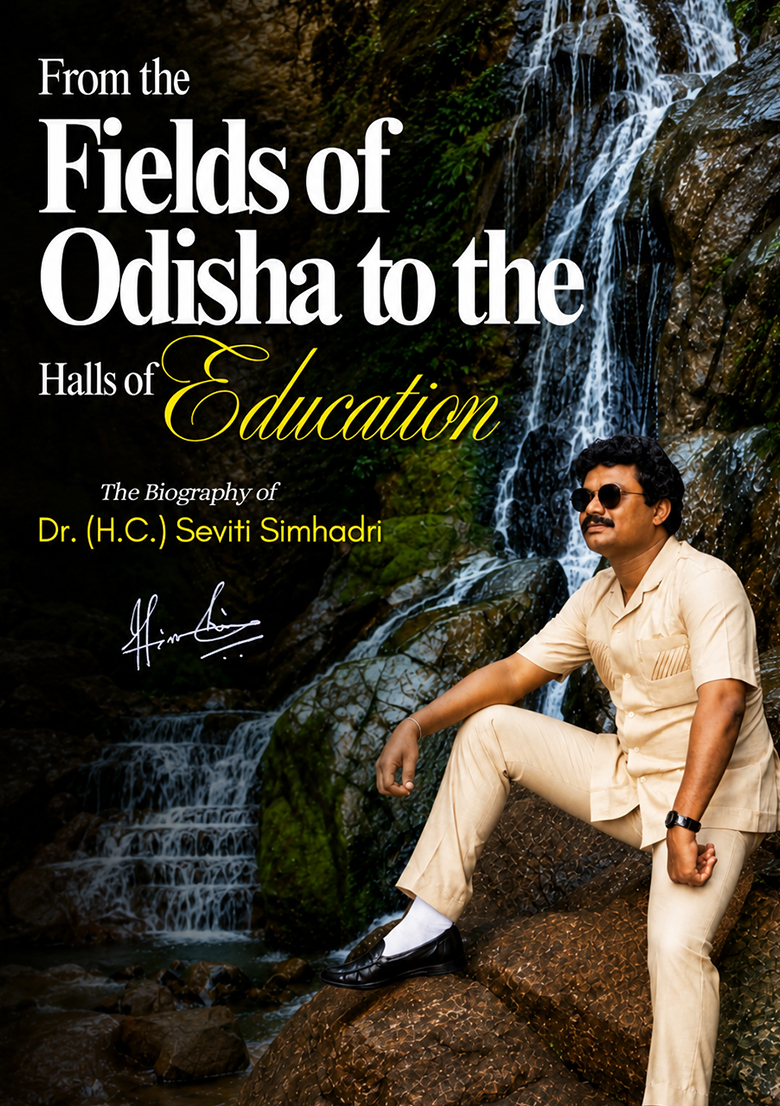
“He carried his village in his heart and his students in his soul. That was his only luggage through every loss, every illness, and every new beginning.”
Introduction
The journey of Dr. Seviti Simhadri carries the quiet strength of a life built through effort rather than privilege. His story began in a small village in Odisha, within a farming family where education was limited, resources were modest, and daily life depended upon hard physical work. From those surroundings emerged a young boy who would later enter classrooms, institutions, and leadership positions far removed from the world in which he had grown up. His progress was neither sudden nor effortless. It unfolded through study, responsibility, risk, disappointment, recovery, and an enduring commitment to education.
His earliest years taught him that advancement demanded movement, both physical and personal. Schooling beyond the seventh standard required him to travel to Gopalpur, nearly five kilometres from his village. That daily journey reflected more than the distance between home and school. It marked the beginning of a lifelong willingness to move beyond familiar limits. Good marks in matriculation opened the way for further education, while his growing interest in Physics gave direction to his academic ambition.
At Khallikote College and Berhampur University, Dr. Simhadri proved that a rural background did not determine the limits of achievement. He completed his Bachelor of Science with Honours in Physics and secured seventh rank in the university. For him, that result carried personal meaning. It became evident that a student educated through a regional medium, raised by parents with little formal schooling, could still stand among the strongest performers at the university level. He later completed his Master of Science in Physics, specialising in Solid State Physics, and continued expanding his knowledge through an MBA in Marketing.
His professional direction did not follow the path he had once imagined. During his younger years, he prepared seriously for the Civil Services Examination and appeared in all three permitted attempts. He was unable to qualify, and research opportunities also became difficult to pursue while he remained focused on those preparations. What appeared to be an unfinished ambition gradually redirected him towards teaching. He had not expected to become an educator, yet the classroom became the place where his knowledge, discipline, and ability to guide others found their strongest expression.
In 1987, he began working as an Assistant Professor at the College of Engineering and Technology in Chennai. His routine during those years demanded considerable discipline. This period revealed an important quality in his character. He did not see professional work and continued learning as competing responsibilities. He treated both as necessary parts of growth.
Teaching soon became more than employment. Over the years, Dr. Simhadri worked with students preparing for engineering and national-level examinations. He taught Physics, Engineering Physics, Material Science and related subjects, often simplifying complex ideas for young learners who carried their own ambitions and anxieties. His contribution gradually expanded from classroom instruction to administration and institutional leadership.
The decision to leave secure employment and establish the Andhra Institute of Engineering and Technology in 1993 became one of the boldest turning points of his life. He entered the venture without strong financial backing, carrying the responsibilities of marriage and fatherhood while attempting to build something of his own. As sole director, he taught, managed, and guided the institution.
“A humble beginning does not decide how far a person can travel; it quietly teaches the strength required for every step ahead.”
Phase 1: Roots in the Fields of Odisha
The life of Dr. Seviti Simhadri began on 2 July 1961 in a small village in Odisha, within a family whose daily existence was closely tied to the land. His parents worked in the fields, carrying the responsibilities of a farming household while raising six children. They had little access to education themselves. His father, Late Seviti Bairagi, had studied only up to approximately the fourth standard, while his mother had received no formal schooling. Their knowledge had not come from books or classrooms. It had been formed through labour, responsibility, and the constant need to provide for the family.
Dr. Simhadri was the youngest among three brothers and three sisters. Being the last-born placed him in a home already shaped by the experiences, duties, and relationships of his elder siblings. The family possessed limited means, yet its members shared the practical understanding that everyone had a place and responsibility within the household. Life did not offer ease, and expectations could not be built around comfort. What surrounded him instead was the visible example of parents who worked with their own hands and accepted hardship as part of sustaining their children.
The fields were not merely the source of the family’s livelihood. They formed the background against which Dr. Simhadri first understood persistence. He watched his parents work without the security that formal education or salaried employment might have provided. Their lives depended upon physical effort and their willingness to return to the same responsibilities each day. They could not guide him through advanced lessons or academic decisions, yet they created the conditions that allowed him to attend school. Their contribution lay in sacrifice rather than instruction.
Growing up in such surroundings meant that education could never be taken for granted. The village offered schooling only up to the seventh standard, and his earliest years of learning were spent there. The school was part of the familiar world in which he had been born, close to his family and the rhythms of village life. At that stage, education remained physically accessible, though the larger journey ahead was still uncertain.
Once he completed the seventh standard, continuing his studies required a more demanding routine. The next school was situated in Gopalpur, approximately five kilometres away from his native place. There was no convenient arrangement that could carry him there each day. He had to walk. That distance became part of his education in a way no lesson in a textbook could fully express.
The walk also marked a gradual movement away from the boundaries of his village. Every day, he travelled from the known world of home and fields towards a place where new learning became possible. There was no guarantee that these efforts would lead to distinction or professional success. At that age, the immediate goal was simply to continue. Yet the discipline required for those daily journeys was quietly preparing him for the greater demands that would come later.
“Confidence often begins with one honest achievement that quietly tells a person, ‘You are capable of more than you imagined."
Phase 2 : Physics, Rank and the First Taste of Achievement
After completing his matriculation with good marks, Dr. Seviti Simhadri entered a new stage of learning where determination alone would no longer be enough. Higher education demanded stronger concentration, disciplined study, and the ability to adapt to a wider academic environment. For a young student who had grown up in a rural setting and studied through a regional-language medium, this transition carried its own challenges. Yet it also opened the door to a subject that would eventually shape his professional identity and remain central to his life for decades: Physics.
He pursued his Bachelor of Science at Khallikote College, affiliated with Berhampur University. Physics became his Honours subject, while Mathematics and Chemistry formed part of his wider academic study. The combination required careful reasoning, accuracy, and sustained attention. Physics, in particular, demanded more than memorising information. It required him to understand relationships, examine principles, and approach problems with patience. These habits gradually strengthened the analytical nature that later became visible in his teaching and educational leadership.
At college, Dr. Simhadri was no longer studying only to secure the next opportunity. His education had begun to reveal his academic ability. The young student from a village in Odisha was now competing within a university system where performance was measured against students from different backgrounds and institutions. He did not enter this space with inherited academic confidence. His confidence had to be earned through work.
The language of advanced education also presented a significant adjustment. His early schooling had taken place through a regional medium, while higher studies brought him closer to an academic world in which English carried increasing importance. Scientific concepts had to be understood with precision, and technical expressions had to become familiar. He was learning not only the subject itself but also how to function within a new educational environment.
This transition did not happen through a single moment of ease. It required him to remain patient with himself while steadily developing the ability to understand and express complex material. The distance between his early educational setting and the demands of university-level Physics was considerable. Instead of treating that difference as proof that he did not belong, he approached it as another challenge to be overcome through preparation.
His Bachelor of Science examination was held in April 1981. When the results were declared, Dr. Simhadri had achieved First Class Honours in Physics with Distinction. More significantly, he secured the seventh rank in the university in Physics Honours.
“Some dreams do not arrive in the form first imagined; they reshape a person until a deeper purpose becomes visible.”
Phase 3 : The Dream Beyond the Classroom
After completing his postgraduate studies in Physics, Dr. Seviti Simhadri stood at a point where education had widened his possibilities, though it had not yet settled the direction of his life. His academic journey had given him knowledge, confidence, and the ability to compete beyond the boundaries of his early environment. He now carried an aspiration that extended beyond the university classroom. He wanted to enter the Civil Services and take on a role through which responsibility, authority, and public contribution could come together.
The ambition was serious. It was not a passing idea or an examination attempted without preparation. Dr. Simhadri devoted himself to it with the belief that sustained effort could create an entirely new future. Civil services represented a demanding path, and he understood that success required more than academic qualification. It called for wide reading, disciplined preparation, clarity of thought, and the ability to remain committed through uncertainty.
His background had already taught him how to pursue difficult goals without ideal conditions. He had reached higher education through personal effort and had performed strongly in a subject that demanded precision. Those experiences encouraged him to believe that the civil services examination, however competitive, was within the range of possibility. He approached the preparation with sincerity and allowed the dream to occupy an important place in his young adulthood.
The disappointment was not limited to an examination result. It involved the gradual closing of a path into which he had invested time, concentration, and expectation. After the third attempt, there was no further opportunity to return and try again. He had to accept that a goal he had genuinely valued would remain incomplete.
Such moments often test more than professional ambition. They challenge the way a person sees his own ability. Dr. Simhadri had known the confidence of securing a university rank, and he had experienced the satisfaction of progressing through advanced education. The civil services outcome now presented a different reality. Strong academic performance and earnest preparation did not always lead directly to the desired destination.
He did not treat the failure as proof that his education had been wasted. Nor did he allow the unsuccessful attempts to erase the confidence he had built through earlier achievements. The result forced him to reconsider direction, not worth it. He still possessed his knowledge of Physics, his postgraduate qualification, and the discipline developed through years of study. What had changed was the road through which those strengths would be used.
Note of Thanks
The journey of Dr. Seviti Simhadri was shaped not only by personal effort but also by the support of people whose presence gave him strength at important moments. With sincere gratitude, he acknowledges his parents, whose hard work in the fields made his education possible. Though they had received little formal schooling, their discipline, sacrifice, and commitment created the foundation upon which his life was built.
He remains deeply thankful to his wife, Shanti Rani, who stood beside him through changing professional responsibilities, institutional challenges, financial difficulties, and periods of personal hardship. Her steady support helped him carry the demands of family life while continuing to serve education with commitment.
Special appreciation is extended to his elder brother, AppaRao, whose assistance became especially valuable when Dr. Simhadri established the Andhra Institute of Engineering and Technology. His support gave practical strength to a difficult professional decision.
Dr. Simhadri also expresses heartfelt gratitude to his sons, Sai Murali and Sai Bhargav. Their progress brought him immense pride, while their care during his severe illness revealed the depth of their love and responsibility. Their lives gave new meaning to dreams, sacrifices, and lessons carried across generations.
He remains grateful to the institutions that entrusted him with teaching and leadership responsibilities and to the colleagues who shared different stages of his professional journey. Above all, he thanks the many students who allowed him to become part of their learning. Their respect, progress, and continued remembrance remain among the most meaningful rewards of his life.
This note also honours every person who supported Dr. Simhadri during periods of illness, recovery, and professional renewal. Their faith reminded him that no journey is completed alone and that sincere relationships remain among life’s greatest achievements.
thanks,
– Dr. Seviti Simhadri