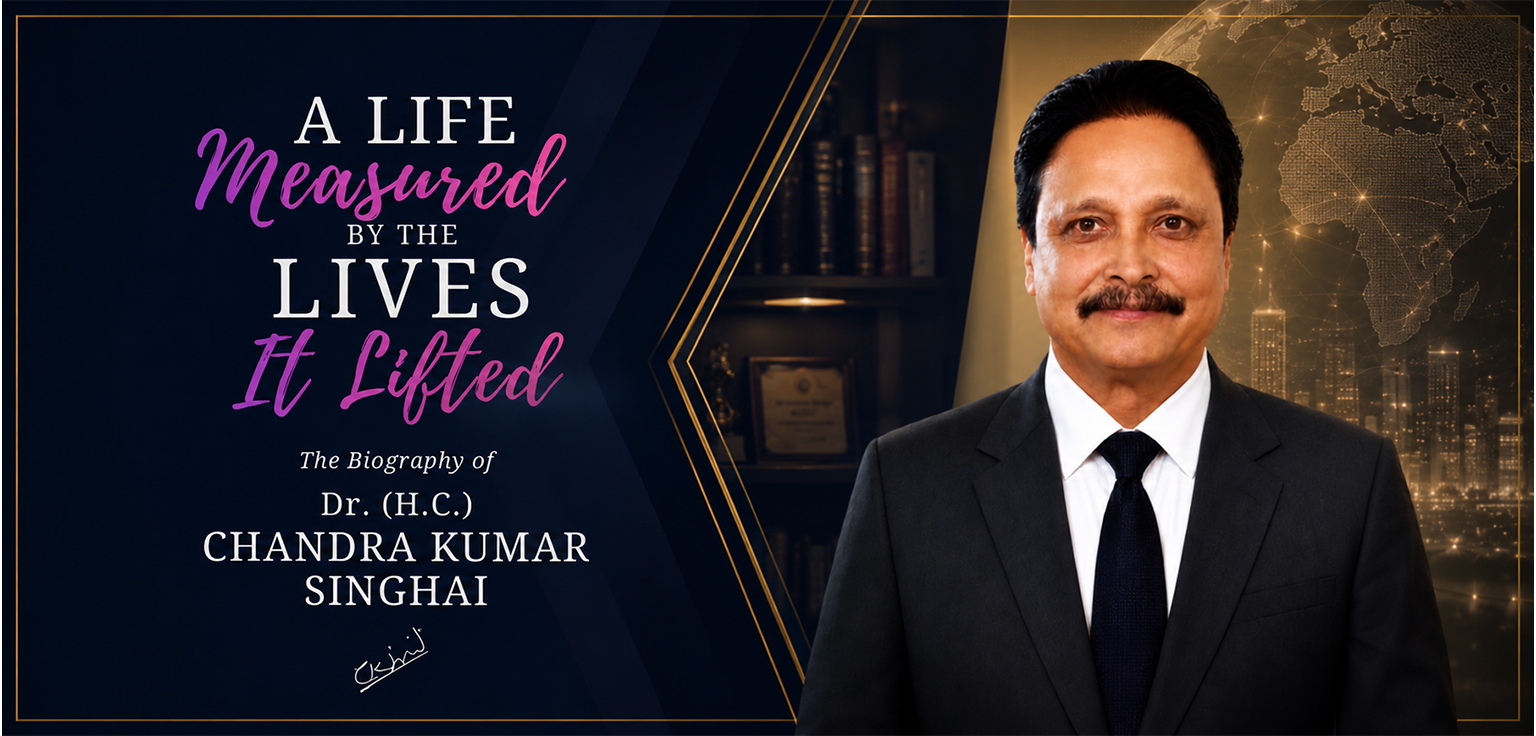
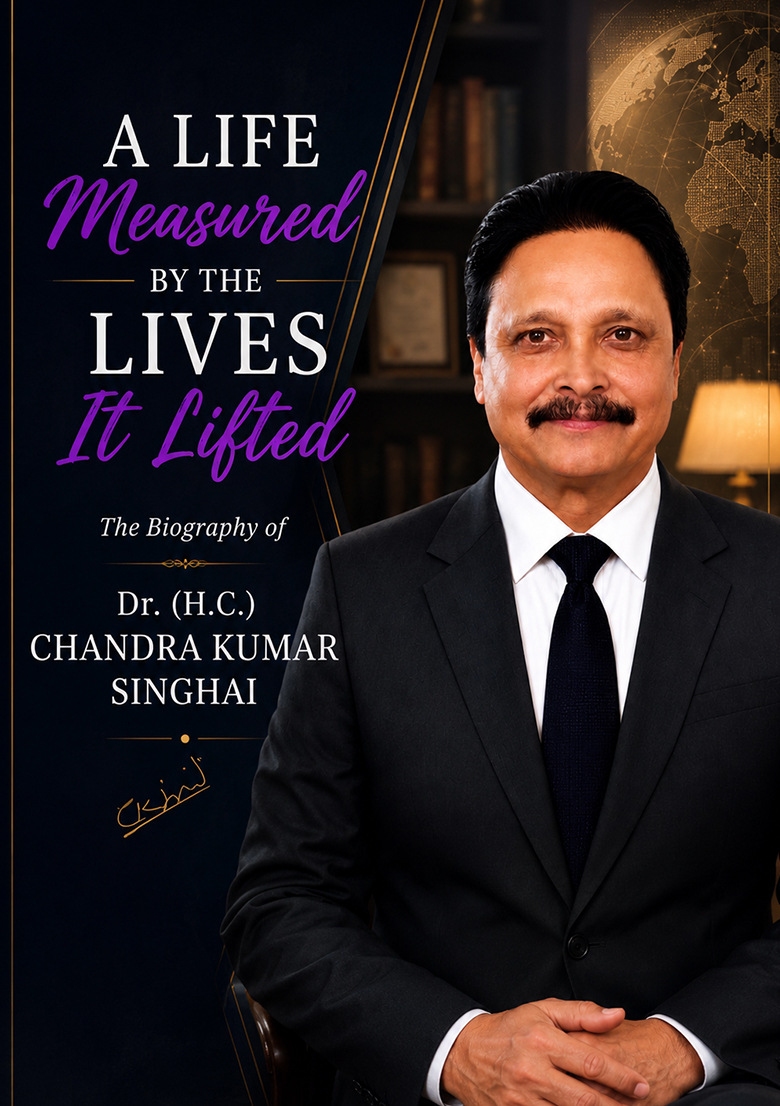
“The true worth of a life is not found in awards or titles. It is found in the relief it brought, the trust it earned, and the hope that outlived it.”
Introduction
Some lives are remembered for a single achievement, while others gain meaning through the many people, institutions, and communities they touch. The journey of Dr. Chandra Kumar Singhai belongs to the second kind. He built a life across business, education, healthcare, service, faith, and public welfare. But the thread running through it all was simple: he wanted to be there when someone needed help.
Dr. Chandra grew up in circumstances that demanded maturity early. His family background also carried a tradition of public service, patriotism, and social responsibility. These early influences did not remain limited to personal values. They gradually shaped the way he approached education, work, relationships, and service.
His academic journey led him towards Economics, a subject he valued for its practical relevance to planning, finance, projects, and decision-making. After completing his higher studies, he moved towards enterprise rather than conventional employment. Business gave him independence, but more importantly, it gave him the means and flexibility to support others. Over time, his professional life became closely connected with the needs of students, families, patients, institutions, and community initiatives.
One of the most significant chapters of his journey emerged through nursing education. What began as a response to a personal experience developed into a larger mission. Establishing a nursing college in a period when such opportunities were limited required persistence, administrative effort, academic planning, and faith in a field that was not yet widely understood. Dr. Chandra continued to work through the early difficulties of student enrolment, language barriers, faculty shortages, course development, and institutional systems. His role later expanded beyond his own college as he guided and supported the growth of nursing education across Madhya Pradesh.
His service, however, was never confined to one institution. Through Rotary Club Jabalpur West, Saraswati Shiksha Parishad, Jain organisations, medical camps, educational programmes, and welfare initiatives, he remained closely involved with the concerns of ordinary people. He helped students continue their education, supported healthcare access, contributed to employment, assisted families during crises, and responded personally when someone required urgent help. During the COVID period, this instinct to act became even more visible as he helped with transport, medicines, food, hospital care, and final arrangements for families facing unbearable circumstances.
This biography presents a man who did not measure life through titles alone. Dr. Chandra Kumar Singhai measured it through action, honesty, availability, and the courage to keep going. His journey reveals how service can become a way of living, not an occasional act, and how one person’s steady commitment can quietly influence generations.
“What we learn from family, struggle, and responsibility often becomes the foundation of everything we do later.”
Phase 1: Roots of Service, Loss, and Early Formation
Dr. Chandra Kumar Singhai was born on 1 February 1954 in Keolari, District Seoni, Madhya Pradesh, into a Jain family whose identity was closely tied to public service, social responsibility, and a strong sense of duty toward others. His childhood unfolded in a village environment where family relationships, community life, and inherited values carried deep importance. Long before he understood the wider meaning of leadership or service, he had already begun absorbing both through the lives of those around him.
His grandfather, Late Shri Dalchand Jain, was remembered as a freedom fighter, a social reformer, and a respected figure in the region. The family spoke of him not merely as someone who had participated in the freedom struggle, but as a person who believed that one’s life should remain connected with the welfare of society. The atmosphere created by his example left a lasting impression on the generations that followed. Dr. Chandra grew up hearing and observing that patriotism was not limited to words. It was reflected in conduct, sacrifice, and a willingness to take responsibility when others needed support.
His father, Late Shri Sumerchandra Jain, was a businessman. At that time, the region had a different administrative and geographical character, with much of the family’s work connected across areas that had once been part of the Central Provinces and Berar, when Nagpur served as the capital. Business activities were spread across different places, and the family was familiar with movement, trade, and public dealings. Yet Dr. Chandra was too young to experience his father’s presence for long. He lost him when he was only five years old. That loss became one of the earliest realities of his life.
He was still at an age when a child usually depends on others for every sense of security, but circumstances demanded that he begin growing inwardly much earlier. Although he belonged to a joint family, the absence of his father created a gap that could never be treated as ordinary. His mother, Smt. Shanti Bai Jain, carried the responsibility of raising him with remarkable firmness and patience. She became the centre of his upbringing, his education, and the values through which he learned to understand life.
She had studied up to the eighth standard, which was itself significant for a woman of her generation. Her education did not remain confined to basic literacy. She spoke English fluently and was able to communicate comfortably with people from different regions. Years later, women from South India who came to Jabalpur often found it easier to speak with her than with others around them. They would sit beside her, discuss their concerns, and feel understood. That ability to connect with people reflected not only her education but also her alertness and emotional intelligence.
“Education matters most when it teaches a person to choose honesty, effort, and independence.”
Phase 2 : Choosing Substance Over Convenience
As Dr. Chandra Kumar Singhai moved beyond his school years, education became more than a formal requirement. He wanted learning to carry discipline, depth, and practical value. His first year of the Bachelor of Arts programme was completed in Jabalpur, but the academic environment there did not satisfy him. He found the system too open and too easy to navigate without genuine study. Books could be carried into examinations, papers could be completed with unusual flexibility, and arrangements were sometimes made for students facing personal difficulties. For many, such convenience might have felt helpful. For him, it weakened the very purpose of education.
He could not accept a qualification earned without the effort it deserved. Rather than continue in a setting that did not match his expectations, he chose to leave and pursue his studies elsewhere. That decision took him to Mandla, nearly one hundred kilometres from Jabalpur. The distance did not discourage him. What mattered was finding an academic environment in which he could study seriously and feel that his progress had been honestly earned.
His years in Mandla brought him closer to the kind of learning he respected. He studied there for the following years, completing his higher education through Rani Durgavati Government College, Mandla, which was affiliated at the time with Dr. Harisingh Gour University, Sagar. He earned his Bachelor’s degree in 1974 and later completed his Master’s degree in Economics in 1976. His postgraduate subjects included Advanced Economic Theory, Economics of Growth, International Economics, and Labour.
The educational journey was not free from disruption. During the period of the Emergency, he faced rustication and had to complete part of his studies privately. The interruption could have become a reason to abandon the path, but he refused to let an institutional setback decide the direction of his life. He adjusted to the circumstances and completed what he had started. The experience strengthened his belief that education had to be pursued with determination, even when the expected route was no longer available.
His choice of Economics was deliberate. He had once considered the medical field, but when that path did not become possible, Economics appeared to him as the strongest alternative. He saw it as a subject connected closely with real life. It taught him how to think about resources, planning, financial balance, projects, and long-term decisions. In later years, the value of that education became visible whenever he prepared balance sheets, studied project reports, planned new work, or tried to understand the practical outcome of an idea before acting upon it.
For Dr. Chandra, the subject was not limited to theories learned for an examination. It trained him to look beneath the surface of a proposal. He learned to consider what a project would require, whether its structure was workable, and how different financial and human elements could be brought into balance. This ability later became useful across the varied responsibilities he accepted, even when the work itself had little connection with a conventional career in Economics.
“Work should not only build a career; it should also create chances for others to move forward.”
Phase 3 : Enterprise Guided by Responsibility
After settling in Jabalpur, Dr. Chandra Kumar Singhai began shaping a professional life that allowed him to work independently. Business appealed to him not only because it offered financial stability, but because it gave him control over his time. He wanted the freedom to respond when someone needed help, rather than remain bound by a fixed schedule or a position in which every decision depended on someone else’s approval.
His approach to enterprise was practical. He understood that business demanded attention, planning, relationships, and the ability to solve problems quickly. At the same time, he never treated earning as the only purpose of work. From the beginning, his professional life remained closely connected with the needs of people around him. A child unable to continue school, a young person searching for employment, a family struggling with medical expenses, or someone seeking admission could reach him without hesitation. He did not believe that help needed to wait for a formal programme or public announcement.
There were occasions when children came to him because they lacked money for books or education. He would provide what was needed from his own resources. If a young person had the ability to study but could not afford the fee, he tried to ensure that financial difficulty did not close the door. In his own college, he supported economically disadvantaged students through scholarships paid from his personal funds. The institution operated on a no-loss, no-profit basis, and he did not view such assistance as charity. To him, it was simply a way of making sure that a capable student was not left behind.
His support often went beyond paying fees. He helped people secure admissions and guided them through processes they could not manage alone. He used his knowledge of institutions and his familiarity with officials to connect deserving individuals with opportunities. Many beneficiaries did not remain in regular contact with him, and he sometimes realised the lasting effect of his help only years later, when someone approached him with gratitude and reminded him of an admission or appointment he had arranged.
Employment was another area in which he remained personally involved. Through his contacts and understanding of local administration, he assisted many people in finding work. Some were placed in positions connected with the agricultural produce market, while others found opportunities in different departments and institutions. He also helped people secure third-grade and fourth-grade employment where possible. These interventions were not driven by influence for personal gain. He saw access to a job as a means of restoring dignity to an entire family.
The trust people placed in him grew steadily. His calm manner and reputation for helping without demanding anything in return made others comfortable approaching him. He often said that people knew him as a peaceful and straightforward person, and because of that, they rarely refused when he requested assistance for someone. His credibility became one of his most valuable resources.
Note of Thanks
As Dr. Chandra Kumar Singhai looks back upon the many people who stood beside him, he carries a deep sense of gratitude for every hand that strengthened his journey. He remains thankful to his mother, Smt. Shanti Bai Jain, whose guidance gave him the courage to continue through uncertainty, and to his wife, Manju Singhai, whose understanding allowed him to devote himself fully to responsibilities beyond the home. He also acknowledges his daughters and family members, who supported his work with patience and often became active participants in service themselves.
He expresses sincere appreciation to S. K. Chaudhary, whose early professional support opened an important door in his working life, and to Suresh Gautam, whose friendship remained steady through changing years. He also remembers Satish Dayal Sharma with affection and gratitude for the trust, companionship, and support that helped many public efforts move forward smoothly.
Dr. Chandra is equally grateful to Dilip Kumar for sharing his knowledge during the formative years of nursing education, and to Digvijaya Singh, Vimla Verma, senior officials, educators, and administrators who encouraged the development of a new academic path when systems were still taking shape.
His thanks extend to the doctors, nurses, volunteers, Rotary members, social workers, teachers, religious leaders, and community representatives who gave their time without hesitation. Many travelled long distances, worked through difficult conditions, and responded whenever a patient, student, or family needed help. He also acknowledges Rotary Club Jabalpur West, Saraswati Shiksha Parishad, Jain institutions, medical teams, and every organisation that gave him a platform to serve more people. Above all, Dr. Chandra Kumar Singhai remains grateful to those who trusted him with their difficulties.
thanks,
– Dr. Chandra Kumar Singhai