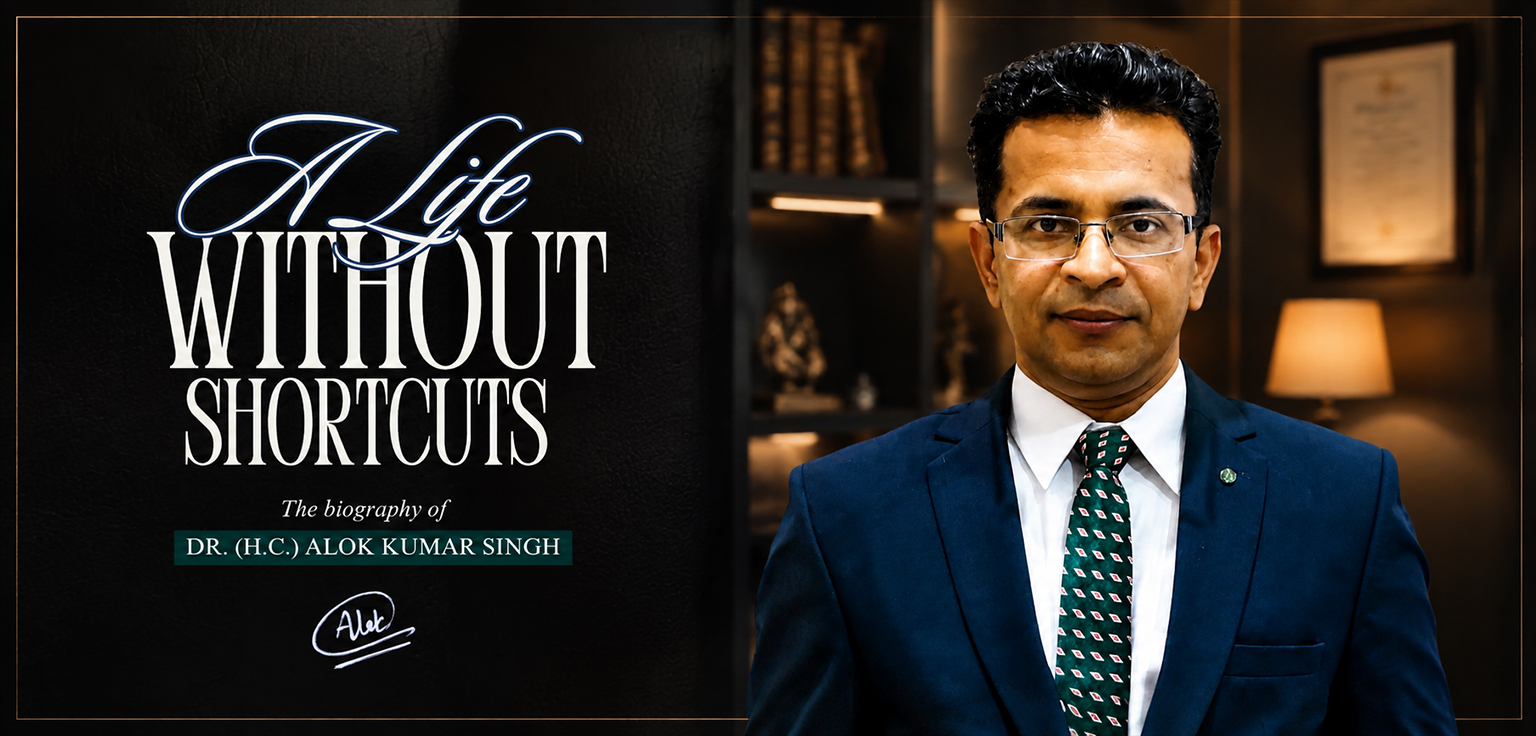
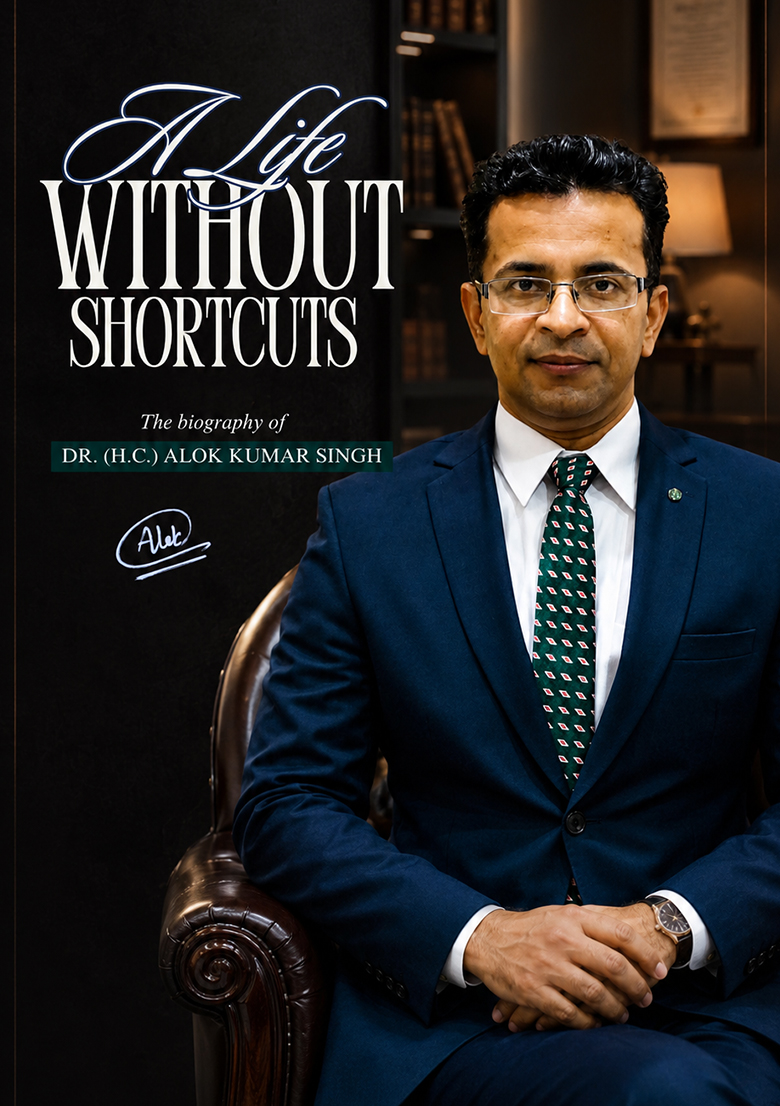
“From a Hindi-medium classroom to the CEO’s chair, he didn’t just cross the language divide. He proved that character speaks louder than any accent.”
Introduction
The journey of Dr. Alok did not unfold according to an easy or carefully protected plan. It developed through changing circumstances, difficult decisions, and years of work across insurance, cooperative banking, microfinance, and non-banking financial services. Every stage demanded something different from him. At times, he had to learn what his early education had not exposed him to. At others, he had to remain steady when financial uncertainty made withdrawal seem easier than perseverance. Through each change, he continued to rely on the qualities he considers permanent: discipline, consistency, and loyalty.
Mathematics came naturally to him, but communication, particularly in English, remained a challenge. He entered adulthood at a time when computers, online resources, and digital communication were not readily available to him. Until graduation, magazines and employment newspapers served as important sources of information. He learned through discussions with relatives, teachers, friends, and fellow students. When he later encountered colleagues from English-medium and computer-based educational backgrounds, he recognised the gap but did not accept it as permanent. He used whatever access he had to practise on computers, understand email, explore the internet, and gradually become comfortable with technology. The same person who once had no early computer training would eventually work confidently with digital systems and artificial intelligence.
His original ambition was to pursue B.Tech. That intention changed when his father lost his job and the family’s financial position weakened. He and his brother had to reconsider their educational goals, and B.Sc. became a path shaped more by circumstance than personal choice. The loss deepened when his father passed away while he was still completing graduation. It was not only an emotional blow but also the removal of the person who had guided the family and ensured that every child received the best opportunity he could provide. From that period onward, education became connected with responsibility rather than personal preference alone.
Science gave him a foundation in mathematics and physics, but his professional interests gradually moved towards finance. He strengthened that transition through management, insurance, Company Secretary studies, rural development, and senior leadership learning. His education did not remain confined to qualifications. He learned basic accounting through practical work, studied rural development to understand agricultural and allied-sector lending, and absorbed professional judgement from experienced seniors. Retired administrative officers and cooperative-sector leaders became valuable mentors because he was willing to listen. Their experiences taught him that learning from another person’s mistakes can prevent avoidable errors in one’s own work.
His career began at ICICI Prudential Life Insurance, where he worked as an Associate Health Assurance Manager. The role introduced him to a structured financial-services environment and marked the beginning of a professional journey that would extend beyond nineteen years. An overseas opportunity also came his way in 2007, but he declined it because he had already entered into a professional agreement with the organisation. That choice reflected a principle that later became central to his outlook: commitment must carry weight, even when another opportunity appears attractive.
Cooperative finance gave his abilities a broader field. Beginning at the working level, he gradually advanced through regional, zonal, and acting leadership responsibilities. He handled administration, operations, staffing, business development, budgeting, reporting, customer relationships, and branch profitability. His work extended across different states and required him to understand local markets, recruit teams, train employees, and maintain coordination between branches and the head office. During this period, he helped open 84 branches and contributed to organisational expansion and financial growth. The experience showed him that an institution grows through the people who carry its work into the field.
"A child’s first understanding of leadership begins at home, in the people who carry responsibility without seeking recognition for it."
Phase 1: Roots in Varanasi and the Values of Home
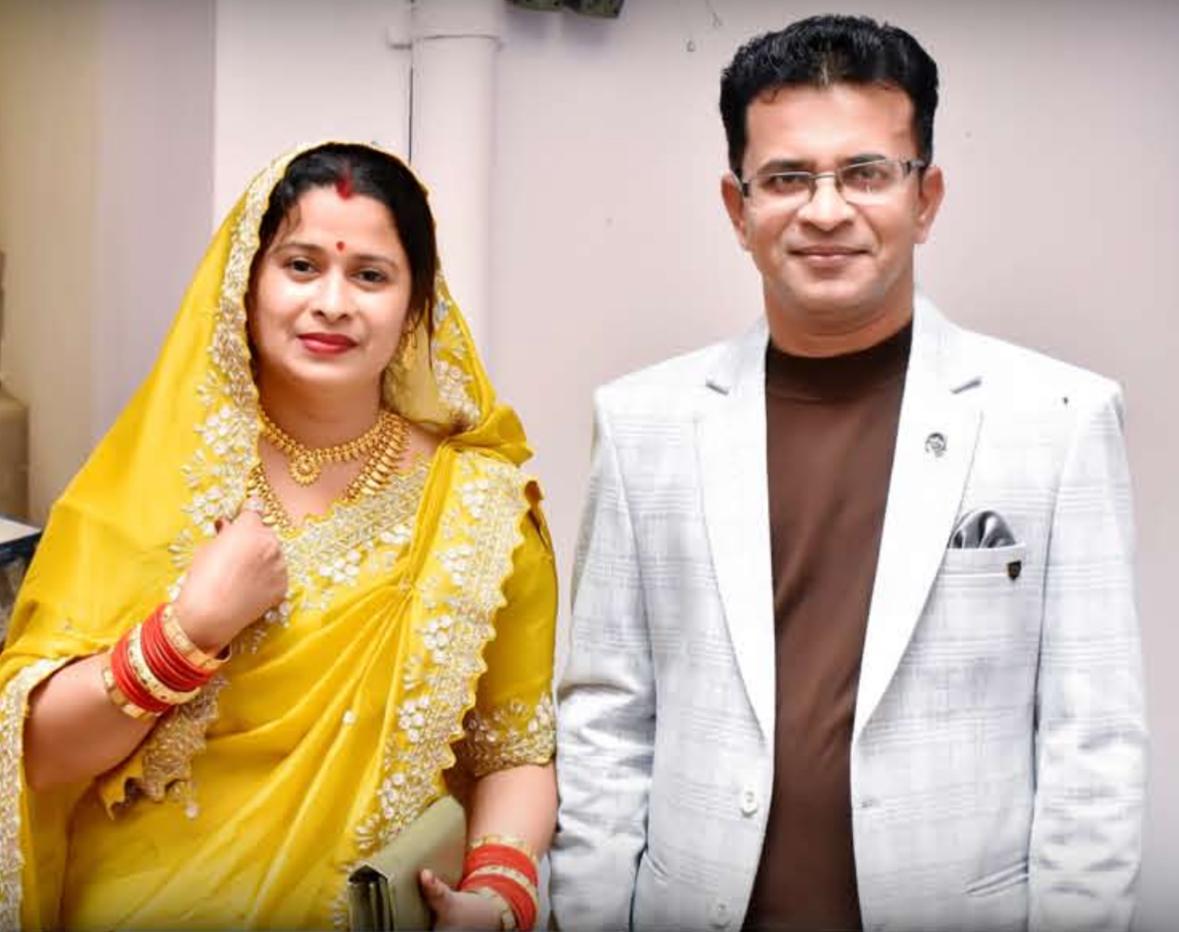
Dr. Alok Kumar Singh was born on 28 March 1985 in Varanasi, into a Hindu family whose strength rested on education, responsibility, and mutual support. His father, Late Vijay Bahadur Singh, and his mother, Pushpa Singh, created a home in which life was understood through practical choices rather than empty instruction. Their influence came from the way they faced circumstances, guided the family, and fulfilled their responsibilities. Before Dr. Alok encountered leadership in institutions, he had already seen two distinct and equally powerful forms of it within his own home.
His family belonged to a joint household. His father was one of four brothers, and although different members later lived in separate places because of their employment, their decisions continued to reflect a shared family structure. Physical distance did not weaken the bond between them. The family remained connected by consultation, responsibility, and respect for the person capable of guiding a situation wisely. This environment gave Dr. Alok an early understanding that a family does not remain united merely because its members live together. It remains united when people continue to value one another’s judgement and accept responsibility beyond their individual concerns.
His father stood at the centre of this family structure for many years. He was regarded as the head of the household and carried the duties that came with that position. His professional life was closely connected to cooperative banking. He served Krishi Export Commercial Corporation for more than eighteen years and held the responsibility of a Branch Manager. Banking was not simply an occupation within the family’s history. The association extended to the maternal side as well, where his relative had been connected with the establishment of Bhumi Vikas Bank. The institution initially served rural borrowers through smaller credit facilities, including loans related to livestock, agriculture, and allied activities. Long before Dr. Alok entered financial services, the language of rural credit, responsibility, and institutional work was already present within the family.
Yet the deeper impression left by his father did not come from a designation. It came from his attitude when professional security disappeared. After spending more than eighteen years in banking, he lost his employment. At an age when beginning again was difficult, he found himself responsible for a large family whose needs could not be postponed. The change affected the household, but it did not alter his commitment to his children. He continued to give them whatever support he could arrange. If education required sacrifice or even borrowing, he was prepared to make that choice.
He believed that every child should be educated and encouraged each one to pursue what he or she genuinely wanted. He did not transfer the weight of his disappointment onto them. Even when his own circumstances had become uncertain, he refused to make their aspirations feel like a burden. There was no assurance that every plan would succeed, but he did not use uncertainty as a reason to stop trying. His approach was simple in spirit: whatever the difficulty, something had to be done. Complaining could not replace action.
That outlook became one of the earliest principles absorbed by Dr. Alok. His father did not leave behind a carefully worded lesson for every challenge. Instead, he showed through conduct that responsibility must continue even when the method is unclear. A person might not immediately know how a problem will be solved, but he must still possess the willingness to face it. For a son watching his father hold a family together after losing professional stability, this was not an abstract idea. It was evidence that courage often appears in ordinary decisions made repeatedly under pressure.
“A difficult beginning does not decide how far a person can go; it only teaches him how much of the road he must learn to build for himself.”
Phase 2 : Learning Beyond the Language Divide
For Dr. Alok, education began in a setting where opportunity was present, but access was not equal in every form. He was the last child in his family to enter primary education through the Hindi-medium system. The classroom gave him a foundation, yet it also placed him on a path that differed from students who had grown up using English and working with computers. This difference did not appear as a serious concern in the earliest years. Its weight became clearer only when education began moving towards communication, technology and professional readiness.
Mathematics was the subject in which he felt naturally comfortable. Numbers offered clarity. A problem had a structure, a method and an answer that could be reached through reasoning. His ability in mathematics gave him confidence as a student and later guided him towards the study of science. Communication was more difficult. Coming from a Hindi-medium background, he was not fluent in the kind of English that many students around him appeared to use with ease. He understood that academic ability alone would not remove this disadvantage. A person could be strong in a subject and still struggle to express that knowledge in an unfamiliar language.
The difficulty was not limited to English. Technology was also entering education and employment at a pace that he had not experienced during his schooling. He had no formal computer training and did not attend a computer course. Before 2008, he did not even have a mobile phone. Internet access, social networking platforms and the immediate availability of online information were not part of his early learning environment. Until graduation, much of what he knew about education and employment opportunities came through printed material and direct interaction with other people.
Magazines were among the most useful resources available to him. Employment publications such as Rozgar Samachar carried information that students actively sought at the time. He would refer to such material to understand available opportunities, examinations and possible directions. Printed pages required patience. Information had to be searched for, read carefully and discussed with others. There was no instant answer waiting behind a screen, and no online platform to organise every possibility. Learning depended on personal effort and the willingness to keep looking.
The people around him became another important source of information. Many members of his wider family were teachers, so conversations about education had substance and purpose. Friends and fellow students also helped one another decide where to apply, which interviews to attend and what options might be worth pursuing. These exchanges were practical rather than formal. Someone would learn about an opportunity, share it with others, and discuss whether it suited their abilities or circumstances. In the absence of digital access, collective knowledge helped students move forward.
Dr. Alok did not follow a fixed coaching system. Throughout his education, he neither depended on tuition nor received the kind of structured preparation that often guides students step by step. His learning was largely self-directed. He read what was available, listened to people who knew more than he did, and tried to make sense of each new requirement. This method demanded initiative because there was no teacher constantly directing his next move. If he did not understand something, he had to seek the answer through observation, conversation, or repeated effort.
"Some dreams are left behind not because they mattered less, but because life placed a greater responsibility in their place."
Phase 3 : When Circumstance Rewrote the Plan
There was a time when Dr. Alok saw his future in engineering. He wanted to pursue B.Tech, and the ambition reflected his natural connection with mathematics and science. It was a direction he would have chosen for himself if life had continued as expected. Yet the circumstances surrounding his education began to change before he could follow that plan. What came next was not a simple revision of academic preference. It was a period in which personal ambition, family responsibility and financial reality became inseparable.
The turning point began with the loss of his father’s employment. Late Vijay Bahadur Singh had already spent more than eighteen years in cooperative banking and had carried the educational responsibilities of the family with determination. When that professional stability disappeared, the effect reached every member of the household. The family’s ability to support long and costly educational paths became limited, and choices that once seemed possible had to be reconsidered.
Dr. Alok and his brother were both affected by this change. Their educational goals could no longer be planned according to interest alone. They had to consider what the family could realistically manage. For Dr. Alok, this meant letting go of B.Tech, the course he had genuinely wanted to pursue. The decision did not emerge from a loss of interest in engineering, nor from uncertainty about his ability. It came from circumstances that left little room for personal preference.
He chose B.Sc. and continued with mathematics and physics. Science remained close to his abilities, but the course itself was not his first choice. In his own understanding, he did not enter B.Sc. by design. He arrived there by chance, because the path he had imagined was no longer financially possible. At that stage, general academic courses were also a more familiar choice within his environment, while education was not always viewed through the lens of business or professional specialisation.
Accepting B.Sc. required a quiet adjustment. He had to study seriously within a path he had not originally selected, without allowing disappointment to become an excuse for poor effort. Mathematics continued to provide intellectual confidence, while physics kept him connected to scientific thought. These subjects gave direction to his graduation, but they could not entirely remove the knowledge that his intended journey had changed.
The situation became far more difficult when his father passed away while Dr. Alok was still completing graduation. The loss was deeply emotional. The person who had guided the household, made major decisions and carried responsibility for the children’s education was no longer present. His death did not only create grief. It changed the practical structure of the family at a time when Dr. Alok had not yet completed the preparation needed to establish himself professionally.
Note of Thanks
Dr. Alok carries enduring gratitude for Late Vijay Bahadur Singh, whose courage and commitment gave him a lasting standard of responsibility. He remains equally thankful to Pushpa Singh, whose judgement, communication, and strength have continued to guide the family through changing circumstances.
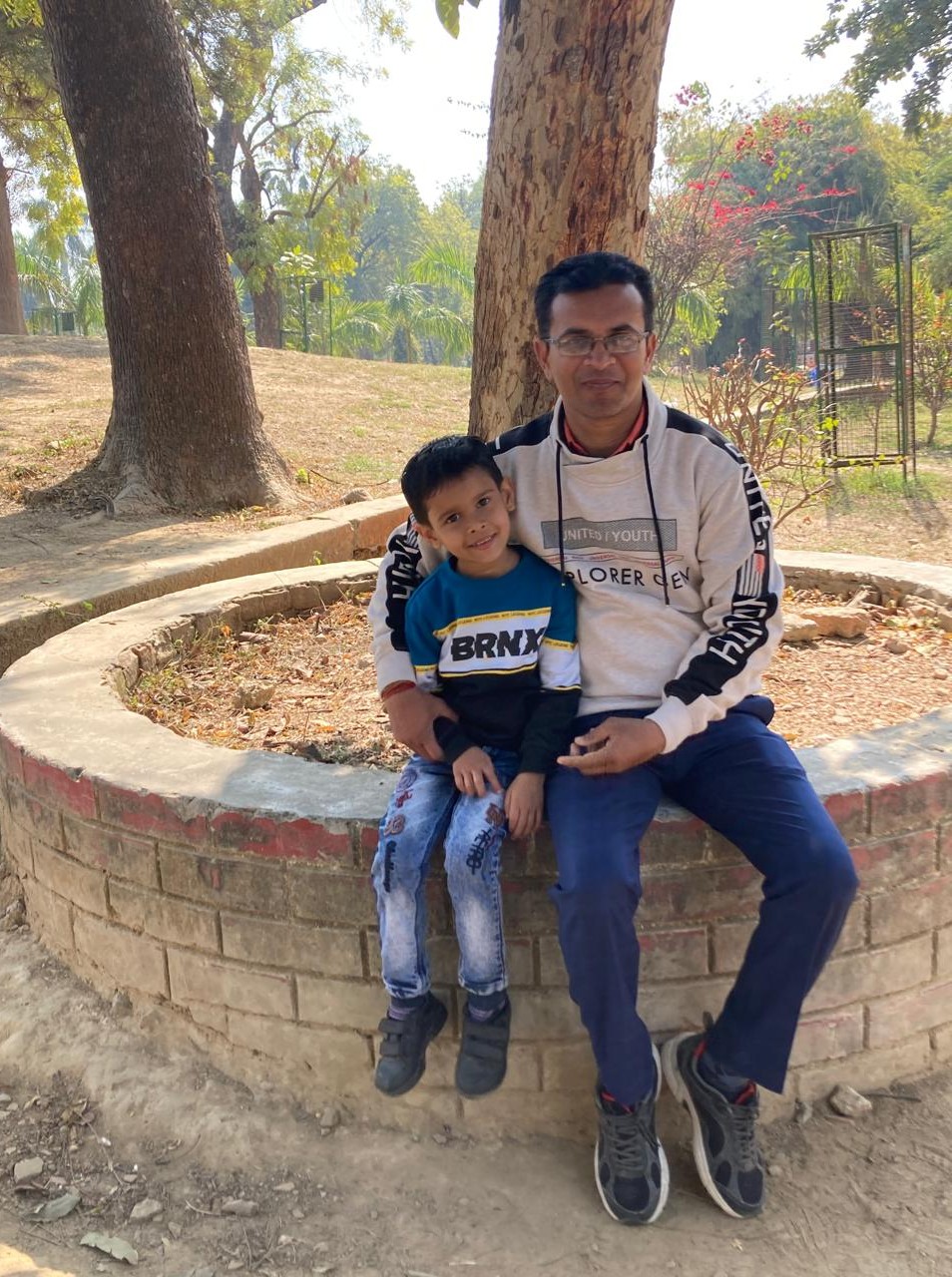
His deepest appreciation belongs to Rani Singh, whose quiet understanding protected the balance of their home while professional responsibilities demanded his time and attention. He also acknowledges his sons, Aadi Singh and Yash Singh, whose presence gives personal meaning to everything he continues to build.
He remembers with gratitude the custodian who supported him during a period of financial strain and the friend in Nairobi whose assurance restored his confidence when uncertainty had become overwhelming. Their help did not remove the work before him, but it reminded him that he did not have to carry every difficulty alone.
Finally, he acknowledges the employees, colleagues, advisers, investors, and institutional leaders who placed confidence in his abilities. Their collective effort supported every organisation and responsibility associated with his journey. For him, gratitude is not expressed only through words. It is honoured by remaining loyal to the trust received, valuing every contribution and carrying each responsibility with the same sincerity with which it was entrusted.
thanks,
– Dr. (H.C.) Alok Kumar Singh