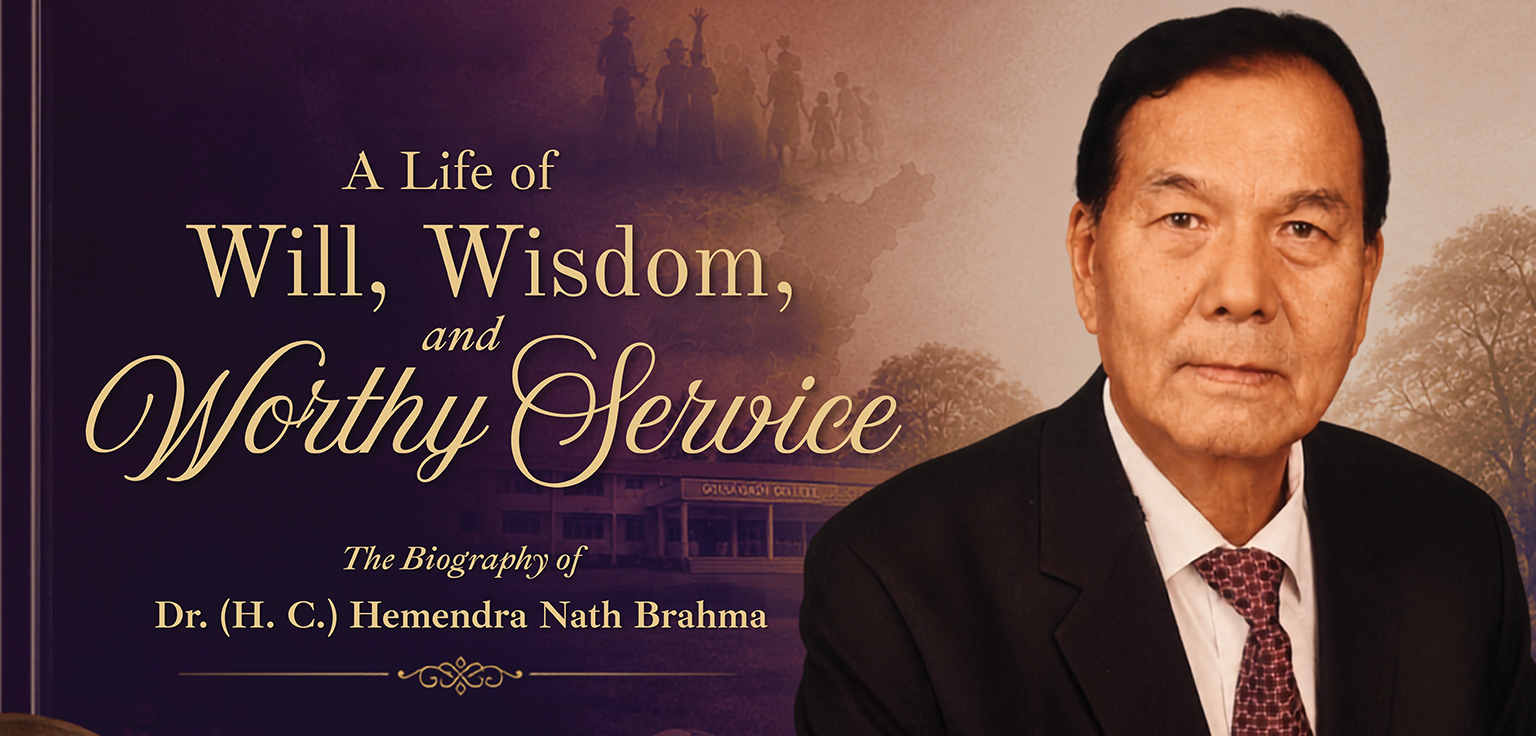
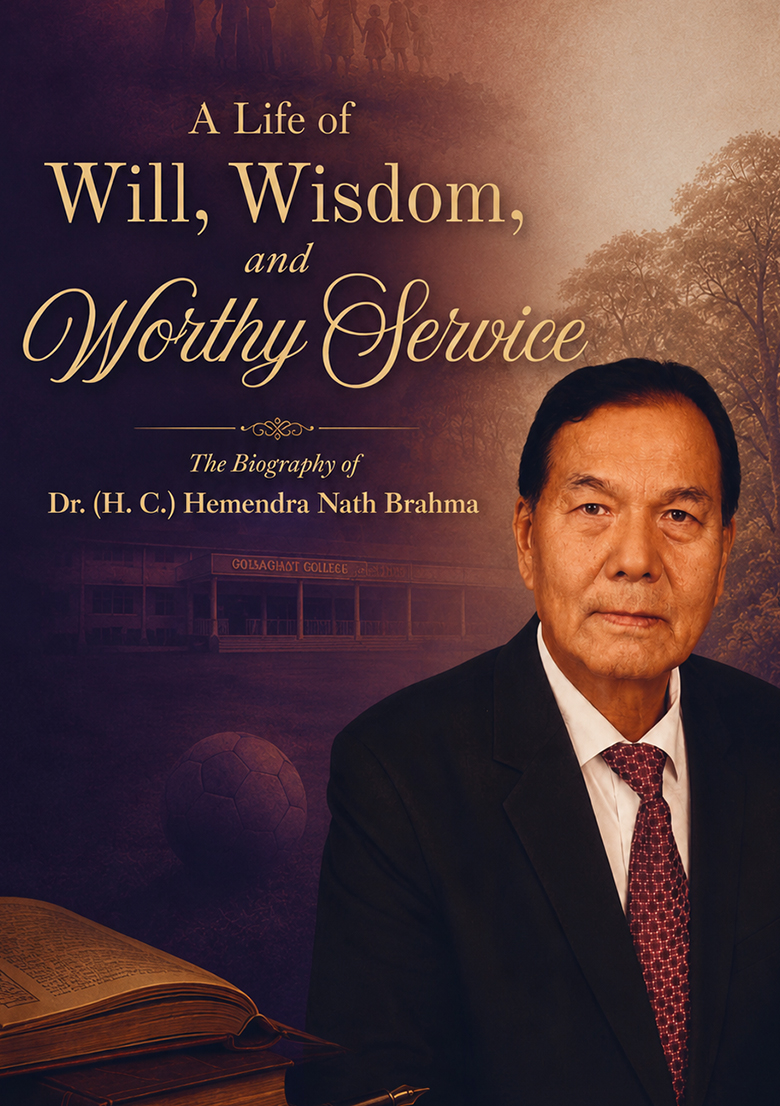
“To work for people is to serve with devotion, for every sincere act of service becomes a prayer to God.”
Introduction
The life of Dr. Hemendra Nath Brahma is a journey shaped by struggle, discipline, service, and an unwavering belief in purposeful action. Born on 30 September 1951 in a remote village Kamalsing under the Gossaigaon Sub-Division in the District of Kokrajhar, BTC, Assam, he grew up in an environment where simplicity was not a limitation but a foundation. His early years were rooted in the values of family, community, and hard work, guided by his father, Late Fatik Chandra Brahma, and his mother, Late Jashada Brahma. From those modest beginnings, he moved forward with a quiet determination that would later carry him into education, public service, social leadership, sports administration, and political responsibility.
His educational journey began in his own village, where he studied at Kamalsing MV School and completed Class 6 in 1966. From there, he continued his studies at Gossaigaon highschool, which later became a higher secondary school. In 1969, he passed his matriculation examination, marking an important step in a journey that was never easy, yet always meaningful. His path then took him to Shillong, where he joined Shillong College for Pre-University studies in 1970. This movement from village schooling to a wider academic environment reflected not only personal growth but also the widening of his world.
After completing his Pre University education, he joined St. Anthony’s College, where he pursued his Bachelor of Arts with Honours in Political Science. He graduated in 1974 and was placed in the Second Class. This phase of his life was not limited to classrooms alone. During this period, he also worked in the Department of Health, attended the office during the day, went to the football ground in the evening, and continued his classes with discipline. His life during those years was full of responsibility, yet he did not allow one commitment to erase another. Study, service, and sport moved together in his daily routine.
Football remained one of the strongest passions of his life. Even while managing work and education, he continued to practice and participate actively in sports, especially football and volleyball. In 1972, he represented the Assam Government in the All India Football Meet held in Shillong. He also represented his state government in volleyball, once in Haryana and once in Chandigarh. These experiences reflected the physical discipline, team spirit, and competitive energy that became a natural part of his personality.
After graduation, he moved to Guwahati, where he continued his service and joined the M.A. course in Political Science at Gauhati University. He also took up law, but due to the pressure of office duty from morning to evening, he could not continue the law course. Yet he remained focused on Political Science and completed his M.A. in 1976, again being placed in the Second Class. His academic journey was marked by effort, travel, personal challenges, and sacrifice. He once had to travel overnight by train to attend his final examination after coming home for a family ceremony, studying during the journey and going directly to the examination after reaching Guwahati. Such moments reveal the determination with which he treated education.
“Some lives begin far from the noise of opportunity, yet they grow strong because the heart learns early how to walk with patience, purpose, and faith.”
Phase 1: A Childhood Rooted in Simplicity and Silent Strength
The story of Dr. Hemendra Nath Brahma begins in a remote village Kamalsing under the Gossaigaon Sub Division in the District of Kokrajhar district, where life was simple, grounded, and closely connected to family and community. Born on 30 September 1951, he entered a world where comfort was limited, but values were abundant. The surroundings of his childhood did not offer the privileges often associated with ease or convenience, yet they gave him something more lasting. They gave him discipline, humility, and a natural understanding of struggle. These early influences became the unseen strength behind the many roles he would later carry as a student, teacher, public representative, social worker, and sports leader.
His parents, Late Fatik Chandra Brahma and Late Jashada Brahma, formed the first foundation of his life. Their presence shaped his early sense of responsibility and belonging. His father had served during the British period as a Grade One Forester and later joined the Health Department as a Health Inspector. This background carried its own quiet message. It showed a young child that work was not only a means of livelihood but also a way of serving institutions, people, and society. From his father’s life, he would have seen the dignity of duty. From his mother’s presence, he received the warmth of home and the emotional grounding that every child needs before stepping into the world.
The early years of Dr. Hemendra Nath Brahma were not marked by luxury. They were shaped by village life, limited resources, and the honest rhythm of ordinary days. In such an environment, childhood teaches lessons without speeches. It teaches a child to observe, to adjust, to respect elders, and to understand that every achievement has to be earned patiently. The values he absorbed during these years did not remain confined to his childhood. They travelled with him throughout life, appearing later in his sincerity as a teacher, his simplicity as a leader, his honesty as a public representative, and his willingness to help people according to his capacity.
His first steps in education began at the school situated in his own village. It was here that he started learning, not only from books, but also from the discipline of attending school in a rural setting. For a child from a remote village, education was never merely a routine. It was a doorway. It carried the hope of movement beyond familiar surroundings while still remaining attached to one’s roots. He studied there until Class 6 and completed that stage of schooling in 1966. This early academic phase may appear simple in record, but in the life of a village child, it carried great meaning. It was the beginning of confidence, awareness, and a wider dream.
During those early school years, he learned to move within a world where effort mattered more than facility. The school did not simply prepare him for examinations. It introduced him to discipline, regularity, and the idea that knowledge could create direction. The young boy who sat in those classrooms could not have known the full shape of the journey ahead. He could not have known that education would one day lead him to college, university, teaching, public service, and leadership. Yet the seed had already been planted. His village school gave him the first formal space to imagine life beyond the immediate limits of his surroundings.
“Every step away from familiar soil asks for courage, but every lesson learned on that path returns as strength.”
Phase 2 : When Education Began to Widen the Horizon
After completing his early schooling, Dr. Hemendra Nath Brahma entered a stage of life that slowly began to widen his world. The foundation had already been laid through village education, family values, and the discipline of regular study. Yet the years that followed carried a different meaning. They were no longer only about learning from books. They turned into a journey of mobility, adaptation, exposure, and silent preparation for the more significant obligations that life would present.
In 1966, he joined Gossaigaon highschool, which was then known as a high school and later became a higher secondary school. This transition was important in his academic growth. It took him beyond the earliest circle of schooling and placed him in an environment where he had to continue shaping his confidence and discipline. For a young student coming from a modest background, such movement was never merely a change of institution. It was a step into a wider space of learning, where each subject, each classroom, and each examination carried the weight of aspiration.
Those high school years helped strengthen his academic direction. He continued with sincerity and completed his matriculation examination in 1969. This achievement became an important milestone in his journey because it prepared the way for higher education. At that time, passing matriculation was not only a personal accomplishment but also a meaningful step for someone whose beginnings were rooted in a remote setting. It showed that he had the patience to continue, the seriousness to study, and the courage to move forward even when the path demanded effort.
The completion of matriculation opened the next chapter of his education. In 1970, he joined college for Pre University studies at Shillong College in Meghalaya. This was a major movement in his life. From a student shaped by rural surroundings and school discipline, he was now stepping into a broader academic atmosphere. Shillong introduced him to a different educational environment. one that required adjustment and maturity. It was a place where his mind began to meet wider perspectives and where the possibilities of learning became larger than before.
For Dr. Hemendra Nath Brahma, this stage was not simply about leaving one place and entering another. It was about carrying his roots with him while learning how to stand in a new world. Many young people remember the first movement into college life as a turning point, and for him too, this period had its own importance. It allowed him to grow beyond the boundaries of earlier schooling and to understand that education could become a bridge between humble beginnings and meaningful opportunity.
The Pre University period at Shillong College helped prepare him for the seriousness of degree education. It was during this time that he began to move closer to the academic path that would later define his professional identity. Though life had not yet revealed all the responsibilities that awaited him, these years were quietly shaping the person he would become. The discipline of school had given him a base, and college life began giving him exposure. Between the two, his character gained steadiness.
“Some journeys do not ask a person to choose between duty and dreams. They teach him to carry both, one with responsibility and the other with love.”
Phase 3 : The Years That Tested His Balance and Built His Resolve
After completing his Pre University education, Dr. Hemendra Nath Brahma entered one of the most defining and demanding phases of his youth. He joined St. Anthony’s College, Shillong, for his Bachelor of Arts studies and chose Political Science as the field through which his academic mind would continue to grow. This was not merely a continuation of formal education. It was a period that tested his discipline, stretched his daily routine, and revealed the rare balance he was capable of maintaining between work, study, and sport.
At an age when many students are able to give their full attention only to college life, Dr. Hemendra Nath Brahma was already carrying multiple responsibilities. After passing his Pre University examination, he joined the Department of Health. His days were not free or relaxed. He attended the office from around ten in the morning until half past four in the evening. This routine itself demanded energy, punctuality, and seriousness. Yet his day did not end with office work. Once the official hours were over, he would go to the playground, known as Pologround, where he practiced football.
This pattern of life shows much about his inner nature. He did not treat responsibility as an excuse to give up personal growth. He also did not allow his love for sport to weaken his commitment to education. Instead, he learned to arrange his life around all three. Office duty gave structure to his day, football gave him energy and discipline, and evening classes kept his academic journey alive. In this way, he continued his studies while also serving in a department and nurturing his passion for sports. It was a demanding way to live, but he accepted it with quiet determination.
His time at St. Anthony’s College therefore became more than a degree course. It became a training ground for life. The classroom gave him knowledge, the office gave him responsibility, and the football ground gave him stamina.
Together, these experiences shaped a personality that could later move across different areas of public life without losing balance. The young student who attended classes after a full day of work was slowly becoming a man who understood the value of time and effort.
In 1974, he graduated with a Bachelor of Arts with Honours in Political Science from North Eastern Hill University, through St. Anthony’s College. He was placed in second class. This achievement was meaningful not only because it added an academic qualification to his name but also because of the circumstances under which he earned it. His degree was not gained in isolation from the pressures of life. It was gained while he was working, practicing, attending classes, and refusing to leave any part of his development behind.
The subject of Political Science also became important in his life. At that time, he may not have imagined the full direction his future would take. He had no personal desire to become a politician, and public life would come to him much later through the pressure and trust of people. Yet his academic choice gave him a deeper understanding of society, governance, and public structures. The knowledge he gained during these years would later connect naturally with his roles as an educator, social worker, and public representative.
Note of Thanks
Dr. Hemendra Nath Brahma offers his sincere gratitude to every person who has been part of his life’s journey, directly or indirectly. His story has never been shaped by individual effort alone. It has grown through the blessings of family, the trust of people, the guidance of elders, the companionship of colleagues, and the encouragement of students, friends, relatives, sports associates, and well-wishers who stood with him in different phases of life.
He remains deeply thankful to his parents, Late Fatik Chandra Brahma and Late Jashada Brahma, whose values became the first foundation of his character. Their influence continued to guide him through education, service, social responsibility, and public life. He also expresses heartfelt gratitude to his wife, Mrs. Bharati Brahma, whose constant support gave him strength during his long and demanding journey. Her presence remained one of the most important sources of balance in his personal and professional life.
With affection, he acknowledges his sons, Sandeep Brahma, Jayanta Brahma, and Dhandeep Brahma, whose lives and responsibilities have remained close to his heart. He is also grateful to his extended family and relatives, whose inspiration, unity, and encouragement strengthened his belief in collective growth and mutual support.
One of the most meaningful turning points in his life came in 1977, when he resigned from the Food Corporation of India and joined Gossaigaon College. For this important decision, he offers his heartfelt thanks to the then Principal of the College, Late Amritlal Basumatary, who personally encouraged and insisted that he join the institution. Dr. Hemendra Nath Brahma also remains deeply grateful to Mrs. Anu Rani Basumatary, wife of Late Amritlal Basumatary, as both of them inspired him to pursue higher education and move forward with confidence. Looking back, he considers his decision to leave the Food Corporation of India and join the College as one of the most beautiful and significant decisions of his life. It became a true turning point, shaping his path as an educator and opening the way for many important contributions in the years that followed. For their guidance, inspiration, and faith in him, he shall remain ever grateful.
Dr. Hemendra Nath Brahma also extends his thanks to his colleagues at Gossaigaon College, his students, the people of 29 West Kokrajhar (ST) LAC, members of social and cultural organizations, and all those associated with football in Assam and beyond. Their trust gave him opportunities to serve as a teacher, public representative, social worker, and sports leader.
Above all, he is thankful to everyone who believed in his sincerity and allowed him to contribute according to his capacity. His life has been guided by the belief that service to people is one of the highest forms of duty, and for every opportunity to serve, he remains humbly grateful.
thanks,
– Dr. Hemendra Nath Brahma