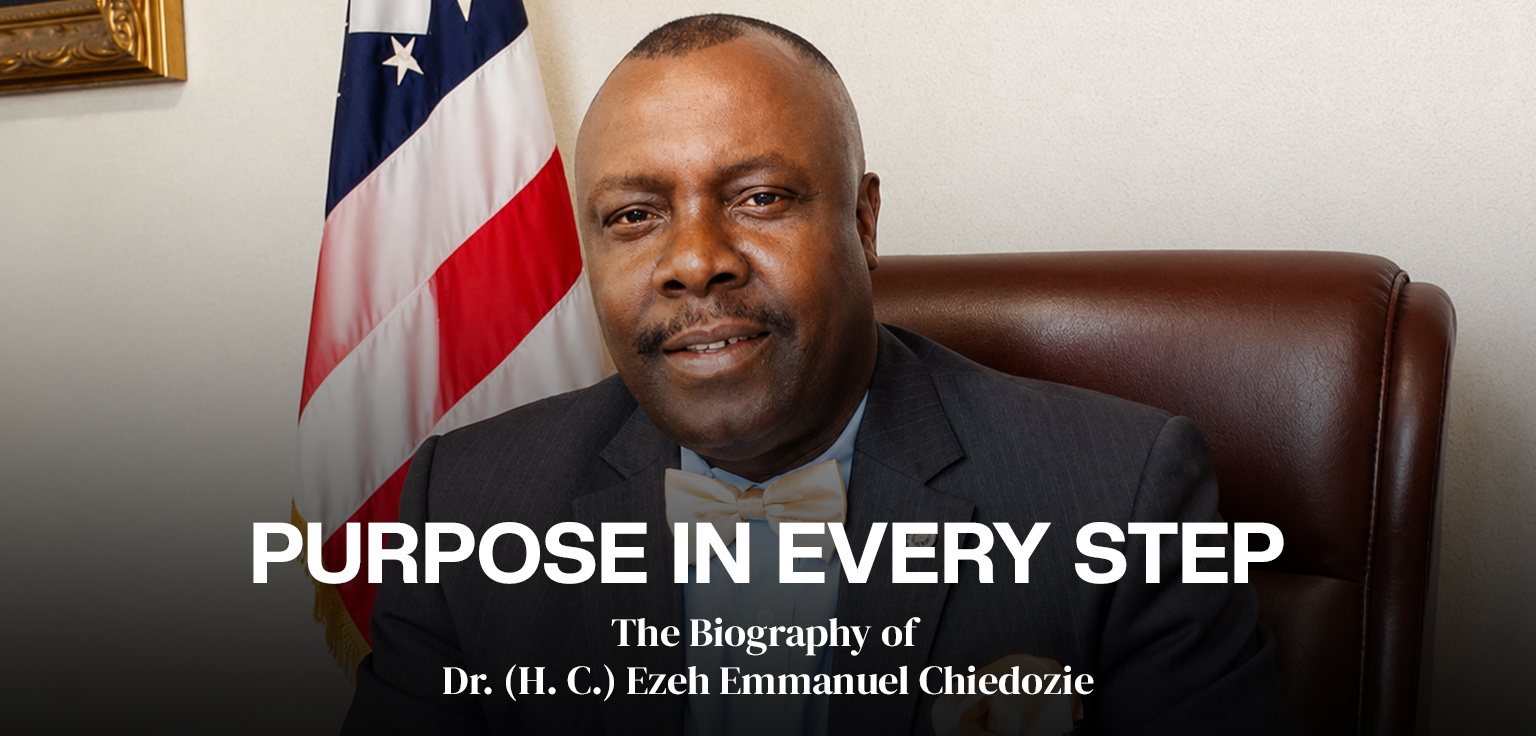
“A life lived with clarity, guided by integrity, and carried forward with quiet determination leaves a legacy that speaks without needing to be heard.”
Introduction
Every life journey carries within it a quiet sense of direction, often shaped not by external pressures but by an inner clarity that steadily guides decisions over time. The story of Dr. Ezeh Emmanuel Chiedozie reflects such a path, one that unfolds through self-belief, personal conviction, and a consistent commitment to growth. It is a journey that does not rely on dramatic circumstances or defining influences but instead evolves through choices made with certainty and purpose.
Born in Nigeria, the western part of Africa, he experienced a childhood that he describes as normal and grounded. Growing up with both parents, Chief Samson Ezeh and Rachael Ezeh, his early years were shaped within a stable family environment where education and routine formed the structure of daily life. His schooling followed a straightforward course through primary and secondary levels, without any specific academic inclination that defined his early identity. Yet, beneath this ordinary beginning, there existed a quiet awareness of direction that would later influence the course of his life.
During his formative years, a natural fascination with flying emerged. It was not inspired by a mentor or shaped by any particular event but rather by a simple experience that left a lasting impression. The idea of becoming a pilot resonated with him in a way that required no further validation. It became one of the options he considered seriously while still in high school, and eventually, it was the path he chose to pursue. This decision marked the beginning of a journey that would take him far beyond familiar surroundings.
As a teenager, he moved to the United States of America after being admitted for training as a Commercial Pilot to the North American Institute of Aviation in South Carolina.
Unlike many who follow a conventional academic route, his focus was direct and specific. He joined the North American Institute of Aviation in Conway, South Carolina, where he undertook formal training in the piloting of airplanes. The experience was both technical and transformative, requiring discipline, precision, and focus. It was here that he earned his credentials as a licensed commercial pilot, instrument-rated, qualified to operate both single-engine and multi-engine aircraft, and further established himself as a certified flight instructor.
The training environment also exposed him to a diverse international community. Students from different parts of the world came together within the same learning space, creating an atmosphere that extended beyond technical education. This exposure offered him a broader perspective, allowing him to engage with individuals from varied cultural and social backgrounds. The experience didn’t have one big moment that stood out, but it did help me understand the world and the people in it better.
“A simple beginning often carries within it the quiet strength to shape an extraordinary journey.”
Phase 1: Where It All Began : A Grounded Childhood in Nigeria

The early life of Dr. Ezeh Emmanuel Chiedozie began in a setting that was steady, familiar, and deeply rooted in simplicity. Born in Nigeria, West Africa, his childhood was not marked by extraordinary events or defining incidents but rather by a sense of normalcy that quietly shaped his understanding of life. It was within this environment that he experienced the foundational years that would later influence the way he approached the world, his responsibilities, and his aspirations.
Growing up under the care and presence of his parents, Chief Samson Ezeh and Rachael Ezeh, he was part of a household that provided stability and structure. His upbringing reflected the rhythm of everyday life, where routines were followed, expectations were understood, and responsibilities were introduced at an early stage. There was nothing dramatic about these early years, yet they carried an understated importance. The consistency of his environment allowed him to observe, absorb, and gradually form his own perspective without disruption or uncertainty.
His childhood, as he describes it, was normal. This sense of normalcy, however, was not without meaning. It represented a life where he had the opportunity to grow without distraction, to experience the natural progression of learning, and to move through each stage of development at a steady pace. He attended primary school and later progressed into secondary education, following a path that was both expected and necessary. These formative years were less about defining achievements and more about building familiarity with discipline, routine, and the process of learning.
During this time, there was no particular subject or academic inclination that stood out as a defining force in his life. His engagement with education was steady but not driven by a specific passion within the classroom. Instead, his schooling served as a platform that prepared him for the next stage of his life, equipping him with the basic structure and understanding required to move forward. It was not about excelling in a particular field during these years, but rather about completing a phase that would eventually open the door to greater opportunities.
“Sometimes, the path ahead reveals itself not through planning, but through a simple moment of clarity that refuses to fade.”
Phase 2 : A Moment That Changed Direction: Discovering the Call to Fly

As Dr. Ezeh Emmanuel Chiedozie moved through his teenage years, there was no immediate indication that his life would take a direction far removed from the ordinary path he had followed so far. His journey until that point had been steady and grounded, shaped by routine and a natural progression through education. Yet, within this phase of his life, something subtle but significant began to take form, something that would quietly alter the course of his future.
Unlike many who are guided by external influences or shaped by strong mentorship, his inclination toward his future path emerged independently. There was no defining figure who introduced him to a specific ambition, nor was there a structured plan laid out before him. Instead, the turning point came through a personal experience, one that was simple in nature yet powerful in its impact. It was during this time that he encountered the idea of flying, not as a distant concept, but as something real and attainable.
The experience itself did not involve complexity or deep analysis. It was straightforward and instinctive. He saw it, experienced it, and recognized within himself a genuine interest. That moment did not require further explanation or validation. It was enough for him to realize that this was something he wanted to pursue. The clarity of that realization is what made it significant. It was not influenced by trends, expectations, or external pressure. It was a decision that came entirely from within.
This emerging interest did not immediately disrupt his ongoing life. He did not abandon his responsibilities or attempt to accelerate his journey prematurely. Instead, he carried this idea with him while continuing through his secondary education. It remained present in his thoughts, gradually becoming one of the options he considered seriously for his future. The way he approached this realization reflects a sense of patience and discipline. He allowed the idea to settle, to become certain, rather than acting on impulse.
“Growth often begins the moment one chooses to leave behind the familiar and step into the unknown with purpose.”
Phase 3 : Stepping Beyond Borders: A Journey Begins in a New Land
The transition from aspiration to action marked a defining phase in the life of Dr. Ezeh Emmanuel Chiedozie. Having arrived at a clear decision about the path he wished to pursue, he stood at the threshold of change, ready to move beyond the environment that had shaped his early years. This phase was not simply about pursuing a career; it was about taking a decisive step into a new world, one that required courage, adaptability, and a willingness to embrace unfamiliar circumstances.
As a teenager, he made the significant decision to leave Nigeria and travel to the United States. This action was not motivated by uncertainty or experimentation, but by a distinct purpose. He knew what he wanted to pursue, and he understood that achieving it required him to go where the opportunity existed. The transition itself represented more than a geographical shift. It marked the beginning of a life that would unfold across different environments, cultures, and experiences.
Arriving in a new country at a young age brings with it a range of adjustments. There are new systems to understand, new surroundings to navigate, and a different pace of life to adapt to. Yet, his approach to this transition remained grounded and focused. He did not allow the unfamiliarity of his surroundings to distract him from his purpose. Instead, he moved forward with clarity, maintaining his focus on the goal that had brought him there.
His entry into aviation training was direct and purposeful. Rather than following a traditional academic route immediately, he chose to enroll in a specialized institution dedicated to flight training. This decision reflected a practical understanding of his objective. He recognized that the path to becoming a pilot required technical training, and he aligned his actions accordingly. It was a continuation of the clarity that had defined his earlier decision, now expressed through deliberate action.
He joined the North American Institute of Aviation in Conway, South Carolina, a place that would serve as the starting point for his professional journey in aviation. The environment he entered was structured, demanding, and focused on precision. Aviation training is not simply about learning to operate an aircraft; it requires discipline, attention to detail, and a strong sense of responsibility. These qualities became essential as he progressed through his training.
Note of Thanks
The journey of Dr. Ezeh Emmanuel Chiedozie is one that has been shaped not only by personal determination but also by the presence of individuals who have quietly contributed to his path. This note is a heartfelt thank you to everyone who has been a part of his life, either directly or indirectly, at different times along his journey.
With deep respect, appreciation is extended to his late parents, Chief and Mrs Samson Ezeh, whose roles in his early life provided the stability and foundation upon which he built his future. Their presence, values, and guidance continue to remain a part of his identity, influencing the way he approaches life with responsibility and clarity.
A special acknowledgment is also reserved for his wife, Arlene Collins Ezeh, whose companionship has been an important part of his life. Her presence, encouragement and support reflects understanding, and shared commitment, adding strength to his journey as it continues to evolve.
Gratitude is also extended to the many individuals he has encountered along the way. Through professional engagements, educational experiences, and personal interactions, each connection has contributed in its own way to his growth and understanding. While not always spoken of, these associations have played a role in shaping perspectives and reinforcing values that remain central to his life.
At its core, this note of thanks reflects a recognition that no journey exists in isolation. Even in a life guided by independence and self-belief, there are moments influences, and relationships that contribute quietly yet meaningfully. Dr. Ezeh Emmanuel Chiedozie acknowledges this with humility, expressing appreciation not through elaboration but through a simple and genuine sense of gratitude for all who have been part of his path, he says THANK YOU !!!.
Thanks,
– Dr. Ezeh Emmanuel Chiedozie