“A thoughtful mind does not rush toward success; it moves with patience, guided by values, strengthened by discipline, and committed to doing what is right.”
Introduction
Dr. Rishab Gupta is a mechanical engineer and engineering professional whose work reflects a disciplined approach to complex industrial systems, with particular engagement in defense-linked projects, high-reliability manufacturing environments, and propellant and explosives engineering infrastructure. His journey is defined by a consistent focus on technical precision, analytical thinking, and the ability to align engineering execution with broader organizational and national objectives.
Born on 6 March 1991, Dr. Rishab Gupta developed an early inclination toward structured thinking and problem-solving. This inclination translated naturally into a strong academic orientation, leading him to pursue a Bachelor of Engineering in Mechanical Engineering. His undergraduate education provided a solid technical foundation in core engineering principles, including system design, mechanics, and process-oriented analysis.
Recognizing the need to complement technical expertise with strategic and innovation-driven perspectives, he further advanced his academic journey by pursuing a Master of Science in Administrative Studies with a concentration in innovation and technology from Boston University, United States. This phase of education broadened his understanding of how engineering systems integrate with innovation frameworks, organizational strategy, and technology-led decision-making. The experience also made him better able to work in global academic and professional settings, improving both his ability to analyze things deeply and his understanding of how different functions work together.
Throughout his academic and professional progression, Dr. Rishab Gupta has demonstrated a consistent ability to approach challenges with methodical precision. His work is characterized by a preference for structured problem-solving, detailed evaluation, and disciplined execution. Rather than relying on approximations, he emphasizes accuracy, process integrity, and long-term sustainability in engineering outcomes.
His professional exposure spans industrial training, international work environments, and involvement in engineering operations across multiple domains. Early experience in precision-driven manufacturing environments provided him with practical insight into production systems, quality control, and process discipline. Subsequent exposure to international organizations further contributed to his understanding of globally benchmarked engineering practices, documentation standards, and cross-cultural technical coordination.
“A strong foundation is not built by circumstance, but by the systems, values, and standards that shape early thinking.”
Phase 1: Foundational Influences and Intellectual Environment
The early life of Dr. Rishab Gupta was shaped within an environment that combined intellectual rigor, disciplined living, and exposure to structured professional values. Born on 6 March 1991, he grew up in a setting where education, analytical thinking, and responsibility were embedded into everyday life. Rather than being driven by external pressure, his early development was influenced by an environment that encouraged independent thinking, observation, and clarity in decision-making.
From a young age, he demonstrated a natural inclination toward understanding systems and processes rather than accepting outcomes at face value. This tendency toward analytical reasoning became a defining characteristic, reflecting an early alignment with engineering-oriented thinking. His approach to situations, even in formative years, was marked by evaluation, logic, and a preference for structured conclusions.
A significant aspect of his early environment was the presence of strong academic and professional influences within the family. He was raised in a lineage where engineering excellence, public service, and national contribution were not abstract ideals but demonstrated realities. This exposure created an early awareness that professional work carries broader implications beyond individual success.
On the paternal side, his grandfather, Dr. G. M. Gupta, is a mechanical engineer with a double Ph.D. and MBA, whose career is closely associated with strategic industrial development in India. His work spanned critical sectors including defense, nuclear power, and atomic energy, particularly during phases focused on import substitution and strengthening indigenous capabilities. He was involved in the execution of large-scale turnkey engineering projects, often in collaboration with international organizations. His career reflected precision, long-term planning, and execution discipline. Notably, his continued pursuit of education, including completing an MBA at the age of eighty-four and being recognized in the Golden Book of World Records, reinforced the principle that learning remains continuous and independent of age.
On the maternal side, his grandfather, Mr. K. S. Rastogi, served in the Indian Administrative Service (Rajasthan Cadre) and demonstrated excellence in governance and public administration. He won a gold medal in math from Delhi University and went to St. Stephen’s College. Later, he was the Chairman of the Board of Revenue in Rajasthan. His career showed that he was honest, analytical, and dedicated to making sure that government systems were accountable to the public.
“Clarity in thinking is developed through consistent evaluation, disciplined effort, and the ability to approach problems with structure.”
Phase 2 : Development of Analytical Thinking and Early Discipline
During the formative years of his academic journey, Dr. Rishab Gupta began to demonstrate a clear inclination toward analytical reasoning and structured thinking. This phase was marked not merely by learning, but by the development of a mindset that emphasized understanding systems, evaluating outcomes, and approaching situations with logical clarity.
Rather than relying on surface-level learning, he showed a consistent preference for understanding the underlying principles behind concepts. His approach to education was characterized by depth rather than volume, focusing on comprehension, accuracy, and practical relevance. This tendency reflected an early alignment with engineering-oriented thinking, where problem-solving requires methodical evaluation rather than assumption.
A defining characteristic during this stage was his ability to approach decisions with clarity and restraint. Instead of acting impulsively, he demonstrated a pattern of evaluating options before proceeding. This behavior went beyond school and into everyday life, showing a disciplined way of thinking that put reasoning ahead of quick fixes.
His academic engagement during this period reflected both capability and commitment. He was recognized not only for intellectual ability but also for his willingness to invest sustained effort into his work. Assignments and responsibilities were approached with seriousness, and once undertaken, were completed with a focus on accuracy and completeness. This consistency in execution laid the foundation for his later professional discipline.
Another important development during this phase was his approach toward challenges. Rather than avoiding complexity, he showed a tendency to engage directly with difficult tasks. This approach reinforced problem-solving ability and built confidence in handling situations that required persistence and structured effort. Over time, this became an integral part of his working style.
“Consistency in execution and clarity in priorities form the foundation of long-term professional capability.”
Phase 3 : Development of Execution Discipline and Structured Approach
As Dr. Rishab Gupta progressed through his formative academic years, the emphasis within his development began to shift from foundational thinking to execution discipline and structured behavior. This phase reflects the transition from developing analytical tendencies to consistently applying them through action, accountability, and organized effort.
A key aspect of his development during this stage was the strengthening of responsibility-driven behavior. Tasks and commitments were approached with a clear sense of ownership, and once undertaken, they were expected to be completed within defined timelines and standards. This approach contributed to the formation of a disciplined work ethic, where accountability was not externally imposed but internally maintained.
His method of working during this period demonstrated a clear preference for structured execution. Whether in academic responsibilities or routine engagements, he followed a systematic approach, ensuring that tasks were completed in a logical sequence with attention to accuracy. This inclination toward process-oriented work established early alignment with environments where precision and consistency are critical.
Another defining characteristic during this stage was his ability to prioritize effectively. Rather than engaging in multiple activities without direction, he demonstrated the capacity to evaluate what was necessary and focus on outcomes that aligned with his objectives. This selective method of allocating effort showed an early understanding of efficiency and getting the most out of resources.
His approach toward challenges also became more refined during this period. Instead of viewing complexity as an obstacle, he engaged with tasks that required persistence and structured effort. This strengthened his ability to handle demanding situations with stability and focus, reinforcing confidence in his problem-solving capabilities.
Note of Thanks
The journey reflected in the life of Dr. Rishab Gupta is not one shaped by individual effort alone. It stands upon the strength, guidance, and encouragement of the people who have been part of his life from the very beginning. This note of thanks is therefore a sincere acknowledgment of those whose presence and support have quietly contributed to the path he has walked.
First and foremost, deep gratitude is extended to his parents, Vimal Gupta and Shipra Gupta, whose upbringing, values, and constant encouragement laid the foundation for his character. Their guidance nurtured discipline, humility, and responsibility, qualities that have remained central to the life and decisions of Dr. Rishab Gupta.
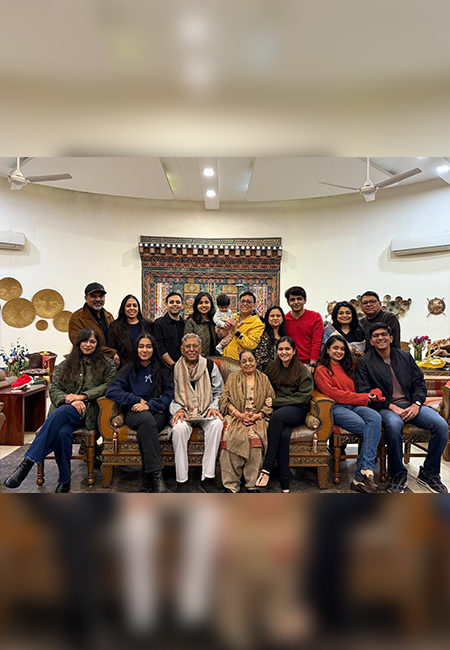
Equal appreciation is owed to the elders and grandparents of the family, whose wisdom and experiences shaped his understanding of life and relationships. Growing up within a close-knit family environment allowed him to observe and learn lessons that extended beyond words. The influence of these elders continues to remain an important part of his journey. In particular, heartfelt gratitude is extended to his grandfather, Dr. Girish Mohan Gupta, whose guidance, trust, and belief in his abilities played a meaningful role in shaping his professional growth and confidence in accepting responsibility.
Special acknowledgement is also given to his life partner, Jagriti, whose companionship represents trust, understanding, and shared responsibility. Her presence has added strength and warmth to the personal chapter of his life.
A heartfelt expression of love is reserved for his son, Vayu, whose arrival has brought new meaning and inspiration to the future. Through him, the values that shaped Dr. Rishab Gupta now look toward the next generation.
Finally, appreciation is extended to friends and extended family members who have remained constant companions through different stages of life. Their encouragement, memories, and shared experiences continue to enrich his journey. This gratitude also extends to the wider family whose support, guidance, and presence in different aspects of life have contributed meaningfully to the journey of Dr. Rishab Gupta.
This life story stands not only as a reflection of one individual but also as a tribute to the many people whose presence has helped shape the path of Dr. Rishab Gupta.
Thanks,
– Dr. Rishab Gupta