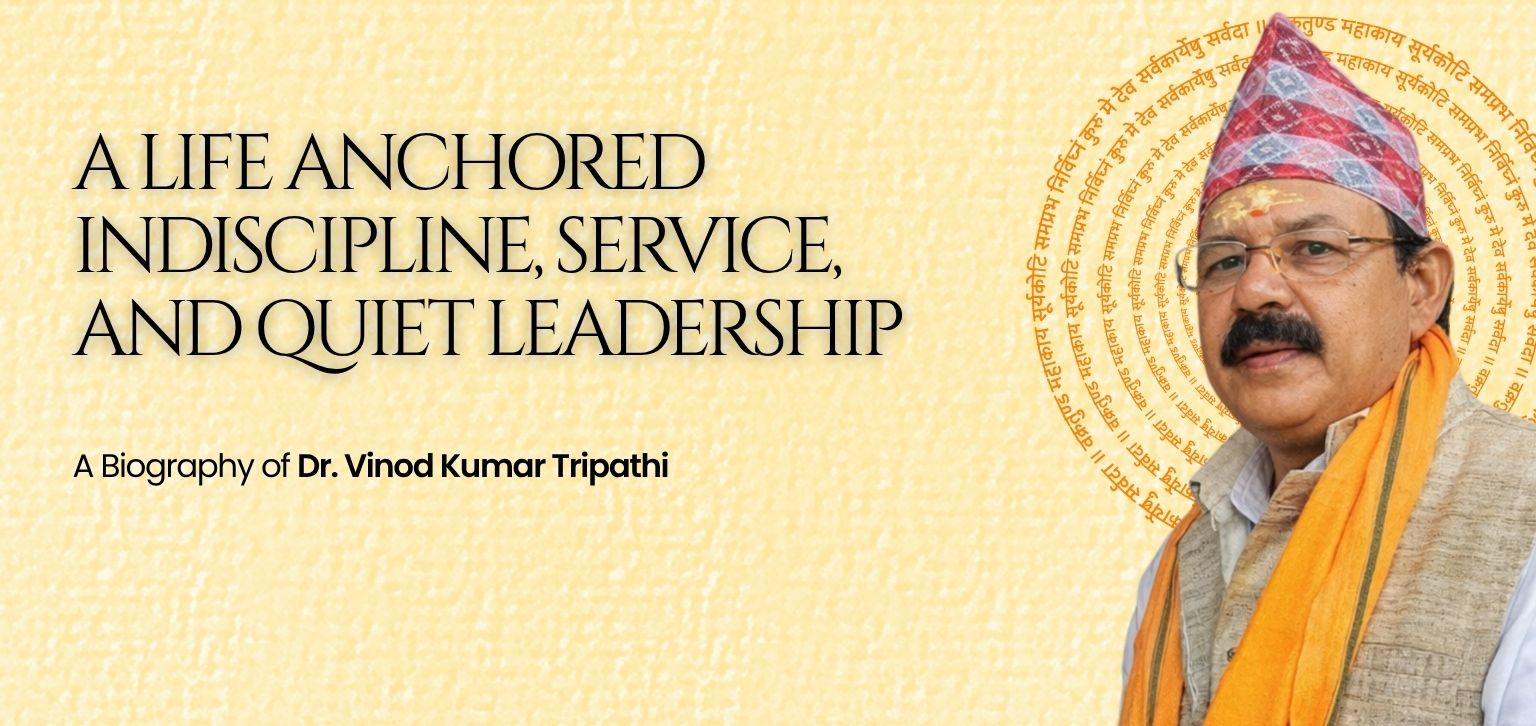
“This is not the story of a life driven by noise or urgency, but of one shaped through discipline, sustained by responsibility, and refined by consistency, where progress unfolded not through spectacle, but through choices repeated with integrity over time.”
Introduction
The life story of Dr. Vinod Kumar Tripathi is not one of sudden success or dramatic turning points, but rather a consistent journey of dedication, learning, and responsibility. His journey unfolds not through grand spectacles but through quiet, meaningful actions that reflect values instilled early in life, values of integrity, discipline, and an unwavering commitment to service and education. This biography aims to capture that steady progression, reflecting the story of a man whose life has been shaped by perseverance, wisdom, and a deep respect for both intellectual and social contributions.
Dr. Tripathi was born and raised in Varanasi, a city steeped in rich cultural and spiritual traditions. Growing up in such an environment, he was naturally exposed to the importance of education, ethics, and discipline from an early age. His father, Late Shri Data Prasad Tripathi, was a revered scholar with mastery in Hindi, English, and Sanskrit. He not only imparted academic knowledge but also instilled a profound respect for disciplined thought and intellectual rigor. His mother, Late Mrs. Tara Tripathi, played a crucial role in balancing the emotional needs of the family, teaching Dr. Tripathi resilience, compassion, and a deep-rooted sense of duty. Together, his parents laid the foundation for a life built on these core values, which would guide him in both his personal and professional endeavors.
From his early school years to his graduation in the 1970s, Dr. Tripathi’s academic journey was characterized not by haste, but by consistency, diligence, and a deep sense of responsibility. Raised in an era of limited resources and strong institutional discipline, his education emphasized not just knowledge but the practical application of learning. His studies in the arts enhanced his linguistic abilities and broadened his understanding of society, culture, and governance, fostering a respect for critical thinking and meaningful self-expression.
In addition to academics, Dr. Tripathi’s formative years were shaped by his active participation in the National Cadet Corps (NCC), where he developed habits of punctuality, accountability, and leadership grounded in service. Training as a cadet was more than just a physical exercise; it built his mental resilience, teaching him to lead by example and to shoulder responsibilities with patience and discipline. This experience, coupled with his involvement in sports, further nurtured his sense of teamwork, endurance, and the importance of collective effort—a trait he would carry throughout his life.
As Dr. Tripathi transitioned into adulthood, his choices continued to reflect a balance of practicality and purpose. At a time when the healthcare and pharmaceutical sectors demanded a blend of technical knowledge and ethical integrity, he pursued a professional qualification in pharmacy. Becoming a registered pharmacist marked a turning point in his career, placing him in a field where precision and responsibility were paramount. This qualification laid the foundation for his later involvement in the pharmaceutical business, where he demonstrated the same disciplined approach he had cultivated in his education and NCC training.
“Before a life learns to lead, it learns to listen, to routine, to values, and to the quiet expectations that shape character long before ambition finds a voice.”
Phase 1: Where Discipline Took Root

Dr. Vinod Kumar Tripathi’s early years were characterized by steady discipline, consistent learning, and a deep sense of responsibility. These foundational qualities were instilled by his parents and nurtured in the environment of Varanasi, a city known for its rich cultural and spiritual legacy. Growing up in a city with such intellectual vibrancy, Dr. Tripathi was naturally exposed to the importance of education, discipline, and ethical conduct from a young age.
His father, Late Shri Data Prasad Tripathi, a scholar proficient in Hindi, English, and Sanskrit, placed great emphasis on the moral and intellectual aspects of education. It was not just about accumulating knowledge but using it responsibly. Dr. Tripathi learned that knowledge should not only be pursued for personal growth but also for the well-being of others, embodying integrity in every step of the learning process.
Equally influential was his mother, Late Mrs. Tara Tripathi, who brought emotional stability to the family. Her strength, patience, and nurturing presence complemented the intellectual rigor of his father. Dr. Tripathi absorbed valuable lessons from her about consistency, care, and emotional resilience. From her, he learned that true stability is built from daily, quiet actions that create a strong foundation.
Dr. Tripathi’s early education was characterized by dedication, patience, and an emphasis on consistency. In his formative years, he was instilled with the understanding that effort, not just outcomes, is what counts. Tasks were completed with diligence, and punctuality was always a priority. It was through this steady approach that he was able to establish habits of responsibility that would serve him throughout his life.
His academic journey was a natural extension of his home life, where discipline and structure were central. As he progressed through school, he maintained a steady pace, focusing more on gaining a deeper understanding of subjects rather than rushing to meet deadlines.
“Education did not teach him speed; it taught him patience, and with patience came the understanding that learning gains strength when discipline gives it direction.”
Phase 2 : Learning Within Structure
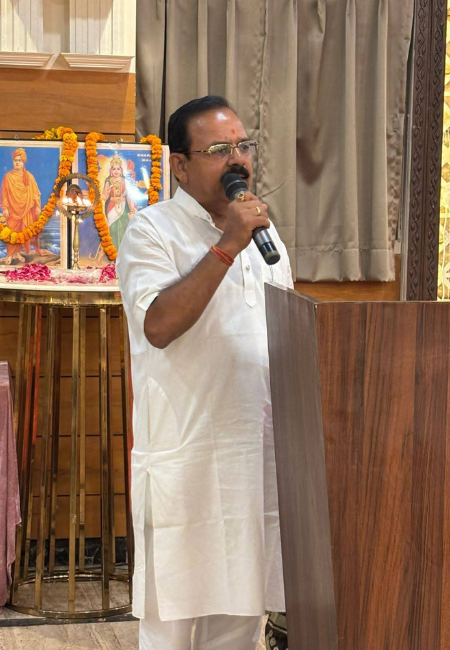
As Dr. Vinod Kumar Tripathi entered adolescence, the discipline that was instilled in his early years took on a more focused and structured form through his formal education. This period was not marked by rebellion or experimentation, but by steady and consistent engagement with academic systems that demanded responsibility, patience, and intellectual honesty. Education became a space where the values learned at home were tested and reinforced.
The transition to secondary education introduced a broader academic environment. Dr. Tripathi found himself in a space that required sustained effort and intellectual engagement across a range of subjects. The emphasis was not on quick results but on long-term, methodical learning. He embraced this challenge, understanding that mastery comes through consistent, reflective engagement rather than hasty attempts to rush through tasks.
A key focus during this phase was his engagement with languages. Dr. Tripathi’s proficiency in Hindi, English, and Sanskrit was not merely academic; it was an intellectual pursuit that sharpened his critical thinking and ethical reasoning. Language was not just a means of communication for him but a powerful tool for shaping thought, expression, and understanding. It was during these years that he solidified his belief that language carries weight—not only in its ability to communicate ideas but in its role in developing intellectual clarity and ethical awareness.
The move to higher secondary education brought with it a shift in responsibility. Dr. Tripathi had to take on greater autonomy in managing his time and academic responsibilities. At this point, the focus was not on achieving specific outcomes or milestones but on solidifying his academic foundation. Education became a preparation for greater responsibility. There was no urgency to rush through it; instead, Dr. Tripathi learned the value of deeply understanding his subjects. This maturity reflected the internal discipline he had developed in his earlier years.
“Discipline ceased to be an idea when responsibility demanded action, and character was tested not by intention, but by consistency under order.”
Phase 3 : Formed by Order and Responsibility

Phase Three of Dr. Vinod Kumar Tripathi’s life marks the period where the foundation laid in earlier years began to take tangible form. It was no longer just about internal discipline; it was about external responsibility. This was the phase where values cultivated in his formative years were put to the test in structured environments that demanded consistency, accountability, and reliability.
As Dr. Tripathi moved beyond school and entered a more structured form of training, his exposure to environments that required precision and adherence to set rules introduced new dimensions to his understanding of discipline. In these settings, punctuality was no longer a choice but an expectation. Tasks were not just completed based on individual effort, but as part of a system where the collective depended on the reliability of each individual. The structured nature of these environments forced him to adapt, quickly internalizing that every action had consequences.
One of the key experiences during this phase was his participation in structured training environments, where he learned that responsibility extended beyond personal goals to include shared objectives. Every task, no matter how small, had a broader impact. Responsibility, Dr. Tripathi learned, was not an isolated endeavor but a communal one—what you do affects the whole. The importance of teamwork, coordination, and mutual trust became clear. These lessons taught him to respect the process, follow through on commitments, and contribute to group objectives without the need for external recognition.
In addition to formal training, sports played a major role in shaping his understanding of responsibility. The teamwork required in sports reinforced his belief that collaboration and alignment were essential for success. Dr. Tripathi quickly learned that the pursuit of individual success in these settings was futile without cohesion within the team. Whether in physical training or sports, he embraced the principle that individual effort must always align with collective goals.
Note of Thanks
This biography is a testament to the invaluable support, guidance, and experiences that have shaped Dr. Vinod Kumar Tripathi’s life and career. With profound appreciation, it acknowledges the essential people and influences that have played a vital role in his journey.
First and foremost, deep gratitude is owed to his parents, Late Data Prasad Tripathi and Late Tara Tripathi, whose unwavering principles of discipline, integrity, and lifelong learning created the foundation upon which Dr. Tripathi built his personal and professional life. Their quiet strength, discipline, and dedication were not simply taught but demonstrated, leaving a lasting impact that reverberated throughout his life.
A special acknowledgement is extended to his wife, Kiran Tripathi, for her enduring support and understanding, which were instrumental in balancing the demands of family life with the commitments of Dr. Tripathi’s professional journey. Her presence has been a continuous source of encouragement and grounding, enabling him to navigate challenges with resilience and clarity.
Additionally, heartfelt thanks go to the teachers, mentors, colleagues, and associates who have contributed to his growth and development. Each person, in their unique capacity, has enriched Dr. Tripathi’s journey with wisdom, collaboration, and shared experiences. Whether through direct mentorship or casual exchanges, their contributions have shaped his approach to leadership, service, and professionalism.
Finally, sincere gratitude is given to the experiences themselves—each challenge, lesson, and moment of responsibility that helped to refine Dr. Tripathi’s character and reinforce the core values that continue to guide him today. It is with these contributions in mind that this biography is offered, acknowledging not only the journey but all those who have made it possible.
Thanks,
– Dr. Vinod Kumar Tripathi