“A meaningful path is not always the one first imagined; sometimes it is the one that tests the heart, refines conviction, and reveals why a life was given its particular calling.”
Introduction
Some individuals are remembered for distinction, some for achievement, and some for the quiet force of character that becomes visible only through time. Dr. Devina Ramtohul Garosurn belongs to the last of these. Her journey did not unfold through ease, certainty, or privilege. It was shaped instead by family influence, difficult choices, emotional endurance, spiritual grounding, and a steadily deepening desire to become useful where pain, neglect, and vulnerability were most visible. What gives her story substance is not simply the range of roles she came to hold, but the moral seriousness with which she approached each stage of life.
Her beginnings were rooted in Suriname, Mauritius, within a close knit domestic world that offered belonging, familiarity, and affection. Childhood was not lived within narrow walls. It extended into the presence of grandparents, uncles, aunts, parents, and younger siblings, forming a living circle of relationships that gave early life warmth and shape. That atmosphere mattered. She had already absorbed values that would stay with her for years to come, even before she earned any qualifications or entered any profession. Care was not presented to her as a theory. It was part of ordinary living. Closeness, attention, and emotional presence were woven naturally into daily experience.
Her father worked as a telephonist in a hospital, and he also pursued plantations, growing crops and herbs through additional labour. Her mother, though known as a housewife, stood beside that effort in practical ways, helping in the fields while also sustaining the household. From those two figures came contrasting yet equally formative influences. One represented discipline, structure, and rigorous reality. The other embodied encouragement, steadiness, and protective faith. Together, they gave her a foundation built not on comfort, but with work, duty, and perseverance. Such a background often leaves a person with an instinctive respect for effort, and that instinct remained central to her outlook.
Movement and adjustment marked the pattern of her early education. She first attended Robert Edward School. Later, following the death of an uncle who had been responsible for bringing After leaving her home, she shifted to Gopeenath Cheetamun Government School in Suriname, which is located closer to her residence. This change may appear small when written as a fact, yet within a child’s world, such moments carry emotional weight. A familiar figure was gone. Daily routine altered. Another setting had to be accepted. Life was already teaching her, even at that age, that continuity could abruptly end and that adaptation often precedes readiness.
As she moved into adolescence, her educational direction began to sharpen. She joined Swami Vivekananda State Secondary School, where the gradual movement through the lower forms eventually led to a decision about subject focus. Science drew her strongly. Biology and chemistry were not merely academic requirements to be completed and forgotten. They pointed toward an aspiration she had begun to hold seriously within herself. She wanted to enter nursing.
“The earliest lessons do not always come from classrooms. Often, they come from the hands that raise us, the homes that shelter us, and the quiet people whose way of living teaches us how to become human.”
Phase 1: Roots of Tenderness and Strength

The earliest chapter of Dr. Devina Ramtohul Garosurn’s life began in Suriname, Mauritius, within a family world shaped by modest living, close relationships, and the ordinary warmth of shared presence. Before ambition, profession, and academic struggle entered the picture, there was first a childhood held together by familiar faces, daily routines, and the kind of nearness that makes a lasting impression on the heart. Grand events or unusual privileges did not mark her beginnings. Instead, they were formed by a household in which affection, duty, and togetherness carried their own quiet significance. That foundation would later prove far more important than it may have seemed at the time because it was there that her nature first took shape.
She was born into a family where work was a lived reality rather than an abstract idea. Her mother was a housewife, yet that description alone did not fully contain the breadth of her effort. She was deeply involved in the practical life of the home and also supported her husband in his agricultural work. Her father served as a telephonist at a hospital in the government sector while also engaging in plantation work as a part-time activity. He cultivated crops, tomatoes, and small herbs, adding another layer of labour to an already demanding life. In that environment, effort was not something spoken about ceremonially. It was simply part of existence. One worked because life required it. One continued because family depended on it. Without formal speeches or visible displays, those realities taught valuable lessons very early.
As the eldest child, Devina occupied a cherished position within the household. She had one younger brother, and by her recollection, she was pampered while growing up. There is tenderness in that admission, because it reveals a childhood that was not deprived of love. She was cared for, noticed, and surrounded by people who made her feel that she belonged. Yet her world extended beyond her immediate parents and sibling. Her maternal grandmother lived nearby, and that closeness became one of the defining features of her early life. She grew up not only with her father, mother, and brother but also within the orbit of grandmother, uncle, aunt, and the larger family rhythm that comes from living among relatives who remain physically and emotionally present.
“Some dreams begin in innocence, but their true shape emerges only when life demands a choice and asks whether desire is strong enough to survive disappointment.”
Phase 2 : Learning to Choose a Future
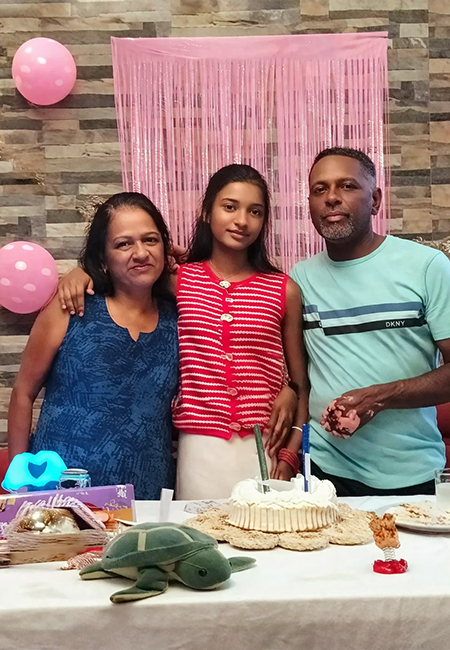
As Dr. Devina Ramtohul Garosurn moved out of childhood and into adolescence, life began to open before her in a more defined way. The warmth of home, the closeness of relatives, and the simple rhythms of early upbringing had already given her an emotional foundation. Yet the next stage required something different. It called for direction. It asked what kind of young woman she would become, what path she would follow, and how she would respond when aspiration met the limits imposed by circumstance. These were not questions she answered all at once. They unfolded gradually through schooling, subject choices, growing self-awareness, and the quiet formation of a professional dream that would come to matter deeply to her.
Her move into secondary education marked the beginning of that inner shift. She joined Swami Vivekananda State Secondary School, where her academic journey entered a more serious phase. At first, the experience followed the ordinary pattern familiar to many young students. The early years were steady and manageable. She moved through Form 1 to Form 3 without dramatic upheaval, allowing herself to settle into the routine of study, classmates, teachers, and the widening world that adolescence brings. Yet beneath the ordinary movement of school life, something more important was beginning to take shape. She was no longer only a child moving from one class to the next. She was becoming a person who had to think ahead.
The pivotal moment arrived when it was time to select her course of study. Many students view this decision as a straightforward educational step. For Devina, it carried more emotional meaning. It was the first moment when interest, identity, and future possibility began to converge. She chose the science stream, taking subjects such as biology and chemistry. That decision was not random, nor was it made merely to follow convention. It reflected a sincere attraction toward a field connected with healing, care, and practical human service. Somewhere within her, the wish to become a nurse had already taken root.
“A calling is tested not when it is imagined, but when it stands face to face with suffering, disappointment, and the kind of truth that asks whether compassion will survive contact with the world.”
Phase 3 : When Service Met Reality

By the time Dr. Devina Ramtohul Garosurn entered the government healthcare sector, the hopeful young student who had once looked toward nursing with brightness and expectation was beginning to encounter a far more difficult side of life. The transition from aspiration to institutional experience did not happen gently. It came with a shock that would forever imprint on her understanding of care, duty, and human responsibility. She had entered this field with a sincere heart. She believed that tending to the sick, the elderly, and the vulnerable meant offering kindness alongside practical help. What she found instead was a setting where her values often stood in painful contrast to the conduct around her.
The difference was immediate. In her mind, healthcare had carried an image shaped by tenderness, discipline, and respect. She had imagined herself in white, caring for older people with the same warmth she had known in family life, giving them attention, speaking to them gently, and making them feel safe. The elderly especially held a special place in her emotional world because her upbringing had taught her to look at older people not as burdens, but as lives deserving patience and dignity. That instinct did not disappear when she entered the ward. If anything, it became stronger. Yet what unsettled her most was the realization that not everyone around her saw the work in the same way.
She observed behaviours that deeply disturbed her. Patients who were weak, dependent, frightened, or in pain were sometimes treated with impatience and roughness. Voices were raised. Needs were ignored. Requests for water, help, or comfort were brushed aside as though suffering had become background noise. Clothes remained soiled. Frail individuals were handled without gentleness. During visiting hours, families would arrive and face the painful sight of loved ones left in conditions unworthy of human dignity. For Devina, the situation was not only unpleasant to witness. It cut against something fundamental in her character. She could not accept that a person lying ill should also be made to feel unwanted.
Note of Thanks
This life narrative closes with heartfelt gratitude to all those whose presence, sacrifice, encouragement, and faith became part of Dr. Devina Ramtohul Garosurn’s journey. No life is shaped alone. Behind every hard-earned step stands a circle of people whose love, strength, and quiet support make perseverance possible even during the most uncertain seasons.
Her deepest appreciation belongs first to her family, whose role has been both foundational and enduring. Special thanks are due to her mother, whose care, guidance, and steadfast belief provided emotional shelter during many demanding years. Her mother not only provided verbal support but also consistently showed her presence, understanding, and strength during times of need. Deep gratitude is also extended to her daughters, Khyati and Preksha, whose affection, sensitivity, and thoughtful gestures brought light into periods of exhaustion and pressure. Their love remained a powerful source of comfort and motivation.
Sincere thanks are also offered to MR GAONEANDRY ANAND, all teachers, mentors, colleagues, and well-wishers who contributed, in different ways, to her growth across the years. Each lesson shared, each opportunity given, each kind word spoken, and each act of trust extended helped shape the path she continued to build with patience and determination. She deeply values their influence in her personal, academic, and professional development.
Above all, she offers this note with gratitude to God, whose grace guided her through challenges, transitions, disappointments, learning, and renewal. Through every phase, faith remained a sustaining force.
Thanks,
– Dr. Devina Ramtohul Garosurn