
“A life becomes meaningful not by avoiding difficulties, but by rising through them with purpose, faith, and courage.”
Introduction
The story of Dr. Olapeju is one of resilience forged across continents, a journey of strength guided by unwavering faith, and shaped by profound transformation. With seasons of triumph and hardship, it ultimately reveals the power of perseverance spirited by divine purpose. Born on a rainy Friday afternoon in October at St Mary’s Hospital, Paddington, London, to a young couple, Mr. Taju Shote and Mrs. Bolanle Shote, both of good stock and pedigree, she entered a world that would demand courage, adaptability, and strength of spirit from an early age.
These early years, rooted in a stable environment, balanced between cultural identities, and shaped by two loving yet disciplined parents, laid the quiet foundation for a future defined by service and leadership.
Her formative years moved between the structured opportunities of the United Kingdom and the stark realities of Nigeria’s public education system. Witnessing scarcity, inequality, and lost potential did not weaken her resolve, it awakened it. Even as a young student, she learned that environment can shape outcomes, but determination shapes destiny.
Sent back to the UK as a teenager, she became a working student, balancing multiple jobs with academic ambition. Those years built her resilience, discipline, and independence, laying the foundation for a successful professional career in business, finance, and project management. Yet fulfillment remained elusive. Deep within, she felt a calling to serve, to return home, and to make impact where it mattered most.
Leaving behind a stable life abroad, Dr. Olapeju answered that call and returned to Ogun State, where public service became her true platform. Through initiatives such as the N-Power Project and the Homegrown School Feeding Programme, she helped transform lives—creating employment for youth, empowering women, feeding children, and strengthening communities. Her work in rural development and urban planning further reshaped forgotten spaces and modernised governance.
Behind the public achievements is a woman who endured personal loss, raised children through adversity, overcame life-threatening illness, and rebuilt her life with grace and resolve. Anchored by faith, supported by family, and strengthened by love, she stands as living proof that purpose can rise from pain.
This is not just the story of success. It is the story of service, sacrifice, and a life lived in answer to a higher calling.
Her childhood in the UK gave her first understanding of structure, opportunity, and the dignity that comes with responsibility. Yet life shifted when her family returned to Nigeria, placing her in an odd environment vastly different from what she had known.Her early schooling at St. Anthony Primary School (a Catholic missionary school) and Anglican Girls Grammar School, a public institution marked by scarcity and struggle, opened her young eyes to a reality where motivation wasn’t evenly distributed and resources were painfully limited. But instead of discouraging her, this environment awakened something within her—a desire to rise beyond limitations and to one day uplift those who didn’t have the same opportunities she was blessed with.
“Every beginning carries a quiet promise—one that reveals itself only to those who grow through it.”
Phase 1: Roots in a Distant Land
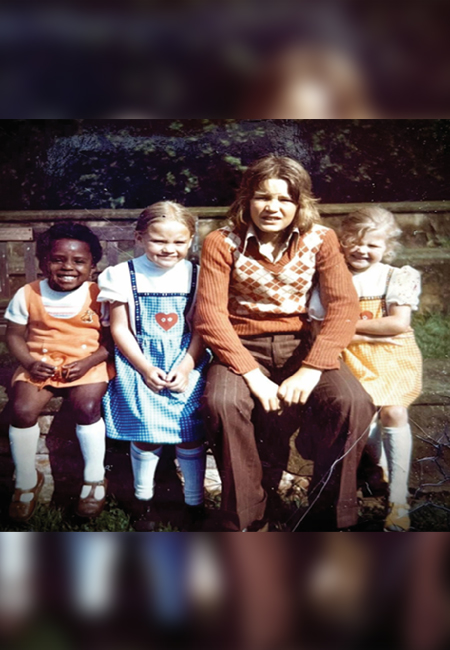
The story of Dr. Olapeju begins far from the place where her greatest impact would one day unfold. Born in a period of racial violence and hostility in Britain, many Nigerian and Afro-Caribbean families faced widespread, overt racism and a constant threat of racial violence, including physical assaults and vandalism of homes. Far-right groups like the National Front (BNP) grew in support and perpetrated many of these attacks. In essence, being a black child in 1970s Britain meant navigating a hostile environment whilst fostering a resilient black identity.
She entered a world that held for her a blend of cultural influences, structured systems, and early exposure to possibilities. Her parents, Mr. Taju Shote and Mrs. Bolanle Shote, both immigrants who carried with them the resilience of their Nigerian heritage, were the first architects of her core values. Through their discipline, sacrifices, and their quiet but steady expectations, they laid the pivotal foundation on which her life would be built.
Her father, Mr. Taju Shote, was a man defined by principles—firm yet fair, deeply disciplined, and unshakeable in his convictions. His presence in her early life shaped how she understood responsibility and commitment. Her mother, Mrs. Bolanle Shote, offered the balance of warmth, stability, and quiet perseverance. Together, they instilled in her not only the confidence to dream, but the work ethic needed to pursue those dreams without fear.
Growing up in the UK during the early 1970s and 1980s, young Olapeju lived in an environment that emphasized order, routine, and exposure to structured education. These formative years were marked by the simple rhythms of childhood—witnessing the explosion of youth culture, pop music, dance, art, 80’s fashion, and individual expression. The simplicity of walking to school, stepping on crisp autumn leaves, learning new words with the curiosity of a child discovering language through two cultures, and watching her parents navigate life in a foreign land with dignity and determination shaped her deeply.
“Sometimes, life takes us where we never expected to go, only to reveal who we were always meant to become.”
Phase 2 : A New Horizon in Nigeria — Discovering Strength Through Change

When Dr. Olapeju returned to Nigeria as a young girl, she left behind the familiar rhythm of her early childhood in the United Kingdom. This journey marked the beginning of a profound awakening—one that would test her adaptability, deepen her resilience, and expose her to the realities of life in ways she had never experienced before.
The move was far more than a relocation; it was a transition into a world alive with a different intensity. Nigeria greeted her with colour, energy, complexity, and opportunity. The climate felt harsher, the people more expressive, and the streets more vibrant. In contrast to the structured predictability of her British upbringing, Nigeria was raw and vivid—a powerful dichotomy that demanded patience, courage, discernment, and faith.
For her parents, returning home was an act of conviction, rooted in a desire for cultural grounding and strong community values. They wanted their children to grow in an environment where heritage mattered and identity was deeply rooted. For young Olapeju, however, the adjustment required time. She had been shaped by the routines and educational systems of the UK, yet adaptability—one of her greatest strengths—soon emerged.
During this period, her parents’ relationship entered a challenging phase that ultimately led to their separation. This shift created a defining emotional moment in her youth. Living primarily with her father, Mr. Taju Shote, she experienced a home governed by discipline, structure, and unwavering moral clarity. His word was absolute, and his values—integrity, firmness, and accountability—became the foundation of her character and future leadership style. These early lessons became the moral compass she carried into every phase of her future.
Her gregarious mother, Mrs. Bolanle Shote, though living separately, remained a constant source of emotional strength and warmth. Their bond was rooted in compassion, reassurance, and unconditional love.
“There comes a moment when life pushes us beyond what is familiar, so we may grow into who we are meant to be.”
Phase 3 : Crossing Borders Again — The Return to the United Kingdom and the Making of a Working Scholar
After completing her GCSE examinations in Nigeria, a pivotal decision by her father reshaped Olapeju’s future. Recognising her potential and driven by foresight, Mr. Taju Shote resolved to send her back to the United Kingdom to continue her education. This return was different from her childhood relocation. Older, more self-aware, and deeply connected to her Nigerian identity, Olapeju understood the weight of the opportunity before her. It was not a privilege to be squandered, but a responsibility to be honoured.
It was a decision rooted in foresight and an understanding that sometimes, to rise, one must venture far from comfort. It meant stepping into a new chapter marked by independence, responsibility, and the maturity that comes when one must build life from the ground up. Her father had given her the foundation; now it was her turn to build on it.
Arriving in the UK in 1987, as a young woman preparing for higher education, she entered adulthood without a safety net. There were no financial guarantees. If she wanted to study, she had to work. If she wanted stability, she had to earn it. It was no longer the world of innocence she had known as a child. She was now stepping into adulthood, and with that came responsibility.
This was in the middle of Michael Jackson’s Bad tour at Wembley Stadium. MJ’s and Whitney Houston’s music ruled the charts and the airwaves. The punks were the biggest craze that hit London like the World War Blitz. Covent Garden, Charing Cross, Leicester Square, and Trafalgar Square were the mecca for youth culture. The summer of 1987–1988 represented a seismic shift in dance music culture—“Acid House Raves” and street fashion. This was the Woodstock of our generation. Pirate FM radio stations popped up all over London’s council tower blocks, promoting illegal raves on farms, warehouses, and factories. It was very easy to have gone off the rails in 1980s Britain. The anthem of the year: Public Enemy, “Rebel without a Pause.” I went shopping on fashionable Carnaby Street for the latest streetwear. I joined the “Free Mandela Protests,” and I was at the African Centre at Soul II Soul events.
Thus began her life as a working student, balancing multiple jobs while attending college and later, university. She worked in various capacities—sometimes during the day, sometimes late into the night—taking on whatever honest work she could find. Whether it was administrative roles, retail positions, hospitality shifts, or clerical support, she embraced it all with humility and determination. She worked various job roles in the theatre district of the West End, as a cashier at Shepherd’s Food. This was before the advent of barcode scanners; you had to have an affinity for numbers. She also worked at Westminster Hospital as a carer and catering assistant.
She learned early that growth is rarely comfortable, but always purposeful. Managing time with precision, valuing every earned pound, and committing fully to both work and study became second nature. Her academic pursuits in business, finance, payroll, and management laid the groundwork for her professional future.
Note of Thanks
As Dr. Olapeju reflects on her life’s journey, she recognizes that every milestone, every achievement, and every moment of resilience was made possible because of the love, support, and presence of people whom God intentionally placed along her path. This note of thanks is her heartfelt tribute to each one of them.
She extends her deepest gratitude to God Almighty, her unfailing source of strength, wisdom, and protection. Every blessing in her life, every opportunity she embraced, and every challenge she overcame stands as a testament to His grace.
She expresses profound appreciation to her beloved father, Mr. Taju Shote, whose discipline, values, and unwavering encouragement shaped her character and instilled in her the true meaning of integrity. To her mother, Mrs. Bolanle Shote, she extends heartfelt thanks for a lifetime of care, sacrifice, and steadfast support—particularly during the most difficult seasons of her life.
Her journey would be incomplete without acknowledging her remarkable children, whose love, patience, and understanding sustained her through times of hardship. She offers special recognition to her first daughter, who became a source of strength and partnership during the years of single motherhood, demonstrating that courage and leadership can emerge even at a young age.
She also conveys sincere gratitude to her loving husband, her soulmate and steadfast anchor, who stood by her through illness, recovery, and the many demanding chapters of her professional life.
Dr. Olapeju extends her appreciation to her mentors—her present boss, Prince Dapo Abiodun, whose vision continues to inspire her, and her former boss, Senator Ibikunle Amosun, former governor, whose high standards and daily expectations pushed her toward excellence. Their belief in her abilities helped shape her purpose. This memoir would not have been possible without their guidance; their energy, wisdom, and passion encouraged and sustained her throughout the writing of this book.
Lastly, she acknowledges all her friends—Mrs. Oyinda, Hon Kesh, Hon Maba—along with all colleagues and her spiritual family who cheered, prayed, and supported her through every journey. This biography stands not as her achievement alone, but as a reflection of every life that helped shape hers.
Thank You
– Dr. Olapeju Shote