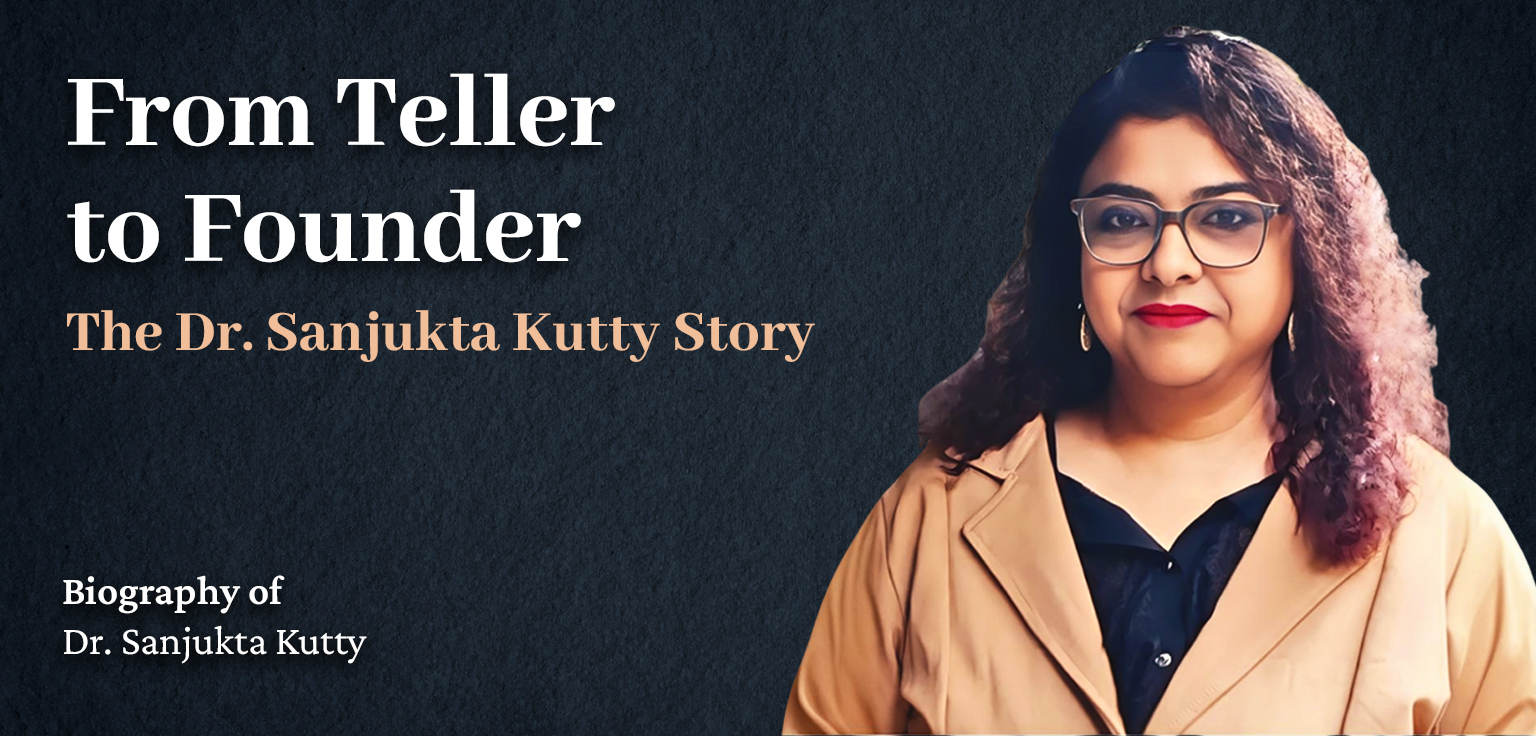
“We are all selling something—our skills, our time, our face value. But the most important thing we can sell is our character, backed by our output.”
Introduction
This simple but deep thought, which Dr. Sanjukta Vinod Kutty had after working for thirty years, sums up who she was. Her story isn’t a straight line up the corporate ladder; it’s a colourful, often surprising journey of a woman who learnt how to turn every setback into a chance to come back stronger. It is a story that shows that strategy can help you build a career, but spirit can help you build a life.
Born into an academically distinguished family in Kolkata, Sanjukta grew up surrounded by intellectual pursuit and scholarly excellence. Her mother, Debrani Bhattacharjee, was a lifelong research scholar who devoted herself to creating linguistic bridges through her work on multi-language dictionaries, including Bengali–Tamil and other cross-language compilations. Her father, the late Mrityunjoy Bhattacharjee, was a renowned Company Secretary whose professional integrity and analytical discipline shaped the intellectual foundation of their household. The family’s legacy of scholarship also extended to her brother, Dr. Dhruvajyoti Bhattacharyaji, a Ph.D. from Jawaharlal Nehru University and a member of the Indian Council of World Affairs (ICWA)—one of India’s premier think tanks on international relations. This deep-rooted culture of academia, inquiry, and multilingual learning defined Sanjukta’s formative years, nurturing both her curiosity and her clarity of thought.
On June 20, 1972, Debrani and the late Mrityunjoy Bhattacharjee welcomed their daughter Sanjukta into the culturally rich city of Kolkata. Her father was a well-known Company Secretary who set a high standard of excellence that was felt in every room of the house. She grew up in a home where intellectual rigour was the norm. But this was balanced by a safe, spoilt childhood, which would later define her as a fierce mind wrapped in a warm, friendly personality. When her father died suddenly in 1994, it was like an earthquake. It was a painful end to one chapter and a harsh push into the next.
What happened next was a series of events that could only be called serendipity, thanks to her mother’s constant support. Her boss at ITC Agribusiness was rude to her, so her mother told her to just walk into a bank and ask for a job. And she did. She didn’t choose Standard Chartered because of its reputation or role; she chose it because its white heritage building was so beautiful. It was a choice made with her heart, not her head, and this would be a theme in her life.
Her first meeting with the bank’s HR was a lesson in how to be brave. She didn’t run away after being turned down because she didn’t have enough experience. Instead, she marched back to demand detailed feedback, saying that if they wanted experienced people, they shouldn’t have put 500 hopefuls through their strict process. The HR head was so impressed by her bravery and refusal to accept “no” without knowing “why” that he made a special paid internship just for her. She didn’t get a letter of appointment to start her banking career; she accepted a challenge.
“The breakfast table was our first boardroom. Companies and their problems were the specials of the day, served alongside the dal and rice.”
Phase 1: The Kolkata Crucible: Forging a Spirit in a House of Ideas

To understand Sanjukta Kutty, one must first travel back to the Kolkata of the 1970s and 80s, a city steeped in intellectual fervour and cultural pride. It was here, in a home that was both a sanctuary and a stimulating classroom, that the foundation of her character was laid. This phase is not merely about her birth and education; it is the story of a unique upbringing that created a woman of formidable intellect and unexpected resilience.
Sanjukta was born on the 20th of June, 1972, into the Bhattacharjee household. Her father, Mrityunjoy Bhattacharjee, was not just a parent but an intellectual giant in her world. A Fellow of the Institute of Company Secretaries of India at a time when the profession was still formalizing its global standards, he was a man who thought in clauses, regulations, and corporate strategy. His work was not confined to an office; it permeated the very fabric of their home life. The breakfast table, a place of familial comfort in most households, was, in the Bhattacharjee home, a vibrant, impromptu boardroom. Young Sanjukta grew up listening to complex business problems being dissected and solved over morning tea. This early, unconscious immersion in the world of high-stakes finance and governance gave her a unique vocabulary and a comfort with complexity that would later become her professional signature.
Her mother, Debrani Bhattacharjee, was more than a scholar—she was a bridge between worlds. A passionate linguist and lifelong researcher, she devoted herself to connecting cultures through language, spending years creating multilingual dictionaries, including one between Bengali and Tamil. For Sanjukta, her mother’s study table was a quiet universe of notebooks, manuscripts, and ideas constantly in motion. The Bhattacharjee home was a place where learning wasn’t an obligation—it was a way of living. Discussions over tea often turned into lessons in history, literature, or science, and curiosity was treated as a family tradition. Her brother, Dr. Dhruvajyoti Bhattacharyaji, carried this same spark into his own path, completing his Ph.D. from Jawaharlal Nehru University and serving with the Indian Council of World Affairs, one of India’s most respected think tanks.
“I didn’t get through. I want to know what I did wrong, so that next time, I don’t repeat it. This is not the last job I’ll be applying for.”
Phase 2 : The Architect of Chance : When Rejection Built a Foundation
The change from the safe halls of academia to the harsh reality of corporate Kolkata could have broken a weaker spirit. After graduating in 1994, Sanjukta learnt a lot about how to bounce back from failure. This showed her belief that setbacks are not stop signs but detours to something better. This part of the story shows how she was determined to make her own way, not by using her privilege but by sheer, unadulterated grit.
The death of her father left a hole in her life, but it also made her feel very responsible. Her first tentative step into the professional world was a contract job at ITC’s Agribusiness Division, where she helped plan the launch of their edible oil. But her regional head’s “typical MCP” attitude, which was rude and dismissive, made the workplace unbearable. It was a harsh lesson in office politics and egos, very different from the meritocratic ideas her family talked about at breakfast. It wasn’t a sign of defeat for her to walk away; it was a sign of respect for herself and a statement that her dignity was non-negotiable.
It was at this point that her mother, Debrani, gave her what seemed like simple advice that would change the course of Sanjukta’s life. She said, “Jake poochhe ke bi,” pointing out that Sanjukta’s commute to ITC took her past the grand headquarters of every major bank in Kolkata’s business district. (Just go and ask them.) This wasn’t a smart career move; it was a mother’s gut feeling that her daughter’s talent would shine if she was given the chance. Sanjukta set out on her unusual job search the next day, with only her certificates and a growing sense of bravery.
She had a unique way of deciding which bank to go to. She didn’t like HSBC because it looked “dingy inside,” and she didn’t like the others either. Then she saw it: a beautiful, white heritage building that used to be the palace of a Badwan Maharaja and is now on a 99-year lease to Standard Chartered Bank. It was royal, it was big, and it spoke to her heart. “That building has a royal feel to it,” she told her mum that night. She didn’t choose based on market reputation or role availability; she chose based on how it made her feel and how it looked.
“You won’t believe it, but this setback with Stan C... it became my fuel. I realized we are all selling something - either our skills, our time, or our character.”
Phase 3 : The Crucible of Service : Finding Purpose in the Customer’s Voice
The paid internship at Standard Chartered Bank was Sanjukta’s foot in the door, but what followed was her real education. The years from 1996 to 1998, spent as an Officer in the Customer Care department of the Credit Cards division, were far more than a first job. This period became the crucible where her theoretical knowledge met the messy, unpredictable reality of human needs and emotions. It was here she discovered that banking wasn’t about numbers; it was about people.
Her workspace was a buzzing hive of telephones and terminals, a frontier in mid-90s Kolkata where the concept of plastic money was still gaining traction. Her role was multifaceted and demanding. Each day began with a cascade of customer queries and complaints that came not as formal letters, but as live, urgent voices over the telephone. She learned to listen not just to words, but to the tones of frustration, confusion, and sometimes, desperation. This was her training ground in empathy, in the art of de-escalation, and in the critical skill of translating complex banking policies into simple, actionable solutions for anxious customers.
But her responsibilities stretched beyond the phone lines. She found herself organizing “service meets” at different corporate offices, a novel concept at the time. Standing before groups of employees, she had to demystify credit cards, explain billing cycles, and sell the very idea of this new financial freedom. This public-facing role honed her natural oratory skills into a professional tool. She learned to read a room, to engage a skeptical audience, and to build trust from a podium.
Back in the office, her duties were equally diverse. She supervised the meticulous collation of Management Information Systems (MIS) reports, understanding for the first time how data drove business decisions. She oversaw the crucial dispatch of thousands of cards and statements, recognizing the immense responsibility that came with handling sensitive customer information. She was also tasked with liaising with existing Merchant Establishments, acting as a bridge between the bank and the shops that accepted their cards.
Note of Thanks
In the telling of any life, the biographer is but a weaver, working with the vibrant threads provided by the subject and those who have walked beside them. Sanjukta Kutty wishes to extend her deepest gratitude to the many hands and hearts that have helped weave the tapestry of her journey.
First and foremost, her thanks flow to her family—the bedrock of her existence. To her husband, Vinod, whose unwavering partnership transformed professional leaps of faith into secure landings, and to her son, Siddharth, whose presence gave every struggle a deeper meaning and whose late-night playtimes redefined her understanding of success. Her mother, Debrani, deserves special acknowledgment; her early challenges were acts of love that forged resilience, and her simple advice to “just go and ask” at the banks set an entire destiny in motion. The memory of her father, Mrityunjoy, continues to be a guiding light, his intellectual legacy the invisible foundation upon which her analytical mind was built.
She also wishes to acknowledge the constellation of mentors and colleagues who saw potential where others saw inexperience. From the HR manager at Standard Chartered who valued “racket” over routine, to the supportive bosses at Centurion Bank and Deutsche Bank who nurtured her curiosity and entrusted her with responsibility—each played a pivotal role in her professional formation. A special thought is reserved for the clients who became comrades, whose trust migrated with her from institution to institution, ultimately forming the cornerstone of her entrepreneurial venture.
Finally, she acknowledges life itself—the greatest teacher. The setbacks, the rejections, and the grueling commutes were not obstacles but essential lessons in disguise. They taught her that our greatest power is our choice of reaction, a philosophy that has become the central theme of her story. This biography is a tribute to that collective journey, a record of a life lifted by love, shaped by challenge, and dedicated to the belief that we are all the architects of our own destiny.
Thank You
– Dr. Sanjukta Vinod Kutty