“The measure of a life well lived is not in the wealth one accumulates, but in the hope, one leaves behind in the hearts of others.”
Dedication
The story of Dr. Raghavendra Amith is not one of privilege handed down or opportunities ready-made—it is a story carved out of resilience, faith, and an unwavering commitment to service. Born on 25th May 1992 in Siruguppa, a modest town in Karnataka’s Ballari district, his life reflects how ordinary beginnings can blossom into extraordinary journeys when rooted in values.
Raised by his parents, Shri Surya Prakash and Smt. Nagaveni, Amith grew up witnessing two powerful examples at home. His father built a business from the ground up through sheer grit and determination, teaching him that dignity comes from perseverance. His mother, at a time when few women dared to dream beyond household boundaries, pursued her graduation by traveling daily to Raichur—becoming one of the first women in her region to do so. From her, Amith inherited the belief that education is not just a personal asset but a social responsibility. Together, his parents gifted him a foundation of discipline, humility, and purpose that became the cornerstones of his life.
What makes Amith’s journey remarkable is not simply his rise in business or the positions he has held, but the values that guided him along the way. At the young age of 22, he was thrust into crisis when his father was hospitalized and a trusted worker betrayed the family business. With no prior knowledge, he stepped in, cleared debts, rebuilt trust, and learned every aspect of the tractor spares industry from mechanics and farmers themselves. From those turbulent years emerged a leader who valued name over gain—someone who believed that honesty, fairness, and integrity were worth more than short-term profit.
Beyond the counter of his shop, Amith’s heart belonged to the community. Whether it was midnight calls to supply tractor spares during sowing season, planting trees across schools and hospitals, organizing blood donation drives, or personally funding felicitation programs for distinction students, he transformed service into a lifelong practice. For him, giving was never about charity—it was about responsibility. His oft-repeated conviction, “No Fundraising, Only Responsibility,” became not just a personal credo but a philosophy of leadership.
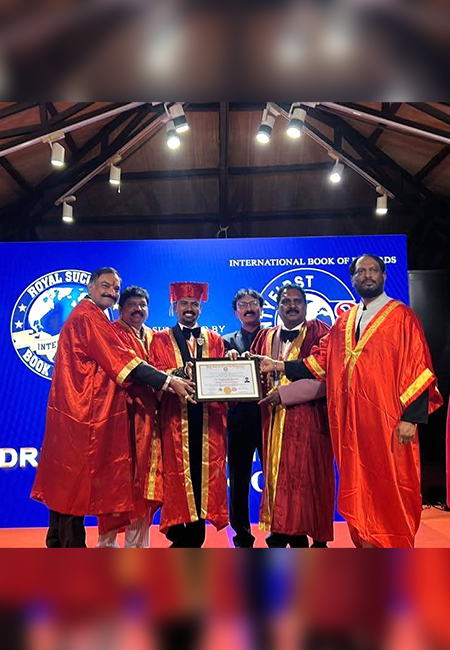
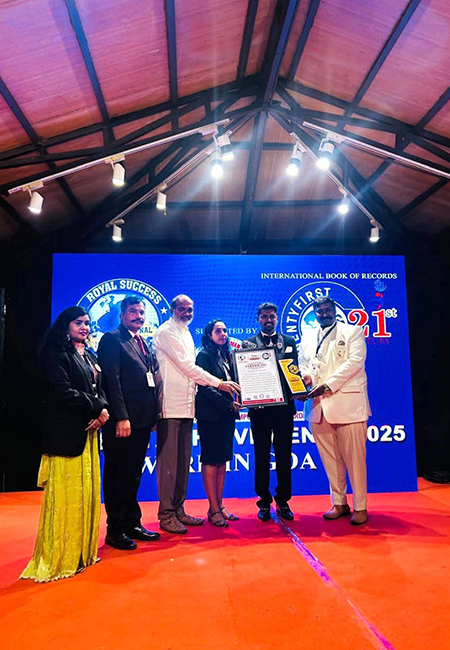
Recognition soon followed. From being honored with multiple awards in the Vasavi Club to being entrusted with state-level responsibilities in the World Arya Vysya Mahasabha, Amith’s leadership proved that age is no barrier when integrity leads the way. His Doctorate in Social Services and the Dream Achievement Award 2025 stand today not only as honors for his work but also as symbols of a life lived for others.
“Greatness is rarely inherited; it is cultivated in silence—through a mother’s perseverance, a father’s integrity, and a child’s promise to make himself useful.”
Phase 1: The Soil of Beginnings: Faith, Family, and First Lessons

Before titles, posts, and public applause, there was a dusty main road in Siruguppa and a boy who learned to read the world through the quiet grammar of work. The town did not promise shortcuts. It offered a different kind of education—one that began at home, continued in temple courtyards, and matured in the rhythm of a small shop where every nut, bolt, and gasket mattered to a farmer’s season. Long before Dr. Raghavendra Amith would be known for statewide responsibilities and public service, he was simply “Amith,” the child who watched goodness done without announcement and effort given without theatre. Those early scenes—his mother’s bus rides, his father’s first invoices, the family’s makeshift ledger of hope—are not background noise to his life; they are the blueprint.
Siruguppa is the sort of place where people recognize your footsteps before they see your face. In the mornings, vendors call out produce by name; by noon, the sun turns tin shutters warm; by evening, temple bells gather everything—trader and teacher, child and elder—into one slow exhale. Amith grew up inside that exhale. From an early age he shared a simple routine with his mother: a stop at the temple to bow before Vasavi Matha, a small prayer whispered more like a promise than a petition, and then on to the tasks of the day. The devotion was not ceremonial; it was formative. To bow was to remember that strength is not loud, and that service, the kind of service that counts, rarely looks like a performance. This would become his lifelong compass: do the right thing when nobody is counting.
If faith was one teacher, perseverance was another, and his mother embodied it with a quiet, undefeated grace. More than four decades earlier—when the idea of a young woman pursuing a degree in many small towns was still met with lifted eyebrows—she chose to study. Each week she would set out from Manvi to Raichur, traveling long stretches by bus for classes, returning home with notes folded neatly, books marked by the steady labor of a mind determined to make room for its own future. There was no hashtag for her courage, no audiences; just the steady punctuation of miles and milestones.
“True education is not measured by grades or degrees, but by the discipline to divide ten rupees with honesty, and the courage to choose reputation over profit.”
Phase 2: The Arithmetic of Integrity: Lessons Beyond the Classroom
The foundations of a life are not always laid in classrooms, though classrooms provide their share of lessons. For Dr. Raghavendra Amith, education was never confined to the four walls of a school or the boundaries of a syllabus. His schooling and graduation years gave him structure and a certain discipline of mind, but his true formation happened at the intersection of books, community engagement, family values, and the internal compass that was steadily pointing toward something greater than personal success. What emerged in these years was not simply a young man pursuing an academic degree; it was the shaping of a worldview, a philosophy of work, and a lifelong ethic: a name is worth more than gain, and reputation is a currency that never depreciates.
As a boy in Siruguppa, Amith walked into school not with a sense of entitlement but with an awareness that every fee paid and every notebook purchased carried the weight of family sacrifice. His father’s shop was still in its formative years, and money was never wasted. Each coin was stretched to cover needs rather than wants, and this taught him early that education was not just a right but also a responsibility.
He did not take school lightly. Lessons were not abstract concepts but possible tools for a future where he might have to hold both his family and his community on his shoulders. Teachers recall him as quiet but alert—someone who listened more than he spoke, but whose questions showed depth when he chose to ask them. Mathematics gave him precision, languages gave him communication, and social sciences gave him perspective. Yet what set him apart was not brilliance in a single subject but a consistency of effort, a refusal to treat anything casually.
Even in those years, community was not something he ignored. If a classmate needed help with homework, he would sit patiently and explain. If a school event required volunteers, he offered without hesitation. These were small gestures, but they hinted at the larger social orientation that would soon define his life.
“Adversity does not break character—it reveals it. In the ashes of betrayal and loss, true integrity rises like steel tempered by fire.”
Phase 3: Forged in Fire: When Crisis Became a Calling
Life often presents its defining examinations not in classrooms or auditoriums but in moments of sudden crisis, where one’s choices must be made without preparation, and strength must be summoned without rehearsal. For Dr. Raghavendra Amith, this crucible arrived at the tender age of twenty-two, when the twin storms of a father’s failing health and a business betrayal collided. What emerged from that trial by fire was not just a young man who survived adversity, but a leader who discovered his resilience, integrity, and courage in the furnace of hardship.
It began with a phone call that no son wishes to receive. His father, the steady hand behind the family’s tractor spares business, had collapsed and was admitted to a hospital in Bengaluru—over 400 kilometers away from their hometown of Siruguppa. The news was devastating. His father had been the anchor of both home and shop, the man whose decisions ensured the family’s livelihood and whose presence provided stability. Suddenly, that anchor seemed to be slipping away.
The young Amith, barely out of graduation and just beginning to explore his path in life, found himself thrust into a world of responsibility that demanded immediate answers. His father’s condition was critical, and long days stretched into nights in the sterile corridors of the hospital. Machines beeped, doctors consulted, and the family prayed, clinging to hope even as the reality of a coma loomed. For Amith, it was not only a test of faith—it was a test of endurance, patience, and emotional strength.
As the family reeled under the weight of this medical crisis, another shock awaited them back in Siruguppa. A trusted shop worker, left in charge of daily operations, had misused the opportunity. Stock was siphoned off, payments were mishandled, and debts piled up. Materials meant for the family shop were diverted to create a competing store nearby. What had been built painstakingly over decades by his father’s sweat and sacrifice was now at the risk of collapse, not because of external competition but because of internal betrayal.
Note of Thanks
In presenting the life and journey of Dr. Raghavendra Amith, I feel deeply privileged to have been entrusted with telling a story that is far greater than words on paper. This biography is not only an account of his achievements but also a reflection of the values, sacrifices, and faith that have shaped him into the leader he is today.
I wish to extend my heartfelt gratitude to Dr. Amith and his family, who opened their hearts and memories with such sincerity. His father’s determination, his mother’s inspiring pursuit of education, and the quiet strength of his wife Sneha Y. and daughters K. Aarna and K. Takshvi gave me an intimate glimpse into the roots of his character. The presence and constant encouragement of his sister K. Shree Lakshmi added a beautiful dimension to this story, reflecting the enduring support that family brings through every chapter of life. Their unwavering support forms the invisible backbone of every milestone described here.
Equally, I acknowledge the farmers, students, teachers, elders, and countless community members who became part of his journey. Their trust in him, and their willingness to walk alongside his vision, offered me invaluable insights into the impact of his service. To the organizations—the Vasavi Club, Yuva Brigade, International Human Rights Council, Arya Vysya Mahasabha, and many others—that gave him platforms to serve, I owe thanks for enabling his growth and leadership.
I also recognize the critics and challenges along the way, for they added depth to this narrative, proving that resilience and sincerity always prevail.
Finally, I thank Vasavi Matha divine blessings that run as a silent thread through this story, guiding his purpose and reminding us that true service is a spiritual calling as much as it is a social responsibility.
This biography, though written with my pen, belongs to every individual who shaped, supported, and believed in Dr. Amith’s path of service.
Thank You
Dr. Raghavendra Amith