
“When the going gets tough, put one foot in front of the other and just keep going. Don’t give up.”
Introduction
Dr. Seema Joshi emerges as a figure of extraordinary resilience and inspiration in the grand tapestry of educators who have shaped lives with their knowledge, commitment, and unwavering sense of duty. She was born on the auspicious occasion of Janmashtami in 1971, and her life has been marked by faith, courage, discipline, and service. She grew up in a family that valued education and public service. Her father, Mr. Ram Prasad, was a district officer, and her grandfather was from Jodhpur, Rajasthan, a Member of Legislative Assembly (MLA). Dr. Seema grew up in a big family with eight sisters. Opportunities were limited, expectations were fixed by patriarchal norms, and girls were not encouraged to break traditional boundaries. Yet, she dared to dream and create her own journey, making education her vocation and mission.
Dr. Seema Joshi’s story starts in the early 1990s, when she started teaching at the remarkably young age of 21. She got her first job as the only woman in the company in 1990, in a society where female professionals were often viewed with doubt and skepticism. Indian society’s patriarchal norms made it extremely difficult for her to be respected by her colleagues. She was mocked, harassed, and humiliated. Many had even predicted that she would not stay in the profession for a long time. Some of her colleagues mocked her determination and strong presence, even calling her “Hitler” and “MIG-21.” Yet, her resilience was her defining trait.
Dr. Seema did not attend school for her colleagues or staff—she went in search of her pupils. They, her anchor, and her extended family became her reason to fight. Her students showed her respect and affection, unlike her colleagues who tried to demean her. Her depth of knowledge, her clarity in teaching, and her ability to inspire them to achieve higher goals were all things they appreciated. Her classroom soon became a place of learning, love, and discipline. Over decades, she would mentor dozens of doctors, IAS and RAS officers, and professionals in various fields, and each of them would carry forward the values they imbibed under her guidance. Thirty to thirty-five doctors, two IAS officers, and many successful RAS officers are among her most successful students. One of her students also became the DRM in Indian Railways, Bengaluru.
Dr. Seema has never seen teaching as just a job. It has been a duty of service. She has frequently stated that she went to her school to stand by her students rather than impress her staff or administration. Her entire life has been centered around this sacred teacher-student relationship, which she values above all accolades, recognition, or material success. Dr. Seema has never charged a single rupee for imparting knowledge, unlike many others in the education sector. She has dedicated 31 years of her life to free education, making sure that lack of resources or poverty never stopped a child from learning.
Her philosophy is simple but deep: “My students are my life.” She has never sought fame or material recognition, and she has never paid for honors or promoted herself. Her ultimate reward is to see her students succeed in life. She has not only taught chemistry to IAS and RAS aspirants, but she has also given motivational classes and competitive exam training and enabled many young people to take leadership roles. She is generous beyond the classroom—she pays talented but underprivileged children’s fees with one percent of her income. She goes further by awarding scholarships and cash prizes to her students on events like Teacher’s Day: ₹11,000 for academic achievers, ₹2,100 for toppers, and comparable sums for those excelling in extracurricular activities.
“It takes courage to grow up and become who you really are”
PHASE 1: A Childhood Based on Dreams, Discipline, and Simplicity
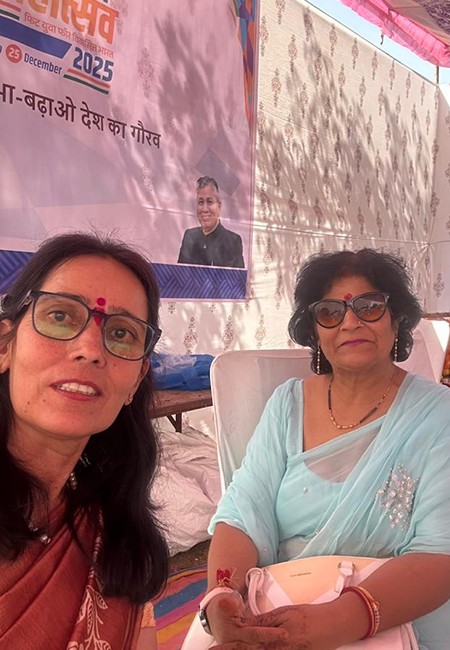
Dr. Seema Joshi’s childhood story begins on the auspicious day of Janmashtami in 1971. Born on Lord Krishna’s birthday, her life—much like Krishna’s—would come to be defined by resilience, courage, and a quiet determination to challenge social norms.
Dr. Seema grew up in a respected family in Jodhpur, Rajasthan, where daily life was shaped by tradition, discipline, and service to society. Her father, Mr. Ram Prasad, served as a District Officer (DO), known widely for his integrity and unwavering principles. Her grandfather had once represented the people of Jodhpur as a Member of the Legislative Assembly (MLA). The family carried a sense of pride and honour, but this also came with immense expectations, responsibilities, and the subtle yet powerful influence of patriarchal values that dominated India in the 1970s and 1980s.
She was one of eight sisters, raised with affection but also with the unspoken limitations that society often placed on girls. In those times, a household blessed with many daughters was viewed with both admiration and concern—their futures required careful protection according to traditional norms. While her father believed strongly in education, he was hesitant about his daughters travelling far or pursuing careers that demanded independence.
Growing up in this environment deeply shaped young Seema. She learned discipline, respect, and unity from her family, but she also became aware of the quiet restrictions surrounding girls. She noticed early on that her world was different from that of boys—freedom was limited, choices were narrow, and voices often went unheard. Yet Seema was not one to accept these boundaries without question. She was born with a courageous spirit and an unquenchable thirst for learning.
Her parents embodied two contrasting but complementary influences. Her father represented order, structure, and authority; her mother embodied compassion, warmth, and unconditional love.
“Strength and growth come only through continuous effort and struggle.”
PHASE 2: Early Career Struggles
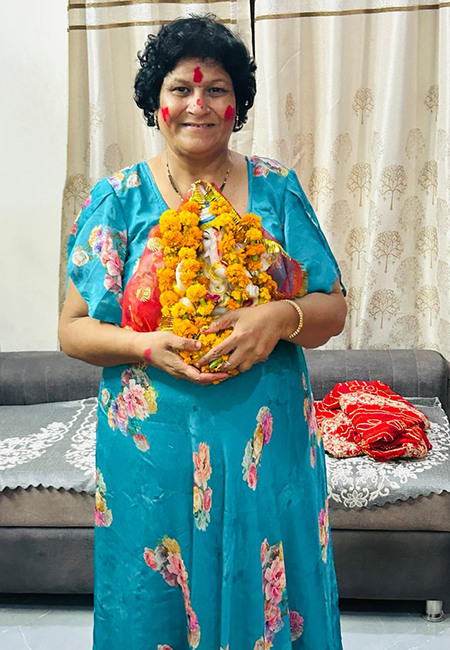
In 1990, Dr. Seema Joshi embarked on a journey that would forever alter the trajectory of her life. Dr. Seema started her first career as a teacher at the young age of 21, when the majority of young women in her generation were still being urged to consider marriage and household responsibilities. In a time when society did not trust women as professionals, especially when it came to teaching science courses like chemistry, it was a brave and daring move for a young woman.
However, this fresh start was not at all simple.
Dr. Seema brought a bundle of anxious excitement and youthful resolve with her when she first arrived at school. With its rows of eager faces, young minds ready to learn, and the scent of chalk dust that seemed to be the fragrance of possibility, the classroom felt like home. However, there was a hard reality outside the classroom.
At her job, she was the sole female educator. The rest of the staff, who were mostly men, did not embrace her. She encountered doubt, derision, and occasionally outright harassment instead of support. The notion of a young woman teaching chemistry—a subject viewed by many of her colleagues as challenging, demanding, and “unsuitable” for women—was unimaginable. Some publicly made fun of her and said she would resign in a few months. “She should be in the kitchen, not in front of a blackboard,” others whispered.
Patriarchal ideals were still prevalent in the 1990s. Women were frequently denigrated for daring to forge their own identities. Dr. Seema saw her job as a battleground where she had to demonstrate her value each and every day. She did not, however, fall apart. Her tenacity sprang from a straightforward yet profound belief: she was there for her students, not for her coworkers.
“A mentor is someone who allows you to see the hope inside yourself.”
PHASE 3: The Development of a Mentor and the Years of Acclaim

A new chapter in Dr. Seema Joshi’s life and profession began at the turn of the millennium. Remarkably resilient, she stepped into the 2000s after enduring the relentless hardships of the 1990s—personal suffering, professional harassment, and the ongoing struggle of being a woman in a male-dominated workplace. Instead of breaking her, these challenges shaped her into a strong woman, a determined educator, and a mentor whose classroom nurtured not only academics but also character, discipline, and inspiration.
The years 2000–2010 marked a period of recognition, growth, and consolidation. While the 1990s had been years of survival and fire, the 2000s became her years of ascent—her efforts started to bear fruit, her students excelled in multiple fields, and society gradually began recognizing the remarkable impact of her work.
One of the defining moments of this decade came in 2002 when she received the Creative Teacher Award. For years, Dr. Seema had worked tirelessly, often without appreciation from superiors or colleagues. She never sought awards; her true satisfaction came from watching her students succeed. Yet this recognition mattered—not because it elevated her personally, but because it validated her innovative, student-focused approach to teaching.
Her creative methods of simplifying chemistry, making it accessible and enjoyable, stood out. She treated the subject as a living science connected to everyday life, not merely a collection of formulas. Her ability to demystify complex concepts earned her deep admiration and lasting loyalty from her students.
By this time, Dr. Seema had already been offering free education for more than a decade. “I don’t teach for certificates; I teach for my children,” she often said, even as the award brought her work into greater public attention.
Note of Thanks
Gratitude has always been the cornerstone of Dr. Seema Joshi’s life. To her, every achievement, every recognition, and every success story of her students has been less a personal triumph and more a collective blessing shaped by countless individuals, circumstances, and divine grace. As she reflects on her journey, she acknowledges that her story is not hers alone—it is woven together by the support, sacrifices, and love of many.
First and foremost, Dr. Seema bows in deepest reverence to her parents. Her father, Mr. Ram Prasad, whose values of honesty, service, and commitment to education became the guiding force of her life, remains her eternal inspiration. The establishment of Shri Ram Shikshan Sansthan in his name was not merely an act of remembrance but a way to continue his legacy of selfless service. Her mother, whose unwavering care never allowed her to shoulder the burdens of household chores, taught her that women could dream beyond the confines of kitchens. Their encouragement, discipline, and sacrifices were the foundation upon which she built her life.
Her siblings—eight sisters in all—and the shared discipline of their upbringing also deserve heartfelt gratitude. Growing up in a family where education was prioritized, each sister carved her own path into government service. This collective strength reminded Seema that women could achieve as much as men, even in a deeply patriarchal society.
She also remembers her grandfather, a respected MLA from Jodhpur, who instilled in her a strong sense of responsibility toward society. His public service, combined with her father’s disciplined leadership as a DO, shaped her conviction that education must never remain a privilege but should reach every child who dares to dream.
To her teachers and professors, Dr. Seema offers profound thanks. It was her college professor who first recognized her brilliance in organic chemistry, encouraging her to pursue a lectureship after she scored an exceptional 48 out of 50 in the subject. Though circumstances did not allow her to follow that path at the time, his belief in her abilities planted a seed of confidence that flourished throughout her career. Every mentor who guided her through academics, debates, NSS camps, and sports contributed to the multifaceted personality she is today.
Above all, Dr. Seema owes her deepest gratitude to her students. They are, as she affectionately calls them, her “true awards.” From the classroom benches of the 1990s to today’s IAS and RAS aspirants, her students have stood by her as pillars of strength. They respected her when colleagues mocked her, supported her when the system tried to break her spirit, and prayed for her when she yearned for motherhood. The yagya they organized, which was followed by the birth of her first child after twelve long years, remains one of the most sacred and emotional chapters of her life.
Thanks
Dr. Seema Joshi