
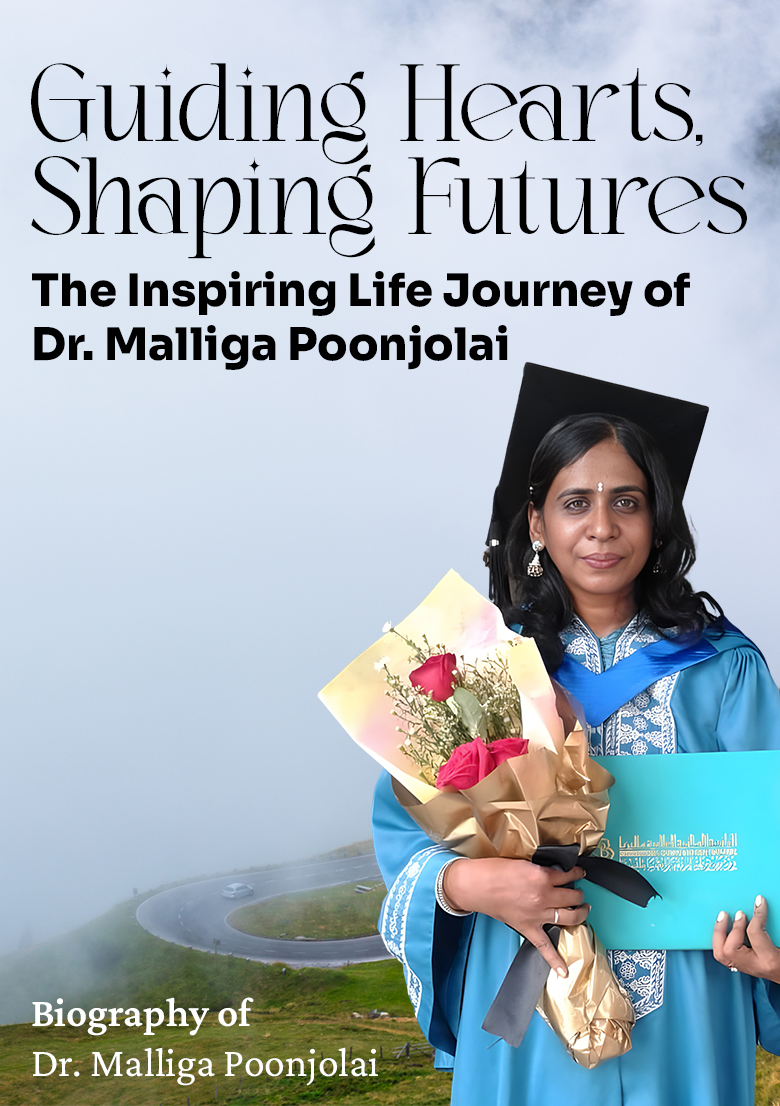
“The good life is a process, not a state of being. It is a direction, not a destination.”
Dedication
I dedicate this biography to the individuals who quietly laid the groundwork for my life, even before I was aware of my future path.
First, I dedicate this work to my late father, Poonjolai, son of Mariappan, whose strength, wisdom, and sacrifice laid the foundation for my life. His example of hard work and resilience continues to inspire me.
To my mother, Saroja, daughter of Seenivasan, whose warmth, patience, and dedication created a home filled with love. Her steady presence and care have always been a guiding light in my life.
To my brothers, Late Nedumananchi, Dr. Maniarasu, and Mr. Rajenthiran, whose love and guidance have been a source of support and strength throughout my journey.
To my sisters, Mr. & Mrs. Thamilarasi and Mrs. Manimegalai, whose care and encouragement have always been pillars of support.
Lastly, I extend my heartfelt gratitude to my beloved husband, Mr. Shalendran, son of Amirthalingam, whose love, patience, and unwavering support have been the foundation of our family. He plays a crucial role in our marriage, providing emotional support, financial responsibility, and shared decision-making.He has been a protector, a role model, and an ever-present source of strength. His ability to keep romance alive, his patience, and his calm nature have enriched our family in ways that words cannot express.This work is a reflection of the love and guidance I have received from each of you. Thank you for always being there.
“Children are great imitators, so give them something great to imitate.”
PHASE 1: Roots Of Warmth: A Childhood Of Care And Curiosity
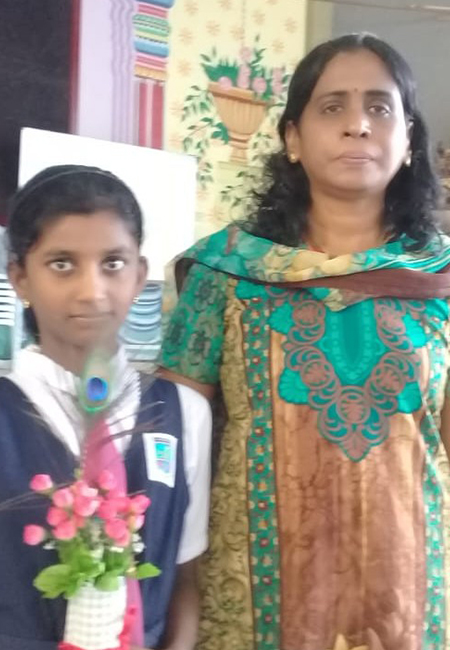
Warm hues, soft noises, and familiar scents evoke my earliest recollections. Even now, when I close myeyes, I can almost smell my mom’s cooking as the gentle morning light filters into our home. The day had officially started with the sound of cooking utensils clattering. The cadence of her movements, slow yet deliberate, would often lull me to sleep before I joined my family in the living room to start the day.
There were advantages and disadvantages to being the youngest child. The five of us—three brothers and two sisters—were more active in our daily lives, made more noise, and were older. Within our shared house, they had their lives—their own friends, their own routines. As a child, I preferred to sit on the sidelines and watch rather than be a part of anything. As a child, I witnessed my siblings bicker, laugh, and even cry. I listened as they returned from school, filled with tales of instructors, tests, and new acquaintances. As I looked on, they would lend a hand to my mom with household tasks or run errands for my dad. Life was teaching me lessons all the while, and I didn’t even know it.
Although our home lacked in opulence, it abounded in a far more precious commodity—security. A constant in my life was my father, a businessman. His calm demeanour and immaculately ironed clothing betrayed his methodical outlook on life, and he left bright and early in the morning. His serene earnestness and dignity made him trustworthy rather than remote. Long lectures on self-control and perseverance do not seem to have been his style. He was unnecessary. He taught us a lot just by being himself. The profound lesson that responsibility is something to live by was with him when he arrived late at night, exhausted but composed.
In her own unique way, my mother was the focal point of our household. Her gentle nature contrasted with my father’s rigidity. She could calm others simply by speaking softly. She had an intimate understanding of our individual tastes, emotional states, and secret anxieties. She seemed to know when we were upset about something long before we said a word. She listened attentively, cleaned meticulously, and prepared with tender loving care. Strength, I realised through her, does not necessarily yell but rather murmurs with deep gentleness at times.
“In the middle of difficulty lie opportunity.”
PHASE 2: When My World Changed: Loss, Grief, And New Resolve
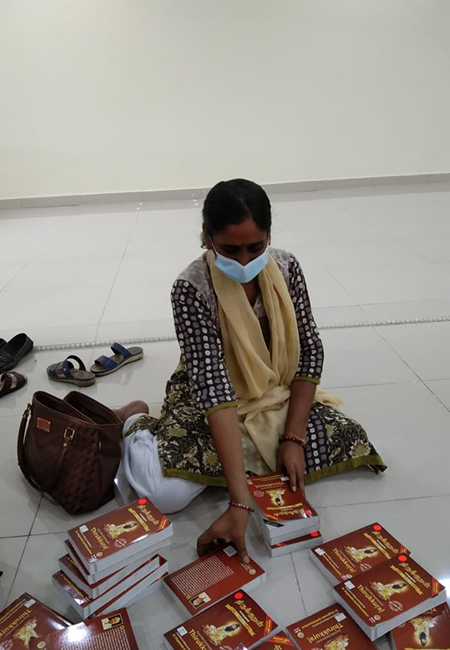
Every aspect of life can be divided into a “before” and an “after” at certain points. The death of my father while I was a fifth grader was the turning point in my life. Decades have gone by since that day, but I can still feel its impact, like a bruise that has faded in colour but hurts when I think about it.
My life had been steady and predictable up until my dad passed away. I grew up in a house where there were many familiar rituals: my mom’s cooking in the mornings, my siblings getting ready for school, and my dad’s footsteps as he got ready for work. Although my world was tiny, it was safe. In that innocent, wordless manner that kids have, I thought things would stay the same forever. However, life does not always meet our expectations.
It was surreal on the day my dad passed away. For some reason, bewilderment stands out in my memory. Whispers were heard. Over time, neighbours disappeared. As the house filled up, I experienced an unusual sense of solitude. I had never seen such raw, intense, and unmistakable anguish on my mother’s face. Even my elder siblings appeared as taken aback as I was. One of them went into an oddly silent state, while the other was fidgety and kept running about the house like a lost puppy.
My life had changed irrevocably, yet I was still too young to comprehend death in its entirety. The foundation upon which our family stood was my father. Even though he was a quiet man, his presence was reassuring. After he left, it felt like our boat was adrift, severed from its moorings.
Adolescent grief is unique. It comes in instalments. It develops gradually, alternating between a state of numbness and an abrupt, unanticipated pain. Going to class and attempting to concentrate on my workmade me feel weirdly normal on some days. There were days when it was like an unseen weight was squeezing my chest, making it difficult to breathe and clouding my thinking.
“A good teacher can inspire hope, ignite the imagination, and instil a love of learning.”
PHASE 3: Chalk And Classroom: My Early Teaching Years
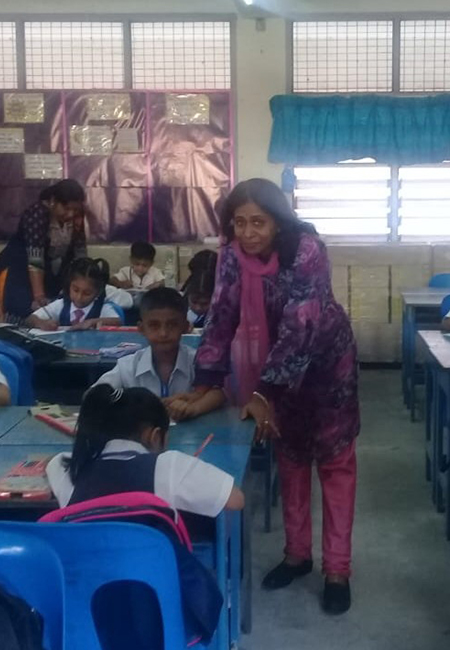
Occasionally we enter certain doors in life without fully comprehending the significance they will later hold. I saw a door similar to this when I walked into my first classroom. I entered the teaching profession because it seemed like the most logical choice after my father passed away, but I remained there because I felt a deep connection and a sense of belonging. Looking back, I can see that my identity as a teacher (and later a counsellor) was firmly established during those formative years spent holding chalk and facing rows of eager faces.
The day I was a substitute teacher and stood before my first class is one that I will never forget. The occasion lacked grandeur. Nobody spoke, nobody applauded, and there was no formality. For all but me, it was a subtle turning point; for everyone else, it was just another school day.
I could almost smell the chalk dust as I stepped into the room, along with the worn wooden tables and the eager anticipation of the children as they were about to meet their new teacher. The kids sat there, looking at me with a mix of wonder and wary amusement. While some straightened their bodies and whispered to their pals, others persisted in their appearing to be oblivious as they continued to fiddle with their books. Underneath the growing anxiety, I could feel a flutter of anticipation.
I set my textbooks on the teacher’s table, took up a chalk, and signed my name to the board. It was wonderful that such a little object could capture the interest of a whole room, yet the chalk had a delicate yet powerful feel about it. The entire class had become silent by the time I turned around. As I stood there, thirty sets of eyes watched me patiently. And it was then that it hit me: becoming a teacher meant taking responsibility—not for theoretical concepts, but for the actual brains and emotions of the kids in my class.
Note of Thanks
When I reflect on my journey, I am incredibly grateful to everyone who has been there for me—those who have travelled the path, provided guidance, offered support, and believed in me. My loved ones, whose unconditional support has always been there for me, deserve my deepest gratitude. Their kindness, empathy, and support have helped me more than words can convey.
The people who saw potential in me and helped pave the way for my success—my instructors, mentors, coworkers, and principals—have my deepest gratitude. I owe my self-assurance and sense of direction to the faith they had in me.
You are my best teachers, my brave students who have confided in me over the years. I learnt the most profound lessons about patience, humanity, and compassion from your honesty, resilience, and spirit. It means a lot that you have put your faith in me to listen to your worries, dreams, and realities.
I also greatly appreciate the communities and parents who believed in the need for guidance and understanding and collaborated with me.
I am deeply grateful to the universe for providing me with opportunities for growth, trials that tested my resilience, and lessons that illuminated my path.
For the blessing that is this trip, I am eternally grateful.
Thanks
Dr. Malliga Poonjolai