“The best way to find yourself is to lose yourself in the service of others.”
Introduction
Dr. Ashmead Jamil Ali starts his day before the first light of dawn; as the world is still encapsulated in silence, he purposes himself to gain control and emerge victoriously in various aspects his life entails. To Dr. Ali, achieving supremacy during these bloody hours can spur unparalleled productivity throughout the day. His meticulous blueprint alongside diverse projects ranging from construction, alongside humanitarian endeavors aimed to assist disadvantaged students, mosques, and schools, outlined strategies to face various day-time challenges—and as the deactivated blueprints emerged, synergy was ready to unleash at full speed. We, as sane beings, should grab the opportunity to seize the day, for it brings with it countless possibilities.
Ali’s life is characterized by milestones showcasing his professional and humanitarian activities. While studying abroad in London, he undertook the dual certifications of an ACCA and CIMA accountant which fueled his entrepreneurial spirit upon returning to Trinidad. Dr. Ali set up Ashmead Ali & Associates, a firm providing accounting, auditing and consultancy services to local entrepreneurs. Subsequently, he founded Ashmead Ali Contracting Services Ltd., moving out of the office to supervise multi-million-dollar civil works contracts across the Caribbean. Dr. Ali, who also owns several properties under the names of Coral Gate, Island Hope, Nosron and Ashmead Ali Contracting Services Ltd demonstrates unparalleled diligence and precision in his strategic investments and spending.
However, all these factors only portray half the story. Dr. Ali is also known for co-founding the AshNad Foundation with a philanthropic agenda. This foundation has built over fifty homes for impoverished families and, on his fifty-second birthday, had achieved much more. During the devastation of Dominica by Hurricane Maria in 2017, he executed the delivery of two thousand tons of food, water, and building supplies to an island in crisis. It is these acts of kindness combined with thoughtful and strategic planning that enable him to provide for those in desperate need.
These three themes capture the essence of Dr. Ali’s life: Faith and values that recall the ethics of Islam with Zakat. He aspires to be truthful and honest in all dealings. Tahir Ali, his father, still independent at ninety-four, taught him self-reliance. His mother, Amiran Ali, gave him a deep sense of service. He was arguably most emblematic is his predawn balancing act of blueprints and appeal letters that occur long before the rest of the world stirs. Every business or charitable endeavour to him is an “inverted pyramid” that has step-by-step logistical plans pre-mapped, from the construction crew to the charitable shipment timing. His impacted is far greater than profit or the wonders of construction. Dr. Ali is best known for nurturing young professionals, whom he urges to embrace: ‘Be good human beings first and skilled professionals later.’
“Family is not an important thing—it’s everything.”
Phase 1: EARLY LIFE & FAMILY BACKGROUND Childhood Roots (1966–Early 1980s)

Dr. Ashmead Jamil Ali is the youngest of three siblings and was born on March 18, 1966 on the island of Trinidad in the West Indies. His birth serves as an almost 180-year-old Indian family journey, which begins as indentured workers in the Caribbean and sugar cane fields. Somewhere along his family’s journey, they faced hardships while shifting to different lands. Their story is an inspiration and marks the family’s emergence from a Frugal lifestyle to a richer life filled with hope, opportunities, and strength.
Ashmead grew up in an incredibly hard-working and ethical household. His father worked as a welder and then foreman for an oil company, leading to the family’s financial struggles easing. Even at the age of 94, his father is proudly totally self-sufficient. His drive showcased an insane amount of hard work and hope, along with imprinting a deep belief. Ashmead was inspired by the amount of work his father put in to help the family and truly believe in chasing your purpose regardless of age.
Amiran Ali, Ashmead’s mother, had to sacrifice her educational goals in order to tend to her family. She was a passionate reader and ensured that Ashmead read by force. One story that Ashmead recounts frequently include his mother pushing him to read great literature like To Kill a Mockingbird, even when he exclaimed, “I don’t understand.” Her enforcement of reading not only enhanced his vocabulary but also instilled an appreciation for narratives, cultural diversity, and empathy.
Being the youngest in the family. Ashmead was raised with older siblings who guided him, each of whom had successful careers of their own. His elder brother, six years older than him, became a Doctor, specializing in the fields of gynecologist and obstetrician. Ashmead learned to respect the technical side of compassion for patients through his brother accessing them during long hospital hours. His sister, four years older, went into teaching and later became the head of an accounting school. The claimed value of mentorship, discipline, and lifelong learning came for Ashmead when he watched her lead these young aspiring accountants.
“Education is the most powerful weapon which you can use to change the world.”
Phase 2: EDUCATION & FORMATIVE YEARS
When he was five years old, Ashmead started his formal schooling at a local primary school, where he encountered English, Mathematics, and Social Studies classes that built upon his family’s tutelage. His mother prepared him well by reading to him, and he managed to achieve remarkable feats as he started reciting passages from children’s literature by the end of the first grade. Teachers also noticed his self-discipline, something he was heard to boastfully prattle about, which stemmed from the mother’s late-night ritual of forcing him to complete all reading, cursive handwriting exercises, and dictation assignments.
Ashmead also made a remarkable contribution to extracurriculars. In primary school, he was enrolled in a debating club, and after some initial shyness learned to speak clearly. By the time he turned 11, he was chosen for the position of prefect, where he acted as a liaison between the students and teachers. This role facilitated the development of his still very much developing leadership style based on service, building empathy towards others, and respectful respect towards other people’s opinions and views.
English literature classes at secondary school (ages eleven to sixteen) were a stepping stone for Ashmead as they built upon his mother’s influence and included widening his reading list to include classics like Shakespeare’s Romeo and Juliet and Jane Austen’s Pride and Prejudice. He also developed an inspiration for characters and their moral dilemmas. Ashmead also displayed mentorship skills when he oftentimes stayed after school to help his classmates with essays. He was known for his discipline which included being on time, his elaborate note/book organization and community service such as volunteer work around school clean up, indicative of a selfless youth
At the age of 17, Ashmead shifted to a more prestigious local college where he undertook A-Levels in Geography, Mathematics, Economics and English literature. He was quick to adapt and sat in leadership positions along the way.
Ashmead completed his A-Levels with passes in Mathematics, Economics, Geography and English Language in 1985, by age eighteen. Although there were local scholarship opportunities in his areas of interest, he wanted to obtain a professional accounting qualifications overseas, because he regarded experiencing a global financial centre as being more beneficial for Trinidad’s nascent economy when he returned home.
In 1984, at the tender age of eighteen, Ashmead set off on a transatlantic flight to London as he intended to further his studies at Emile Woolf Colleges in Holborn. The school provided an ACCA (Association of Chartered Certified Accountants) Foundation and CIMA (Chartered Institute of Management Accountants) syllabus which he deemed would be valuable assets in both the United Kingdom and Trinidad. For Ashmead, adapting to the Caribbean’s lethargic lifestyle and London’s pace was jarring to say the least. The first impression of the city’s grey skies and rush hour blaring with the singing carousel on street, and strangers briskly walking like sphinxes on fire in crosswalks felt poles apart from Carnival celebrations. However, Ashmead sunk his teeth into the books, diligently getting up at 6 a.m. for lectures on financial reporting, mastering the art of management accounting, and tax wizardry.
“The only way to do great work is to love what you do.”
Phase 3: RETURN TO TRINIDAD & EARLY PROFESSIONAL FORMATION
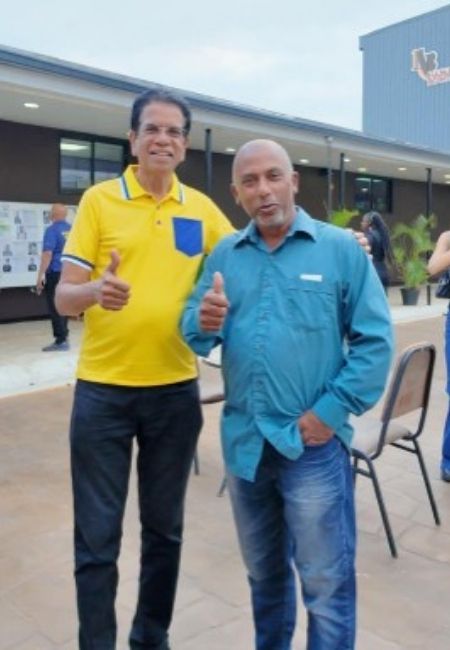
When Dr. Ashmead Jamil Ali returned to Trinidad in mid-1993 after a trip to London, he became aware of glaring deficits with regard to professional education operating in Trinidad. The middle-class families aspiring for professional accountancy certifications through the ACCA, CIMA, and other denominational college certifications based in the UK were financially strained owing to the exorbitant tuition fees, examination fees, and living expenses that exceeded their means. This, as Dr. Ali noted, could have been solved through creative alternatives that could work through the borders of the country, and accessible locally would be programs emulating the workouts and syllabi of Emile Woolf Colleges in London.
In order to realize these dreams, Dr. Ali’s small team consisted of a few colleagues he met during his studies in the UK, who were UK-trained educators and willing to periodically fly in for short courses on teaching modules for advanced financial reporting, management accounting, taxation, and business ethics. With the vision in mind, Dr. Ali obtained classroom space on the island, negotiated subsidized accommodation for the instructors, and coursed local printing companies to create materials that copied the content of the syllabuses curricula to augment the advanced curriculum.
Dr. Ali’s task was to carve out a Caribbean syllabus by integrating Caribbean examples of tax regimens, currency customs, and case studies about Trinidadian firms into each synchronous subject areas. The examinations comprised of multiple-choice questions, written and defended case studies, and oral presentations, which remained as challenging as before. Students undertook classes in ‘single’ module stratified cohorts so that they could be progressively advanced from lower level to higher level subjects. The logistical problem areas across the whole region of the program’s flagship academic teaching unit in the first year was entirely operational. Dr. Ali had to spend a lot of time calculating budgets for his paying of lecturers after their visit since managing exchange rates was such an issue for the school.
Note of Thanks
The life of Dr. Ali is a beautiful illustration of universal principles that are not limited by national boundaries or cultural norms. His predawn planning meetings, in which he quietly sits under lamplight, charting budgets for community facilities and organising timeframes for property expansions, are a clear indication of his unwavering dedication and hard work. These sessions take place well before most people start their day. His actions speak just as loudly as his words; the completion of fifty homes for families who are struggling by the time he turned fifty years old and the delivery of over two thousand tons of relief supplies to Dominica are both examples of his profound sense of compassion and service. These actions demonstrate that compassionate actions, when combined with strategic execution, have the potential to elevate entire communities. Dr. Ali’s unshakeable faith and thankfulness serve as the foundation for his unwavering commitment to the five daily prayers. He also ensures that his Zakat contributions are transparent, allowing his spiritual discipline to direct his philanthropic acts. His life also exemplifies the power of vision and planning, since he has been responsible for creating an accounting technician school and coordinating huge construction projects that involve multiple islands. Each of these endeavours is supported by his methodical approach. Even his daily habits, such as going for a five-kilometer run around Queen’s Park Savannah in the morning before board meetings, are manifestations of his dedication to maintaining physical discipline, mental clarity, and leadership. Each house that was constructed using galvanized blocks and pitched roofs serves not only as a place to sleep, but also as a memorial to the coordinated efforts of volunteers and Dr. Ali’s insistence that every family be treated with dignity. This is more evidence that impact is the result of integrity, planning, and a sincere desire to make a difference. With the onset of the Caribbean Sea sunrise, Dr. Ali’s expedition keeps on being an inspiration, even outside of the biography’s written pages. The man has faith, puts in the work consistently, and has a kind heart, all of which has profoundly transformed communities and improved tremendously people’s lives. However, his story remains incomplete – scholarship after scholarship, homes after home, and so many lives being empowered, his legacy deepens. To all readers, we say this: his vision should be followed where it has shown and will show purpose, struck with unmoving integrity, and, attitudinally, with meekness, it will garner the meaningful impact we wish to have. Because then Dr. Ashmead Jamil Ali’s efforts, as we see, shall blossom in every soul and through all the waters, fueling considerable hope for the future.
Thanks
Dr. Ashmead Jamil Ali