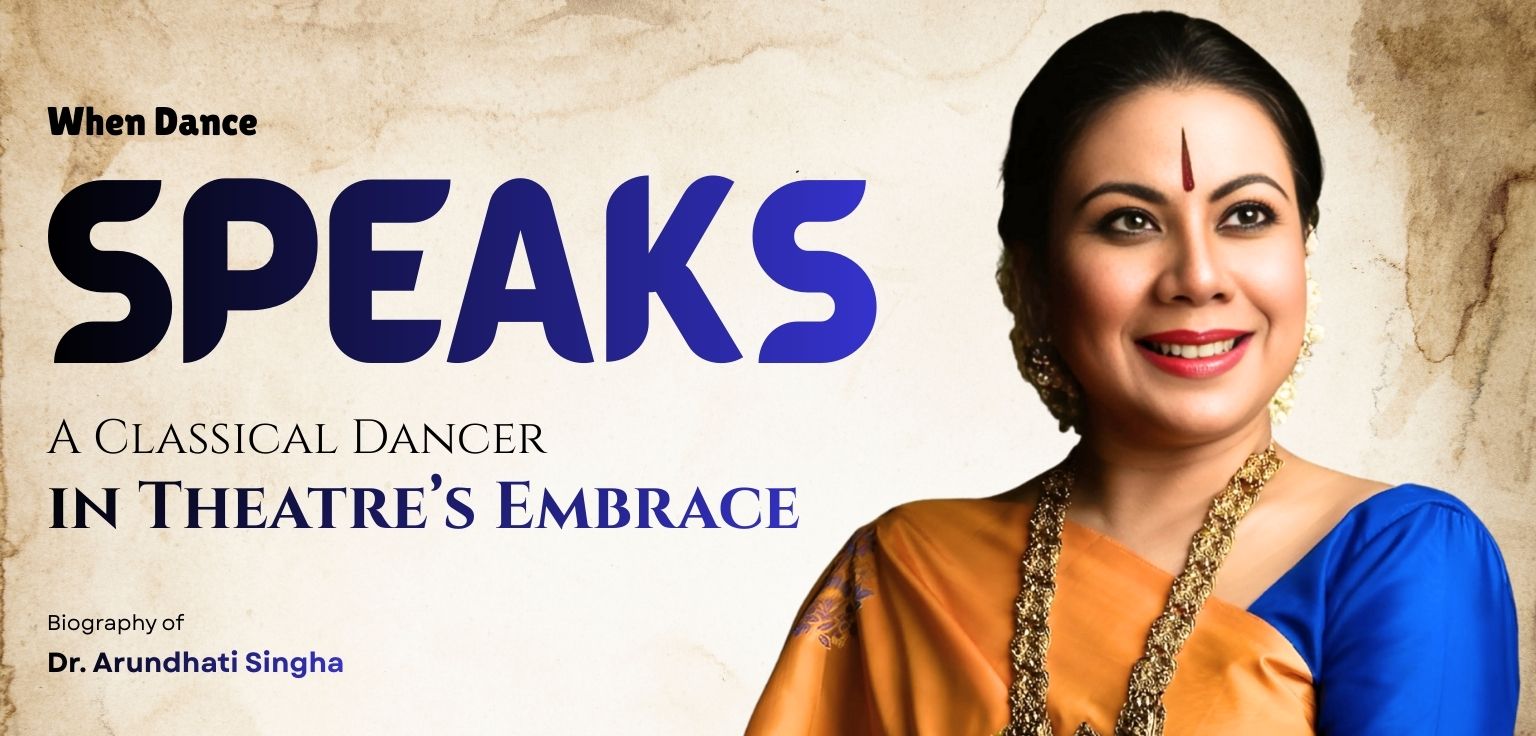
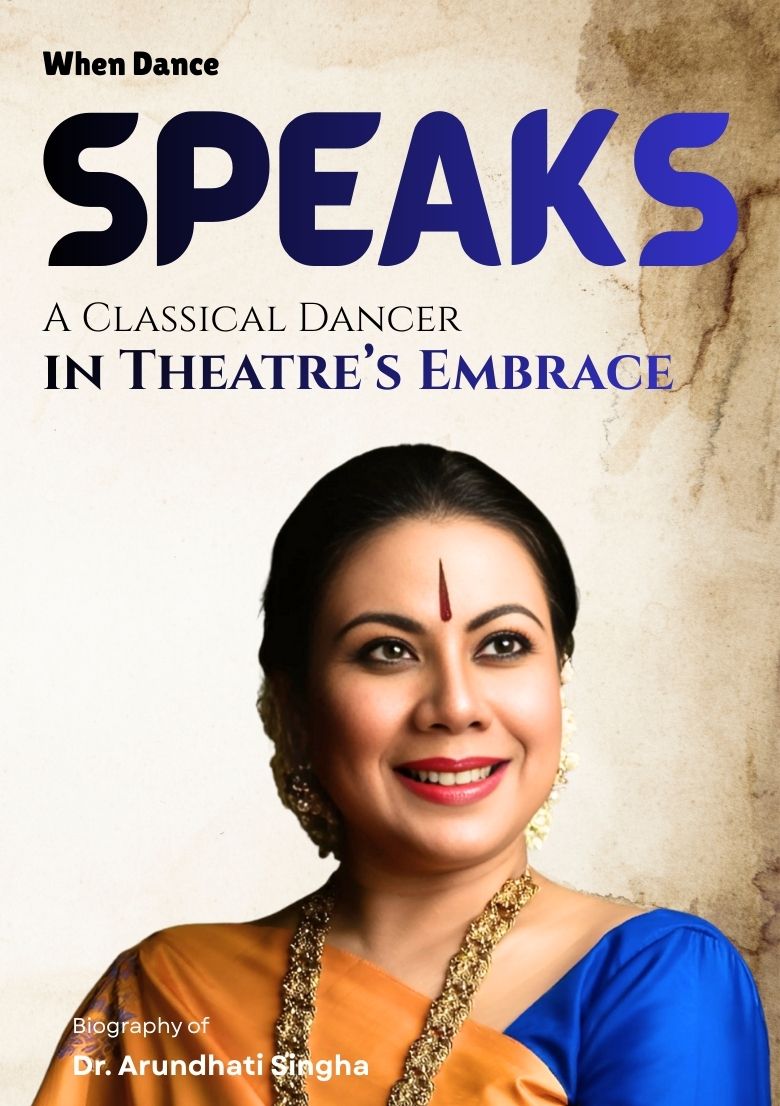
“Dance is the timeless interpretation of life.”
Introduction
In a world that often celebrates speed over depth and spectacle over substance, there are a few individuals whose life work gently reminds us of something greater—something sacred. Dr. Arundhati Singha is one such individual. Her story is not just about mastering the ancient art of Bharatanatyam—it is about embodying it. Through each mudra, each movement, and every breath, she has brought to life the centuries-old spirit of Indian classical dance while courageously shaping it to speak to a new world.
This biography invites you into the heart of a journey that began in the vibrant state of Assam—a land of rich cultural rhythms, yet far from the traditional centers of Bharatanatyam. From this unlikely starting point, a little girl began her dance at the age of four when she started learning Manipuri. She went on to complete her Visharad course in Manipuri, performing in national competitions as a junior artist. Her Bharatanatyam training began later in Guwahati, which she pursued until Grade 6, before leaving home at the age of 12 to join Kalakshetra.
What started as passion soon transformed into purpose, and then into destiny. Her path was never predictable, and certainly not easy, but it was always purposeful. From Assam to Chennai, from Ahmedabad to Kuwait, from small rehearsal rooms to global stages—each chapter of her life has been a performance of its own, filled with grace, grit, and growth.
The story of Dr. Singha is one of extraordinary resilience. Leaving home at twelve, navigating the pressures of hostel life, enduring loneliness, and overcoming cultural skepticism—she did it all for one reason: her unshakable love for dance. In Kalakshetra, she found her spiritual and artistic anchor. At Darpana Academy in Ahmedabad, she collaborated with artists including Late Smt. Mrinalini and Smt. Mallika Sarabhai, and found a platform where her wings could unfurl. She learned not only to move but to move others—to tell stories through her body that words could never fully express.
Her life is a rare fusion of tradition and transformation. On one hand, she is deeply rooted in the ancient grammar of Bharatanatyam, having dedicated decades to perfecting its intricate techniques and philosophical underpinnings. On the other, she is a fearless innovator—blending styles, reimagining myths, and breaking stereotypes. Her creation of Kalbha, a dynamic union of Bharatanatyam and Kalaripayattu, is more than choreography—it’s a declaration that classical arts are not frozen in time, but vibrantly alive.
But Arundhati’s impact goes far beyond performance. As the Artistic Director of Nritta Dhyana in Kuwait, she has become a mentor, a cultural ambassador, and a beacon for young dancers in the diaspora. Her school isn’t just a place to learn dance—it’s a temple of identity, heritage, and hope. For many students living far from their ancestral roots, she offers more than technique—she offers connection. Her work in the Middle East has single-handedly expanded the map of Indian classical dance and redefined where and how it can thrive.
“Dance is the hidden language of the soul.”
Phase 1: Born of Grace
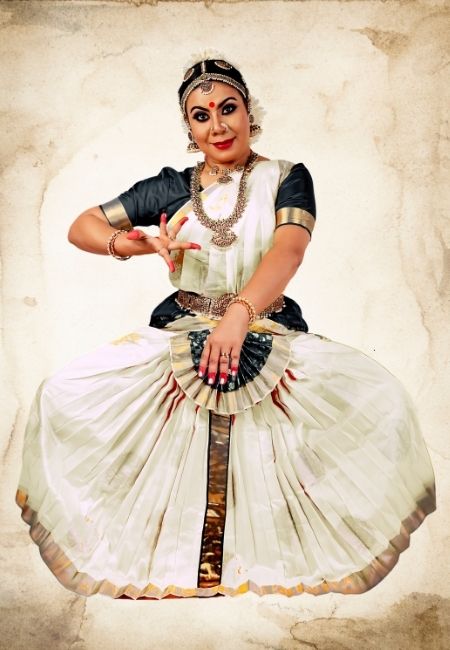
In the mist-kissed mornings of Assam, where the mighty Brahmaputra winds its way through valleys and hills like a sacred thread, a child was born not just to a family—but to a destiny. That child was Dr. Arundhati Singha, whose very name evokes celestial grace. From the moment she opened her eyes, there was an energy about her—a presence that hinted at something ancient, something profound. Even before she could speak in full sentences, she would sway to the rhythm of temple bells and the hum of devotional songs. Her movements, delicate yet deliberate, were not taught—they were remembered, as if drawn from some deep, ancestral memory.
Dr. Arundhati was born into a household where strength and creativity quietly intertwined. Her mother, Late Smt. Rekha Singha, was far more than a successful entrepreneur in the beauty industry—she was a pioneer. At a time when many women were expected to remain within the boundaries of tradition, Rekha Singha redefined possibility. She built an elegant beauty studio that became much more than a business; it was a sanctuary where women discovered not only their grace but also their confidence and voice. In recognition of her pioneering work, Late Smt. Rekha Singha received the Rajiv Gandhi Excellence Award in 1996, sharing the honor with luminaries such as Navjot Singh Sidhu, Kawaljit Singh, Kavita Krishnamurthy, and Yamini Krishnamurthy. Through her mother’s vision and resilience, Arundhati imbibed powerful lessons of independence, courage, and the profound art of building something meaningful from the ground up.
Her father, Group Captain Tarun Kumar Singha, VSM Bar, a decorated retired Indian Air Force officer, flew fighter jets and helicopters before becoming a key figure in defense public relations. He received the Vishisht Seva Medal and other commendations for his service. Since retiring, he has consulted on military-themed films and now works to support veterans and honor military heritage in Darjeeling.
“Success is no accident. It is hard work, perseverance, learning, studying, sacrifice and most of all, love of what you are doing.”
Phase 2: The Kalakshetra Calling
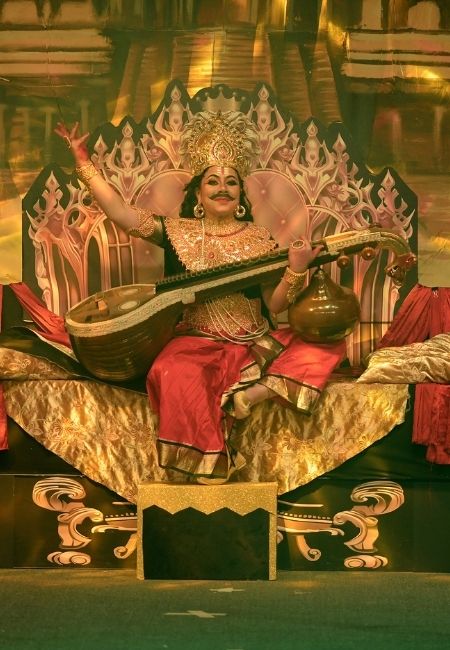
For most dancers, Kalakshetra is not just an institution—it is a dream, a sanctuary, a sacred calling. And in the year 1993, that dream took living form for Dr. Arundhati Singha, when she walked through the storied gates of the Kalakshetra Foundation in Chennai, carrying with her not just a suitcase of belongings, but the weight of her heritage, the hope of her family, and the unyielding passion of a soul destined to dance.
Kalakshetra—literally translating to “the holy place of art”—was founded in 1936 by Late Smt. Rukmini Devi Arundale, a woman who revolutionized Bharatanatyam by bringing it from temples to global stages while preserving its spiritual integrity. Its architecture reflects ancient aesthetics, its pedagogy is rigorous, and its ethos sacred. Within these walls, art is not taught; it is imbibed.
For Dr. Arundhati, being selected for Kalakshetra was not just a personal achievement—it was a symbolic homecoming. The child who had spent her early years perfecting adavus in hostel rooms, dancing through loneliness and learning through longing, had now arrived at India’s premier seat of classical training.
But as sacred as the space was, the path was far from easy.
Life at Kalakshetra demanded sacrifices—living away from family in a strict Gurukul system, adapting to new languages and food, missing birthdays and festivals, and enduring subtle prejudices. Yet these challenges became the forge that strengthened her spirit and deepened her commitment to art.
Dr. Arundhati had stepped into a domain richly steeped in Tamil culture, where language, food, customs, and even rhythm carried a Southern flavor. As an Assamese girl with a different accent, attire, and ancestry, she was often met with curious glances and quiet judgment. Some questioned her place in this classical bastion—could someone so far removed from the art’s geographic roots truly claim it as her own?
“A great artist is not born in a vacuum. They are shaped by the giants on whose shoulders they stand.”
Phase 3: Dancing with Giants
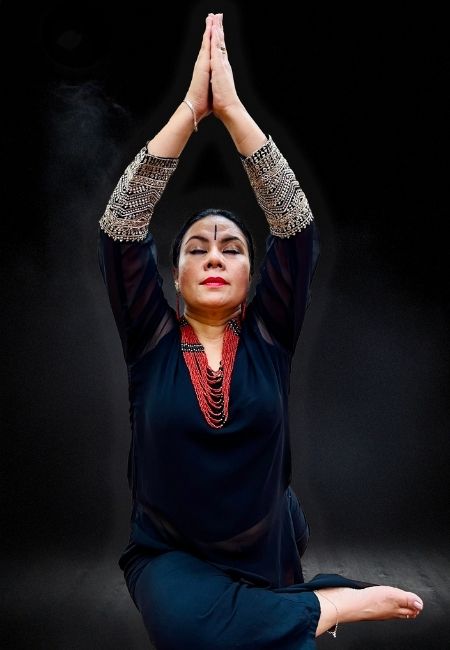
Her discipline had already been forged at Kalakshetra; Darpana became her first professional platform where she applied that training. If Kalakshetra was the sanctum where Dr. Arundhati Singha absorbed the grammar of Bharatanatyam, then her next chapter at the Darpana Academy of Performing Arts in Ahmedabad became the crucible where that grammar began to speak in new languages. Here, form met freedom, and tradition met transformation. It was at Darpana that Arundhati discovered how dance could move beyond beauty and devotion to become dialogue, protest, and awakening.
The shift from Kalakshetra to Darpana was profound. At Kalakshetra, discipline had been her constant companion—long hours of intense training sessions, precision of lines, and surrender to the spiritual essence of Bharatanatyam. At Darpana, however, she stepped into a different world: one of experimentation, where classical dance coexisted with contemporary theatre, martial arts, and multimedia storytelling. If Kalakshetra had given her roots, Darpana gave her wings.
The Academy was still touched by the presence of legends like Late Smt. Mrinalini Sarabhai and Smt. Mallika Sarabhai, whose gentleness and philosophical guidance reinforced the idea that art was a sacred responsibility. Arundhati absorbed their cplontrasting energies but did not linger in their shadows.
At Darpana, she was also entrusted with teaching Abhinaya. Her refinement in Abhinaya came not only from her time there but also through her work with international theatre directors in India and abroad.
Her journey at Darpana was marked by a bold immersion into theatre. She began working on productions that demanded both movement and dialogue, that tested her ability to balance Bharatanatyam’s codified vocabulary with the immediacy of dramatic storytelling.
Note of Thanks
As we come to the closing pages of this biography of Dr. Arundhati Singha, it is with a heart full of reverence and gratitude that we extend our deepest thanks to every soul who has been a part of her incredible journey.
To the masters and mentors—your guidance and faith laid the first bricks of this towering legacy. To the teachers of Kalakshetra Foundation who taught not only movement but meaning, to the iconic Mrinalini Sarabhai and the fearless Mallika Sarabhai who lit the path of purpose in art, we thank you. You did not just train a dancer—you awakened an agent of transformation.
To her family—thank you for being her first and eternal sanctuary. To her late mother, Rekha Baruah Singha, whose entrepreneurial spirit continues to echo in every decision Arundhati takes with courage and creativity. To her father, Retd. Group Captain Tarun Kumar Singha, whose valor, discipline, and values have formed the backbone of her character. And to her child Kaira, who brings light and laughter to her every day—thank you for reminding her that the dance of motherhood is the most soulful one.
To her students, past and present—you are the true legacy of her art. In your tiny steps, trembling mudras, and blossoming confidence, you reflect her journey, her resilience, and her grace. Your belief in her, your hours of practice, and your love for Bharatanatyam have kept the flame of tradition glowing far from its origin.
To the cultural institutions, collaborators, and global audiences—thank you for welcoming her with open hearts and open minds. Whether in Italy or Poland, Kuwait or the USA, your embrace of her performances and her innovative spirit gave her the courage to keep blending tradition with imagination. To the teams behind her productions, the stage crews, musicians, lighting artists, and event organizers—your invisible efforts have shaped visible magic.
To Kuwait, her karmabhoomi—thank you for becoming a second home. What began as a distant land soon became a thriving canvas for her creativity. The Nritta Dhyana Academy was not built with bricks and mortar, but with love, sweat, patience, and a community that believes in the power of culture. Thank you for providing her the freedom to plant seeds of Indian heritage in your soil.
To every person who questioned, doubted, or challenged her—thank you. Your skepticism sharpened her will, and your silence only amplified her inner voice. It is often through resistance that strength is revealed, and her journey is richer for it.
And most of all, to Dr. Arundhati Singha herself—thank you for choosing courage when comfort was easier. Thank you for embracing solitude at twelve so the world could one day watch you shine. Thank you for dancing not just for applause but for meaning. Thank you for being a light for those who don’t yet see themselves in the mirror of classical arts.
Your story is a dance—of devotion, discipline, discovery, and daring. And this biography is merely a mirror, reflecting the richness of a life lived with rhythm and reason. May this book reach every soul in search of inspiration. May it be passed down like a sacred mudra, from one hand to another. May we continue to tell your story, not just through words, but through every heartbeat that dares to dream.
Thanks
Dr. Arundhati Singha