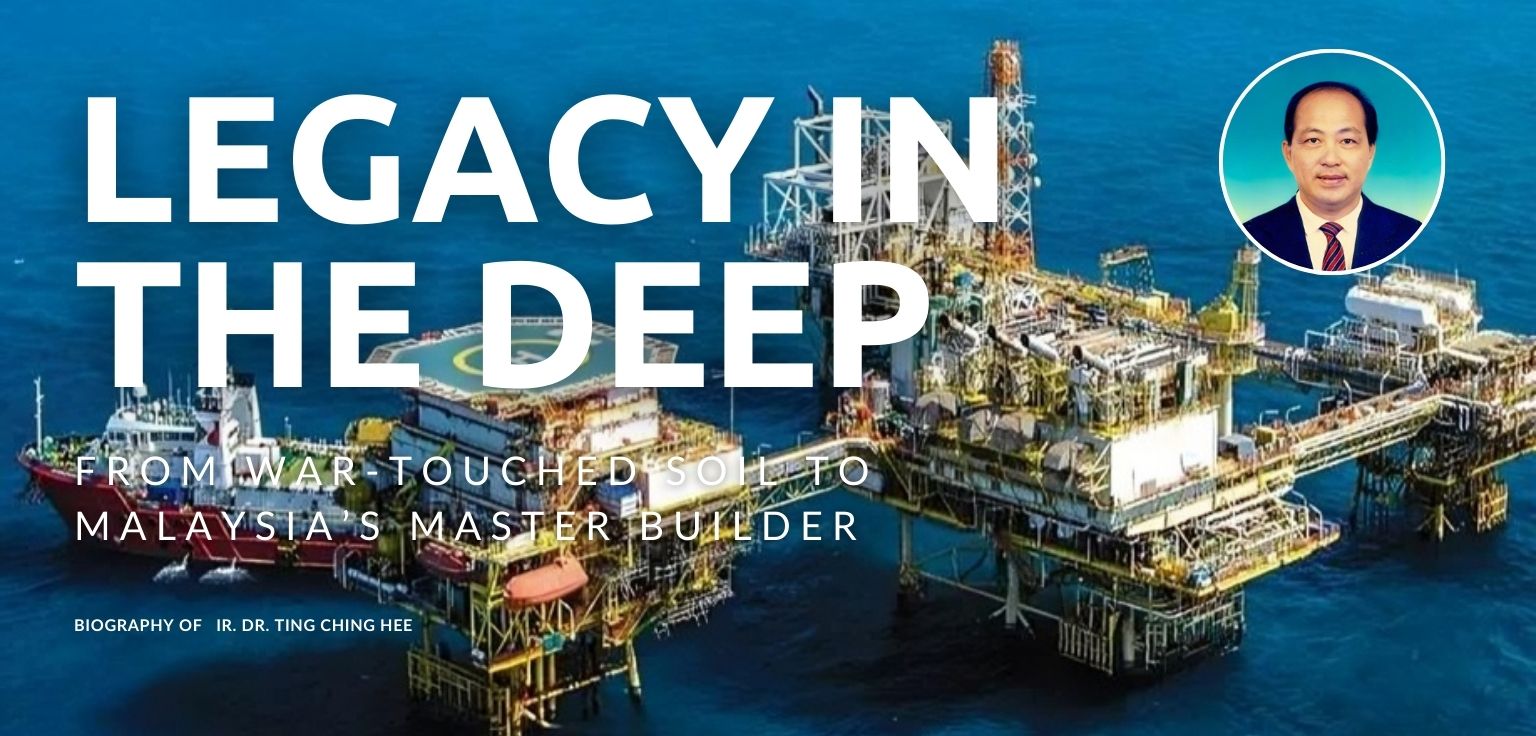
“You don’t inherit strength. You shape it—through storms, solitude, and small decisions no one ever sees.”
Introduction
People often assume that those who’ve built something significant must have known all along where they were headed. That there was some grand design, a master plan, a set of secret instructions. But the truth is rarely so glamorous. My life has not been a straight line of strategic success. It has been a series of choices—some bold, some reluctant, many born out of necessity—woven together by one unshakable instinct: prepare for what others avoid.
When I look back, I do not see a smooth path. I see a mosaic of turning points: a phone call late at night informing me that a barge project had been halted mid-construction; a silence across the dinner table because I couldn’t find the words to explain another business loss; a fleeting smile from a worker after we salvaged a pipeline the world thought was lost. Those moments weren’t part of any resume, but they are the real biography.
The legacy I’ve created—whether through engineering achievements, corporate management, or building businesses from the ground up—is not the result of genius or luck. It’s the result of being willing to learn every time I was brought to my knees. The success came later. What came first was the quiet decision to never give up, even when everything around me said I should.
This story begins at the peak—not because the beginning doesn’t matter, but because the climb becomes more meaningful when you know what the summit feels like. In recent years, I’ve been fortunate enough to stand on that summit, to be known across the Malaysian oil and gas sector as a problem solver, to be called in when others step away, and to lead, manage, deliver, and exceed expectations even when the weight felt impossible.
But none of that would make sense unless I also told you about the foundation it rests on. About the boy who studied under British administration with his entire future hanging on a scholarship. About the young engineer who risked his reputation offshore with nothing more than knowledge and nerve. About the entrepreneur who lost over a million in a collapsed partnership, only to rise again without pointing fingers. Because real legacy is never built on what you earn—it’s built on what you survive and still choose to give.
In this introduction, I want you to see me not as a figure at the finish line, but as a fellow traveler. I’ve made mistakes. I’ve trusted the wrong people. I’ve ignored my own instincts. I’ve paid the price. But I’ve also learned how to listen to the silence inside me, to walk away from deals that didn’t feel right, to build teams not just with skills but with soul. And perhaps most importantly, I’ve learned that success without integrity is just noise.
“To build something that lasts, you must first be willing to lose what is comfortable.”
Phase 1: Building in the Storm – The Peak Years of Enterprise and Mastery
I never imagined that the very years which would bring me recognition, respect, and a seat at the table in some of the region’s most powerful discussions would also be the years that tested me the most—mentally, spiritually, and physically. These were not just the years of professional mastery; they were the years of reckoning.
At this stage in my life, I was no longer the man trying to prove his worth—I had already proven it. The industries knew me. When offshore or downstream projects collapsed, they didn’t look for new players; they called the one who had done the work, stood in the chaos, and delivered—not just once, but again and again. That man was me.
Yet with every call came a greater weight. People often romanticize the idea of being a “problem solver.” But solving problems at this level means inheriting the broken dreams of others, managing the pressure of entire teams, absorbing the financial burdens they’ve run from—and doing so with calm, integrity, and precision.
I was managing complex EPCC operations across Malaysia and the ASEAN region, designing systems, managing risk, leading repairs, and in some cases completely reviving projects that were declared beyond recovery. I didn’t walk into functioning systems—I walked into dysfunction and made it work.
These were not ordinary tasks. I oversaw the movement of ten construction barges, each its own breathing organism, each with lives onboard, deadlines ticking, and reputations on the line. My office wasn’t a corner room with air-conditioning; it was the open sea, the noise of welding sparks, the anxious silence before a structural test, the calculated calm before a concrete pour. This was real leadership—not the kind that gets written in fancy brochures, but the kind that gets written on men’s faces when they look at you and say, “We trust you.”
But with success came a new challenge—the burden of consistency. When you become known as the man who can fix anything, the expectations become heavier than the steel you work with. I could no longer afford mistakes—not because I feared criticism, but because lives and livelihoods now depended on me.
There were nights I questioned how long I could keep this pace. Days when fatigue blurred the numbers on my screen. Moments when I had to pause—not because I was failing, but because I was carrying too much, for too many, for too long. But then I would think about what it took to get here. I would remember the years of being underestimated, the contracts I lost to politics, the meetings where I was talked over until my work spoke so loudly it could no longer be ignored. And I would keep going.
In these peak years, I also learned the power of letting go. Letting go of the need to please everyone. Letting go of the guilt that came from saying no to projects that didn’t align with my values. Letting go of the fear of what would happen if I failed—because by this time, I had failed enough to know that failure doesn’t kill you. What kills you is the fear of it.
“Reputation isn’t built when things go right. It is earned in the moments when everything goes wrong and you still choose to show up.”
Phase 2: Problem Solver of the Nation – When Others Failed, I Stayed
I never asked to be called a problem solver. I became one by necessity, not by title. Over the years, people began to associate my name with difficult situations—projects abandoned midway, companies collapsing under pressure, engineering operations losing structure, clarity, and trust. That’s when I would receive the call. Not in celebration—but in crisis.
It wasn’t because I enjoyed the chaos. Far from it. It was because I had built a reputation—not just for competence, but for consistency. For walking into rooms where solutions had run out and bringing with me not just technical expertise, but calm, courage, and clarity. I wasn’t the loudest voice in the room, but I was the one whose voice mattered when everything else fell silent.
In one particularly brutal chapter, I took over a project from a publicly listed company that had completely lost control of operations. Millions of ringgit were at stake. Deadlines had passed. Trust had evaporated. And yet, there I was—walking into the debris, assembling a fractured team, retracing flawed designs, negotiating with suppliers who had already given up hope of payment. It took every ounce of discipline, emotional balance, and experience I had to steady that ship. And when we succeeded—not just completed the project, but salvaged its reputation—it wasn’t my name on the banner. It was my integrity in the shadows.
That’s the part no one tells you. Being a problem solver is rarely glamorous. You inherit other people’s mess. You carry the pressure of delayed schedules, broken trust, and tight budgets—but you do it without excuses. Because if you’re the last person they turn to, then you better be the one who delivers.
What made it harder was that I rarely had full control. I had to work with half-done designs, underfunded teams, skeptical stakeholders, and tight deadlines. But I never allowed circumstances to become excuses. I always believed that the mark of a real professional is not how well they perform in ideal conditions—but how they adapt when the conditions are anything but ideal.
People asked me how I kept doing it. How I kept showing up for battles I didn’t start, problems I didn’t cause. And the answer is simple: I made a commitment to my name. Not the letters before it. Not the applause. But the legacy that name carried. A legacy of trust. Of quiet delivery. Of dignity in disaster.
There were days it took everything out of me. When I would return home, exhausted not just from the hours, but from the emotional weight of carrying a team’s hopes, a client’s expectations, and my own standard of excellence. My wife could always tell. She never asked too many questions. Just placed her hand gently on mine and let the silence speak for both of us. That stillness often became my recharge.
“The ocean doesn’t care who you are. Out there, only preparation, presence, and purpose survive.”
Phase 3: Offshore Chronicles – Engineering Life in Deep Waters
There is something about the sea that changes a man. Not just the view. Not just the silence. But the sheer unpredictability of it all. One moment you’re staring at calm waters, the next, you’re battling storms that shake the entire platform. It teaches you fast that confidence alone isn’t enough—you need endurance, instinct, and humility.
My life offshore began not with command, but with observation. I was young, and yet I was handed responsibilities that felt larger than my body could hold. Surrounded by experienced welders, crane operators, pipefitters, and supervisors from different nationalities and disciplines, I had to learn quickly that respect in this environment wasn’t given—it was earned.
And I didn’t earn it by talking. I earned it by showing up—on time, every time. By checking every bolt myself. By understanding every pressure valve, every subsea installation schematic, every emergency protocol. While others slept, I studied. Not to prove a point, but because I knew that a single miscalculation out here could cost lives, not just contracts.
In those early offshore years, I learned what true leadership looked like. It wasn’t about shouting instructions from a safe space. It was about being the first one up, the last one to leave, and the one who stood shoulder-to-shoulder with the crew during breakdowns. There were days when equipment failed and we had to operate with bare essentials, days when food ran short due to delivery errors, nights when we worked through fatigue, wrapped in layers of grease and salt.
But despite the hardship, there was something profoundly sacred about that life. Out there, titles meant nothing. What mattered was skill, focus, and the ability to keep your head clear under pressure. You saw a man’s character not in his words, but in how he reacted when alarms went off in the middle of the night. You built bonds with people not over wine and handshakes, but over shared tools and shared trust.
I can still hear the sound of waves crashing against steel, still remember the cold sting of salt in my eyes as I leaned over blueprints on the deck, still feel the heaviness in my legs after sixteen hours of continuous checks and calculations. It was exhausting—but it was also where I came alive, because in those environments, stripped of luxury and distraction, I found clarity.
The clarity that leadership is service. That preparation is protection. That every bolt you double-check today prevents a tragedy tomorrow.
One of the most defining moments of my offshore journey came during a massive subsea installation project. The timeline was impossible, the weather was hostile, and halfway through the operation, a key component of the pipe-laying mechanism malfunctioned. The situation was critical—every delay cost thousands by the hour, and the client’s trust hung by a thread. The team looked to me—not for panic, but for poise.
A Note of Thanks
As I reach the end of this written journey, I find myself pausing—not to admire the accomplishments, but to recognize the hands that held mine through every stage. The truth is, I would not be who I am, or where I am, without the quiet, constant presence of others. And this space, more than any other chapter, belongs to them.
To my wife—my unwavering companion in life, who stood by me during every storm, who kept the home running while I was out fixing the world, who never once made me feel guilty for chasing my mission—I owe you more than words could ever offer. You’ve been the rhythm in my silence, the calm in my chaos, the reason I always found my way back. Every milestone I’ve reached has your name written into its foundation.
To my sons—who gave me reason to build with longevity in mind, who pushed me to become the kind of man worthy of being called ‘father’—thank you. Your strength, integrity, and vision tell me that everything I poured into this life has not only taken root but has begun to bloom in its own way. I see in you both the continuation of something that started long before me, and will live long after me.
To the workers who shared the ground, the decks, the scaffolds, and the sea with me—thank you for trusting me, for teaching me, for showing me that leadership isn’t a position—it’s a responsibility that must be earned daily. Every project we completed, every obstacle we faced, every late-night solution we crafted together—they remain etched in my heart not as tasks completed, but as moments of deep human connection.
To my mentors—some I met in person, others I learned from through their words or actions—your influence shaped how I thought, how I solved, how I stood tall in the face of uncertainty. You showed me the balance between strength and humility, between ambition and grace.
To the clients and companies who placed their trust in me, especially during the most critical of times—thank you. You didn’t just give me contracts. You gave me the chance to serve, to solve, and to grow. You believed in my process when others hesitated, and that belief fueled my best work.
To those who doubted me, overlooked me, or tried to close doors—I thank you as well. Because your doubt became my discipline. Your rejection became my redirection. Your absence created the space in which I found the most powerful parts of myself. In every setback, I discovered a deeper reason to move forward.
To the countless nameless souls who worked behind the scenes—cooks on offshore rigs, drivers in remote villages, welders who never took a sick day, assistants who made sure I had what I needed—I see you, I remember you, and I thank you. To my younger self—thank you for not giving up, for continuing to study when it was easier to quit, for showing up in places where you weren’t sure you belonged, for holding onto your principles when temptation whispered otherwise. You were not perfect, but you were persistent—and that made all the difference.
To the Divine—whatever name one chooses to call you—thank you for the invisible guidance, for the lessons hidden in every failure, for the silent voice that always reminded me of who I am and why I must continue. And finally, to the reader—thank you for walking this path with me. Whether you are here out of curiosity, inspiration, or simply searching for something in your own life, I hope these words gave you more than a story. I hope they gave you a mirror, a companion, a voice that says you are not alone in your struggle, you are not foolish for dreaming, and you are not too late to become all that you are meant to be.
This journey was not perfect. But it was real. And that, more than anything, is what I give thanks for—the chance to live a life of meaning, to work with purpose, and to love without condition.
Thanks
Ir. Dr. Ting Ching Hee