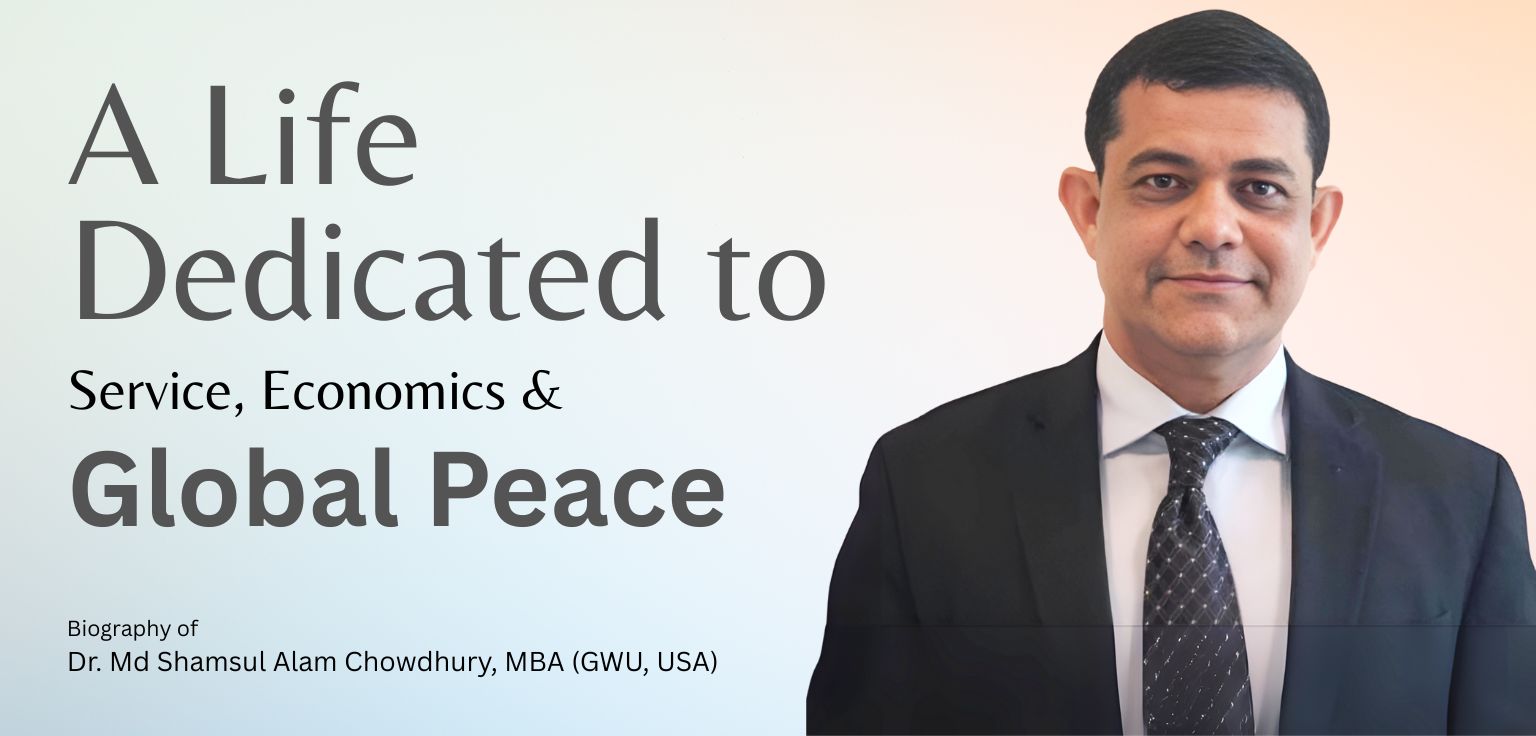
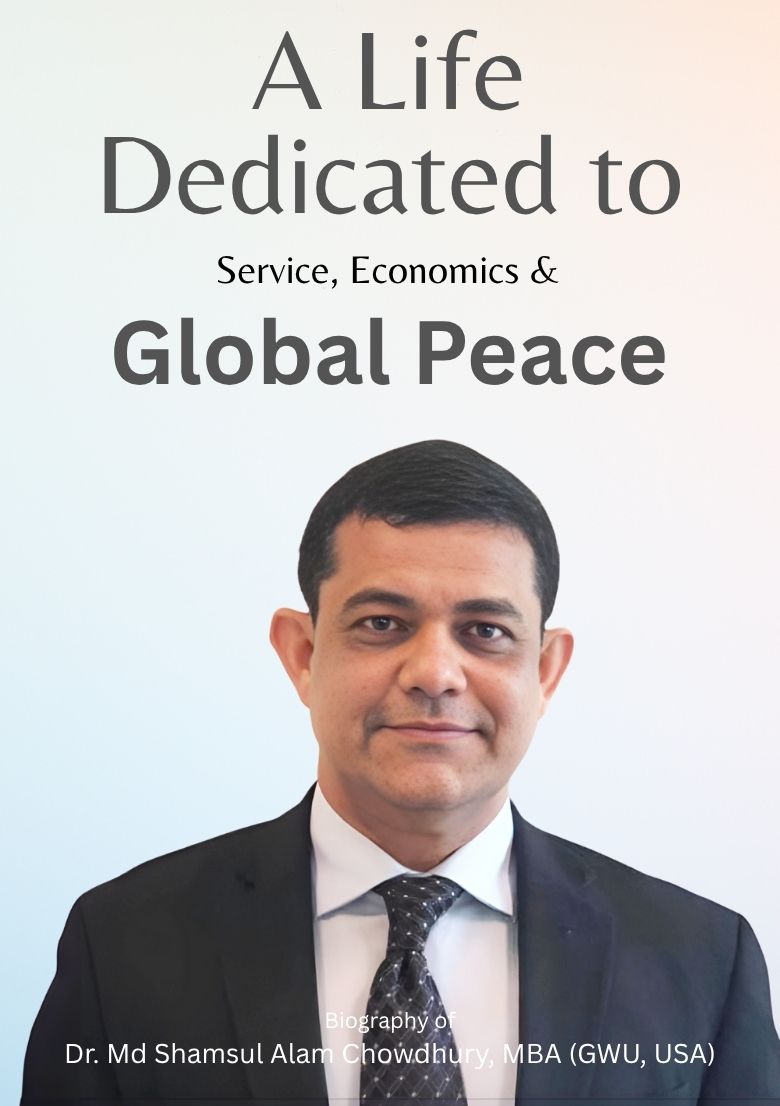
"We may have different religions, different languages, different colored skin, but we all belong to one human race."
Dedication
To my beloved family, this work, and indeed every endeavor I have pursued, is as much yours as it is mine. Behind every chapter of my life, every step forward, and every trial overcome, you have stood, steadfast, patient, and unshakable in your support. This dedication is not a mere formality; it is a tribute from the deepest recesses of my heart, carved with gratitude, love, and reverence. You are my circle of strength, my lifelong inspiration, I have walked many paths: through battlefields, boardrooms, embassies, and bookshops. But at every crossroad, I returned to you. You have been the breath behind every speech, the embrace after every trial, and the faith that fortified my soul. This dedication bears your name, your spirit, and your love.
To my parents, now departed but eternally present in spirit, you gave me everything without asking for anything in return. Your hands were calloused with labor, your dreams modest, but your love limitless. You taught me the dignity of effort and the beauty of honesty. From you, I learned that poverty needs not diminish one’s spirit, and that character is forged not in comfort but in adversity. My earliest memories of education, discipline, and faith are filled with your voices gently urging me forward, even when the path was steep. Your sacrifices laid the foundation of my life. You gave me not riches, but the moral compass I have carried through every rank, every embassy, every book, and every initiative because I have championed. I wish you could have seen where your blessings took me but perhaps you already knew.
To my wife, my lifelong confidante, partner, and pillar of grace. You have borne the weight of absences and the uncertainty of deployments with quiet strength and a dignity that humbles me. When I was stationed in conflict zones or consumed by diplomatic obligations far from home, it was your resilience that held our world intact. You did not just support my journey, you sustained it. You managed the home, cared for our children, nurtured our traditions, and filled every silence with warmth. In your steadfastness, I have found my sanctuary; in your sacrifices, I have found my courage. You have taught me that true strength often comes in the form of gentleness, and that love, when rooted in trust and mutual respect, can outlast any storm. I owe you the stillness in my soul that allowed me to navigate chaos beyond our doors.
To my children, you are my greatest pride and my most enduring hope. Your laughter, your questions, your dreams, they have fueled my own. Each time I entered a warzone, or took the floor at a negotiation table, or penned my thoughts in solitude, I carried your future as a sacred burden. You reminded me that the world we shape today must be kinder, more just, and more inclusive for those who inherit it. I have strived not to leave behind material wealth, but to leave you a legacy of compassion, integrity, and curiosity. In your eyes, I see the world as it should be unburdened by prejudice, rich with possibility. And in your journey, I relive my own aspirations with renewed hope. Whether you follow my path or forge your own, know this, I will always be your quiet guardian, believing in your boundless potential.
"The child who is not embraced by the village will burn it down to feel its warmth.”
Phase 1: Humble Beginnings in Bangladesh (1964–1986)
On August 3, 1964, in a small, quiet village nestled within the lush, deltaic landscape of Bangladesh, Dr. Md Shamsul Alam Chowdhury was born into a world far removed from comfort or privilege. At the time, the country was still recovering from colonial subjugation and hurtling toward the climactic events that would shape its independence grappled with deeply entrenched poverty. Per capita income hovered around a mere $60, and the landscape of rural life was marked not by abundance but by subsistence. Life was fragile: for every 1,000 children born, 125 would not live to see adulthood. It was in this fragile world, where every breath of life was a battle and every scrap of food a blessing, that Dr. Chowdhury took his first steps.
His family, like many in the village, survived on subsistence farming tilling small patches of land to grow rice and vegetables, sometimes bartering for essentials they couldn’t produce themselves. Electricity was a distant dream, and clean drinking water was carried in pitchers from shared village wells. These were the years of waking before dawn, feet heavy with dew, and evenings lit only by kerosene lamps and flickering fireflies. Though his village was impoverished in material wealth, it was rich in resilience and community. The bonds between families ran deep woven through shared hardship, religious harmony, and a collective hope for a better tomorrow.
Yet, even in the face of such adversity, young Dr. Chowdhury displayed a spark that set him apart. From his earliest days in school, he exhibited hunger not just for learning, but for excellence. His teachers noticed his curiosity and tenacity qualities that belied his humble surroundings. In a classroom of barefoot students scribbling on slate boards, he consistently rose to the top, never once ranking below second in his class. Education, for him, was not just a pursuit; it was a lifeline. He treated his books as treasures and school as sanctuary. The weight of poverty could never crush the lightness of dreams taking shape in his mind.
What made Dr. Chowdhury even more remarkable in his early years was his ability to bring people together. While Bangladesh was predominantly Muslim, his village was a mosaic of faiths Hindu, Muslim, and Christian communities coexisted peacefully. It was not uncommon to see him embraced at all religious festivals, where he would sing, play, and celebrate with equal fervor across boundaries that many adults viewed with suspicion or division. He was a unifier in the truest sense, a young boy who intuitively understood that compassion transcended creed.
This empathy and innate leadership didn’t go unnoticed. His peers saw in him not just a high-achieving student but a voice of reason, a natural problem-solver. When disputes broke out over a stolen mango or a cricket match turned rowdy, it was often Dr. Chowdhury who stepped in to mediate. With wisdom beyond his years, he learned to navigate conflict with dignity and diplomacy traits that would become cornerstones of his later diplomatic and military success.
“The more you sweat in peace, the less you bleed in war.”
Phase 2: Military Service and Global Peacekeeping (1986–2019)
When Dr. Md Shamsul Alam Chowdhury was commissioned as a Second Lieutenant in the Bangladesh Army in 1986, he embarked on a journey that would define much of his adult life. This moment marked the culmination of years of determination and discipline, transitioning from the humble setting of rural classrooms to the esteemed ranks of a national military force. For the young officer, the military was not only a career path, but it was also a calling: one that fused duty to country with his broader vision of global peace and cooperation.
The Bangladesh Army, known for its professionalism and commitment to international peacekeeping, offered Dr. Chowdhury a platform through which his leadership could flourish Over the next 32 years, he would ascend steadily, ultimately retiring in 2019 with the honorable rank of Brigadier General, a testament to decades of meritorious service, tactical brilliance, and strategic foresight. His career was marked not just by military advancement but by intellectual refinement as well. Between 1998 and 2001, he completed a Master of Defense Studies at the National University in Dhaka, reinforcing his commitment to marrying theoretical insight with practical application in the theater of command and policy.
However, Dr. Chowdhury’s leadership extended far beyond the borders of Bangladesh. In the volatile mid-1990s, the world was grappling with the tragic unraveling of Yugoslavia. As ethnic tensions escalated into full-blown violence, the United Nations deployed peacekeeping forces to bring some semblance of order. From 1995 to 1996, Dr. Chowdhury was selected as a UN Military Observer in Bosnia and Croatia a posting that would expose him to the raw fragility of human society and test the limits of moral resolve.
What he witnessed in the Balkans left an indelible mark. There, modern Europe was ablaze with medieval hatred neighbor turned against the neighbor over ethnic and religious divisions. “Bodies littered roads. Europeans killing Europeans over nothing,” he later recalled, encapsulating the senseless brutality he encountered. As a peacekeeper, Dr. Chowdhury bore witness to mass displacement, scorched towns, and grieving families the unimaginable rendered mundane by repetition. Yet amidst the horror, he also encountered resilience, collaboration, and the faint but persistent pulse of hope.
He worked closely with NATO counterparts and international partners to uphold ceasefires, monitor demilitarized zones, and ensure compliance with the Dayton Agreement. In forging bonds with soldiers and civilians from different parts of the world, Dr. Chowdhury came to a powerful realization: “Peace is possible when we see each other as equals.” It was this ethos of shared humanity beyond national or ethnic lines that would guide his approach in all future endeavors.
Nearly a decade later, in 2005, another urgent mission called him to West Africa. As a Staff Officer with the United Nations in Monrovia, Liberia, Dr. Chowdhury was embedded in a post-conflict environment scarred by decades of civil war. Here, his role focused on disarmament, demobilization, and reintegration of former combatant’s delicate work that demanded both strategic oversight and compassionate engagement. He also helped coordinate humanitarian aid and support refugee resettlement, bridging military logistics with civilian welfare.
“A country doesn’t go bankrupt because it lacks resources —it goes bankrupt because it lacks imagination.”
Phase 3: The Economist Awakens (2014–Present)
Epiphany at George Washington University “Why does Mexico’s per capita income ($12,000) trail the U.S. ($85,000) when they share a border? Why is Bangladesh ($2,800) not Luxembourg ($108,000)?”
In 2014, after nearly three decades of service in the military and diplomatic fields, Dr. Md Shamsul Alam Chowdhury walked into the classrooms of The George Washington University in Washington, D.C., not as a commanding officer, but as a student curious, questioning, and humbled by the enormity of what he still wished to understand. His pursuit of an MBA at one of the United States’ most prestigious institutions was not merely a continuation of his academic journey but a defining pivot. It was here, in the halls of economic theory and public policy debates, that Dr. Chowdhury’s lifelong observations of global inequality began to crystallize into groundbreaking frameworks.
Even as a seasoned diplomat, he found himself disturbed by the disparities he observed during his studies. In one lecture, as graphs flashed across the projector, he found himself fixated on a nagging question: Why does Mexico, sharing a border and significant trade agreements with the United States, have a per capita income of $12,000, while the U.S. boasts $85,000? And even closer to his heart: Why does Bangladesh, a country of brilliant minds and resilient people, remain at $2,800, while microstates like Luxembourg thrive at $108,000 per capita? These statistics weren’t just numbers to Dr. Chowdhury they were provocations. Sparks. Clues to a puzzle he had been living for decades.
He realized that traditional economic models relying heavily on land, labor, and capital failed to explain such vast disparities in a way that satisfied either his intellect or his lived experiences. It wasn’t simply about resources; it was about systems. Policy. Governance. Vision. His time at George Washington University became an intellectual awakening, prompting him to dive deep into developmental economics, political science, and public administration with a critical, reformist eye. In those years, he didn’t just study theory he set out to reinvent it.
Out of this ferment of inquiry and reflection emerged three foundational concepts that would later form the core of his economic philosophy: Artificial Productivity, Leadership Metrics, and the Bureaucracy Index.
The first of these Artificial Productivity challenged the rigidity of classical productivity measures. In standard economics, productivity is typically defined as output per unit of labor or capital. But Dr. Chowdhury argued that this lens was both narrow and misleading.
“Productivity isn’t just output per labor-hour,” he declared. “It’s shaped by policy. Governments can artificially boost it through strategic investments in education, digital infrastructure, and sectoral alignment with global demand.” For him, productivity was not just an economic output; it was a deliberate design. He cited India’s IT revolution as a vivid example where governmental support, access to English education, and private sector liberalization transformed a low-income economy into a global tech powerhouse, lifting millions out of poverty.
Note of Thanks
With the completion of this biography, a profound journey comes full circle not only in chronicling the remarkable life of Dr. Md Shamsul Alam Chowdhury, but in paying tribute to the constellation of individuals, institutions, and values that have shaped him. No life of such depth is lived alone, and this work stands as both a reflection of one man’s path and a testament to the countless hands, hearts, and hopes that have traveled with him.
First and foremost, sincere gratitude is due to Dr. Chowdhury’s family the silent strength behind every public accomplishment. Their unwavering support, patience during prolonged absences, and sacrifices made in the shadows are woven into every chapter of his life. Whether in the solitude of a peacekeeping outpost or the diplomatic corridors of Washington, it was their love that anchored his spirit and reminded him of what he truly served.
To his teachers and mentors, whose wisdom transcended classrooms and uniforms, thank you for fanning the spark of curiosity that would become a lifelong pursuit of knowledge. It was their faith in his ability often extended when resources were scarce that ignited in him a fierce commitment to learning and public service. Their early guidance formed the intellectual foundation upon which this legacy is built.
To the Bangladesh Army, the United Nations, and the Government of Bangladesh, this biography owes much. These institutions offered Dr. Chowdhury platforms to lead, to protect, and to learn from battlefields to international forums. In those roles, he found not only duty, but purpose, and through that purpose, the voice that would one day challenge global systems in pursuit of equity and justice.
To the team behind the publication, editorial collaborators, and creative contributors, thank you for the care, precision, and empathy you brought to this story. You have not merely compiled facts or refined prose; you have preserved legacy, with all its nuance and humanity.
To the readers, across nations, disciplines, and generations, thank you for opening these pages. This biography is an invitation: to reflect, to question, and to act. May it spark the same sense of duty, moral clarity, and hope that fueled its subject through every phase of his life.
And finally, to Dr. Chowdhury himself, thank you. For the courage to serve. For the humility to listen. For the vision to reimagine. And for allowing your story to become a mirror in which others may see possibility. May your journey continue to inspire those who dare to believe that the world however broken can still be rebuilt through compassion, courage, and conviction.
Thanks
Dr. Md Shamsul Alam Chowdhury